
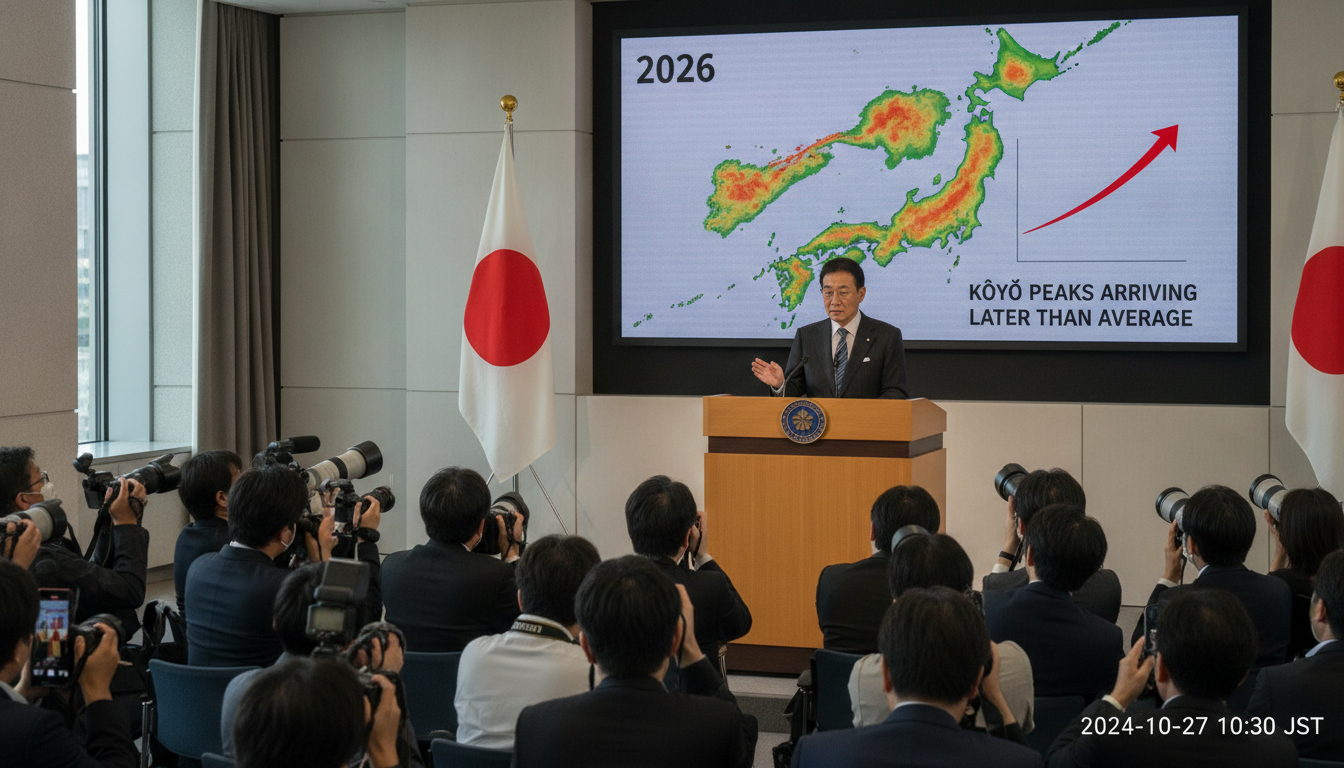
Japan fall foliage forecast 2026: First outlook shows kōyō peaking later than average across the country
Japan fall foliage forecast 2026: First outlook from the Japan Meteorological Corporation predicts later-than-average peak kōyō dates, with Kyoto delayed into December.
The Japan Meteorological Corporation released its first Japan fall foliage forecast 2026 on September 2, revealing a clear trend: peak kōyō will arrive later than the long-term average across most of the country. The forecast calls for yellow leaves and red leaves to reach their best viewing days at slightly shifted times compared with typical years, with some locations pushed more than a week behind usual schedules. Travelers and local authorities are already considering the timing changes as they plan autumn trips, events and services.
Japan Meteorological Corporation issues first seasonal kōyō outlook
The agency’s initial forecast, published September 2, covers roughly 700 popular viewing spots and about 3,000 mountain locations nationwide. This opening estimate is the first of several updates expected before the main season, and it establishes the baseline timing that regional planners and tourism operators will use to prepare. The corporation has a history of issuing seasonal leaf and blossom forecasts and will update this kōyō outlook again in early October as the situation becomes clearer.
Meteorologists describe this first bulletin as indicative rather than definitive, reflecting the current climate and vegetation signals rather than final conditions. The forecast integrates temperature trends, accumulated heat, and early-season weather to project when color will peak at specific sites. Officials stress that local microclimates and unexpected weather — especially wind and rain — can shift peak dates by days, and in some cases by a week or more.
Tokyo and Kyoto: city-by-city peak dates and what they imply
For the Tokyo region, the forecast pinpoints the best short window for yellow leaves at November 26, and the prime date for red foliage at November 29. Those dates fall only a few days later than the long-term averages and are slightly earlier than Tokyo’s peak in the previous year. For visitors who time their trips to the capital specifically for kōyō, the end of November remains a reliable bet under this forecast.
Kyoto shows a different pattern: yellow leaves are projected to peak around November 27, while red foliage is not expected to reach its fullest until December 11. That December red peak is about six days later than the city’s average and marks Kyoto as an outlier this season. Travelers considering a Kyoto visit primarily for crimson maples should shift plans toward early to mid-December rather than late November.
Other urban centers are also mapped out: Nagoya is forecast for yellow on November 17 and red around December 2, Osaka for yellow on November 24 and red on December 4, and Fukuoka for yellow on November 27 and red on December 7. Northern cities show earlier peaks; Sapporo’s yellow and red peaks come in the first week of November, with the red estimated at November 7 and the yellow at November 6. Sendai’s yellow arrives near November 29 while its red peak is forecast for November 25.
Regional outlook from Hokkaido down to Kyushu
Hokkaido’s alpine and boreal forests are consistently the first to show intense color, and this year the forecast reflects that pattern with Sapporo and surrounding areas tipping into peak coloration in early November. High elevations in Hokkaido typically change earlier than lowland islands, and this seasonal map maintains that gradient with mountain ridgelines and national parks lighting up well before the main urban sites. Outdoor operators in Hokkaido can expect a condensed window of peak viewing for some zones, so scheduling flexibility will be important.
The Tohoku and Hokuriku regions present a mixed picture, with Sendai’s red leaves slated for late November while many inland areas could see minor delays depending on autumn temperatures. Central Honshu — including Nagoya and the Japanese Alps — is showing a staggered pattern where yellow tones often lead and red maples follow weeks later, creating a prolonged viewing season for those who can travel between elevations. Coastal areas in the Sea of Japan corridor may experience different timing due to oceanic influences on temperature.
In western Japan, including Osaka and Fukuoka, the forecast indicates later peaks than the long-term average, pushing some prime viewing dates into early December. Kyushu’s more temperate climate generally produces later color, and this season’s forecast amplifies that tendency in the south. For domestic tourism and regional event planning, those later windows could help spread visitor demand beyond the usual late-November rush.
Practical advice for travelers booking kōyō trips in 2026
Visitors planning to chase Japan’s autumn colors should treat these forecast dates as planning tools rather than guarantees, and they should build flexibility into itineraries. For Kyoto in particular, consider booking for the first half of December if crimson maples are the primary objective, because the forecasted red peak sits around December 11. In Tokyo and other major cities, late November remains the most reliable time to catch both yellow ginkgo and early red leaves.
Accommodation and transport reservations remain essential, especially for Kyoto and popular countryside sites where capacity fills quickly during peak weeks. Travelers who can shift single-day visits by a few days will improve their odds of encountering prime color and avoiding the busiest crowds. It is also wise to monitor local updates and the meteorological agency’s next forecast in early October, since the forecasted windows can tighten or move with changing weather.
For photographers and tour operators, the staggered timing between yellow and red peaks can be an advantage: planning multi-day routes that move from lower-elevation yellow stands to higher-elevation red maples may yield a longer, richer kōyō experience. Daytime temperatures, wind forecasts and recent rainfall should factor into any final decision, as wet or windy spells can diminish leaf color and shorten peak periods.
How the forecast is produced and when the next update will arrive
The Japan Meteorological Corporation bases its projections on a combination of climatic data, historical trends and phenological observations that track when leaves typically begin and complete their color change. Analysts use accumulated temperature indices and recent seasonal deviations to estimate the timing for both yellow and red foliage stages. The methodology is designed to provide a practical, location-specific calendar for tourism and local planning while acknowledging uncertainty inherent in seasonal forecasting.
This first 2026 bulletin explicitly covers approximately 700 kōyō viewing spots and some 3,000 mountain locations, giving a broad national picture rather than hyper-local certainty. The corporation has scheduled a follow-up forecast in early October, which will refine the dates as autumn weather patterns become clearer. Local municipalities, park authorities and tour operators commonly wait for that October update before finalizing large public events and promotional calendars.
Officials also remind the public that peak viewing can be altered by short-term weather events and by microclimatic conditions unique to each site. Windy or rainy periods can strip leaves quickly, while calm, clear stretches may extend peak color. For the most reliable guidance, combine the national forecast with local park advisories and recent field reports as the season approaches.
Visitors and planners tracking the Japan fall foliage forecast 2026 should watch for the next release and remain prepared to adapt travel dates and event schedules accordingly.

