
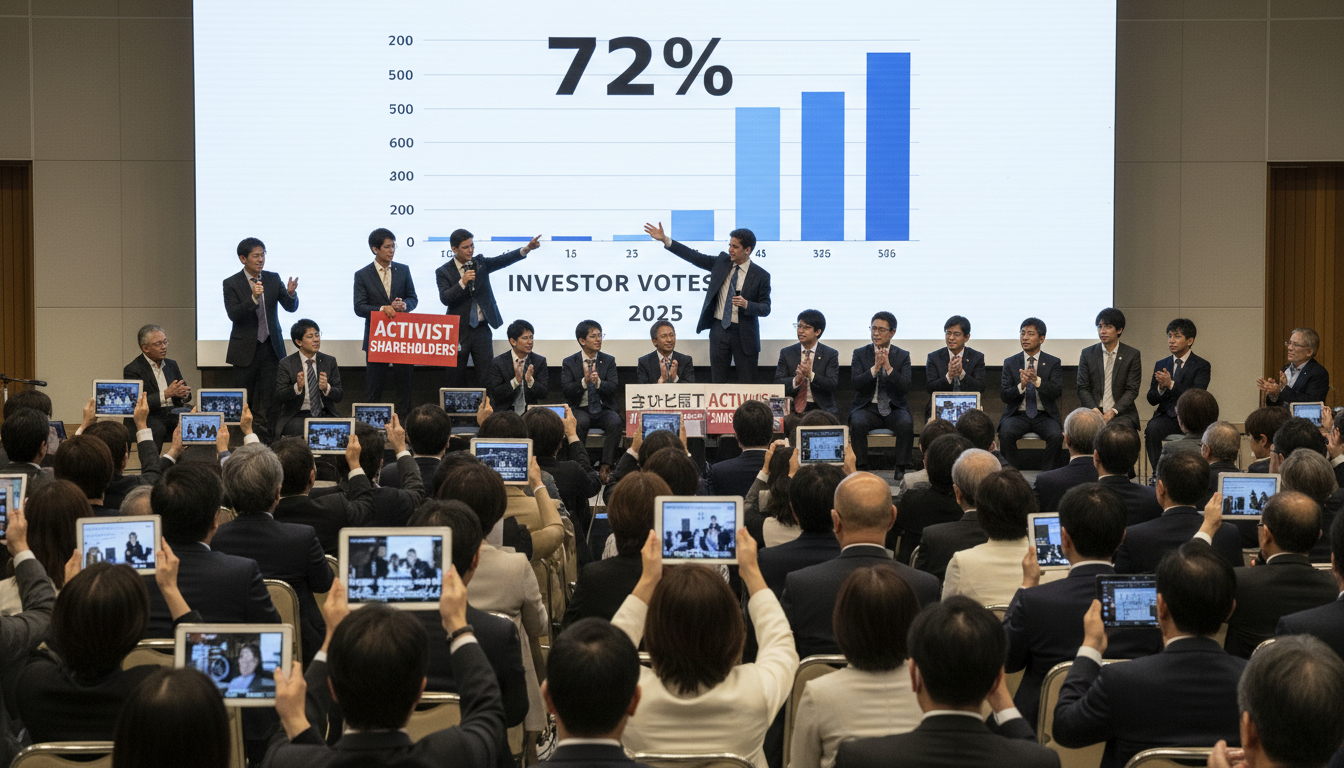
Retail Investors in Japan Boost Voting Power as 72% Voted in 2025
Survey finds 72% of Japanese retail investors exercised voting rights in 2025, driving shareholder activism and corporate governance debate across markets.
Retail investors in Japan dramatically increased their participation in corporate voting during 2025, according to a recent survey that found 72% of individual shareholders exercised their voting rights last year. The surge in retail investor engagement has been accompanied by a noticeable shift in voting patterns, with many retail shareholders aligning with activist investors pressing for management and strategic changes. This uptick is reshaping boardroom dynamics and forcing Japanese companies to reconsider how they engage and communicate with a broader, more assertive shareholder base.
Majority of retail investors cast votes in 2025
A survey conducted among individual shareholders reported that nearly three-quarters of retail investors used their voting rights in 2025. The figure represents a marked increase from prior years and signals growing retail appetite for influence over corporate decisions. Analysts say the combination of digital brokerage platforms, easier voting mechanics, and heightened media coverage of governance issues helped drive the rise.
Many retail investors cited clearer voting instructions and mobile-friendly platforms as reasons they participated for the first time. Pension reforms and high-profile activist campaigns also raised public awareness of shareholder voting as a tool for change. The trend underlines a structural shift in Japan’s investor base away from passive retail complacency.
Retail shareholders increasingly side with activist proposals
Corporate activists have taken note of the rising retail turnout and are tailoring campaigns to court individual shareholders. Several recent proxy fights and proposal battles saw retail votes swing outcomes in unexpected directions, either amplifying or offsetting institutional investor positions. Activists have increasingly targeted retail channels with simplified messaging and direct appeals.
This alignment between retail voters and activist agendas has proven effective on occasion, producing board resignations, governance overhauls, or renewed strategic reviews. Campaigns that frame their demands in straightforward terms — such as dividend increases, share buybacks, or director changes — tend to perform best with retail audiences. For companies, the result can be sudden and intense pressure to negotiate or rework long-standing plans.
Corporate boards face new communication and policy challenges
Boards and management teams are confronting the reality that attracting retail investors can be a double-edged sword. While retail participation can broaden a company’s shareholder base and deepen liquidity, it also introduces volatility in vote outcomes and short-term pressure. Executives are being pushed to enhance transparency and to explain strategy in language that resonates with non-professional investors.
Some firms have responded by investing in investor relations, simplifying disclosure materials, and staging more frequent town-hall events aimed at households rather than institutional fund managers. Others have adopted defensive measures such as staggered board terms or poison-pill style provisions, which in turn have attracted scrutiny from regulators and large institutional investors. The balancing act now for many boards is maintaining long-term strategy while addressing an increasingly vocal retail constituency.
Market implications and investor behaviour shifts
The higher turnout among retail investors is altering behaviours in Japan’s equity market beyond corporate votes. Short-term trading spikes and increased retail interest in mid-cap names have been observed, as individual shareholders chase perceived undervalued firms or companies in the crosshairs of activists. This activity can amplify price moves around key governance events, making market timing and communications more consequential.
Institutional investors are recalibrating their engagement strategies in response, often seeking to build coalitions with retail groups or to anticipate retail voting trends ahead of general meetings. Proxy advisory firms and platforms that aggregate retail voting data have gained prominence, as both companies and activists attempt to interpret and influence the retail vote. The net effect is a more dynamic and contested governance environment.
Regulators and institutions reassess shareholder frameworks
Regulators and industry bodies are monitoring the evolving role of retail investors and considering steps to protect retail participants while preserving market stability. Topics under review include the clarity of proxy materials, safeguards against misleading activist campaigns, and the mechanics of electronic voting. Authorities have signalled an interest in ensuring retail shareholders are both informed and protected when exercising influence.
Meanwhile, institutional investors and pension funds are engaging with retail-oriented platforms to improve stewardship outcomes and to reduce the risk of fragmented voting. Collaborative engagement models and pooled voting initiatives are being explored as ways to align diverse shareholder interests behind coherent long-term agendas. The regulatory and institutional response will shape whether increased retail turnout becomes a stabilising democratic force or a source of episodic disruption.
Longer-term outlook for shareholder engagement in Japan
The arrival of retail investors as decisive voters marks a turning point in Japanese corporate governance. If the trend continues, companies will need ongoing strategies to engage households, anticipate activist overtures, and design governance practices that balance short-term demands with sustainable value creation. The immediate effect is heightened scrutiny of boards and a faster pace of contestation.
Looking ahead, the challenge for market participants will be to translate increased retail participation into constructive outcomes that support long-term company health. For many firms, the priority will be clear communication, adaptive governance frameworks, and early engagement to avoid escalatory conflicts. Retail investors have signalled they are prepared to use their votes — and companies, investors and regulators are adjusting to that new reality.

