
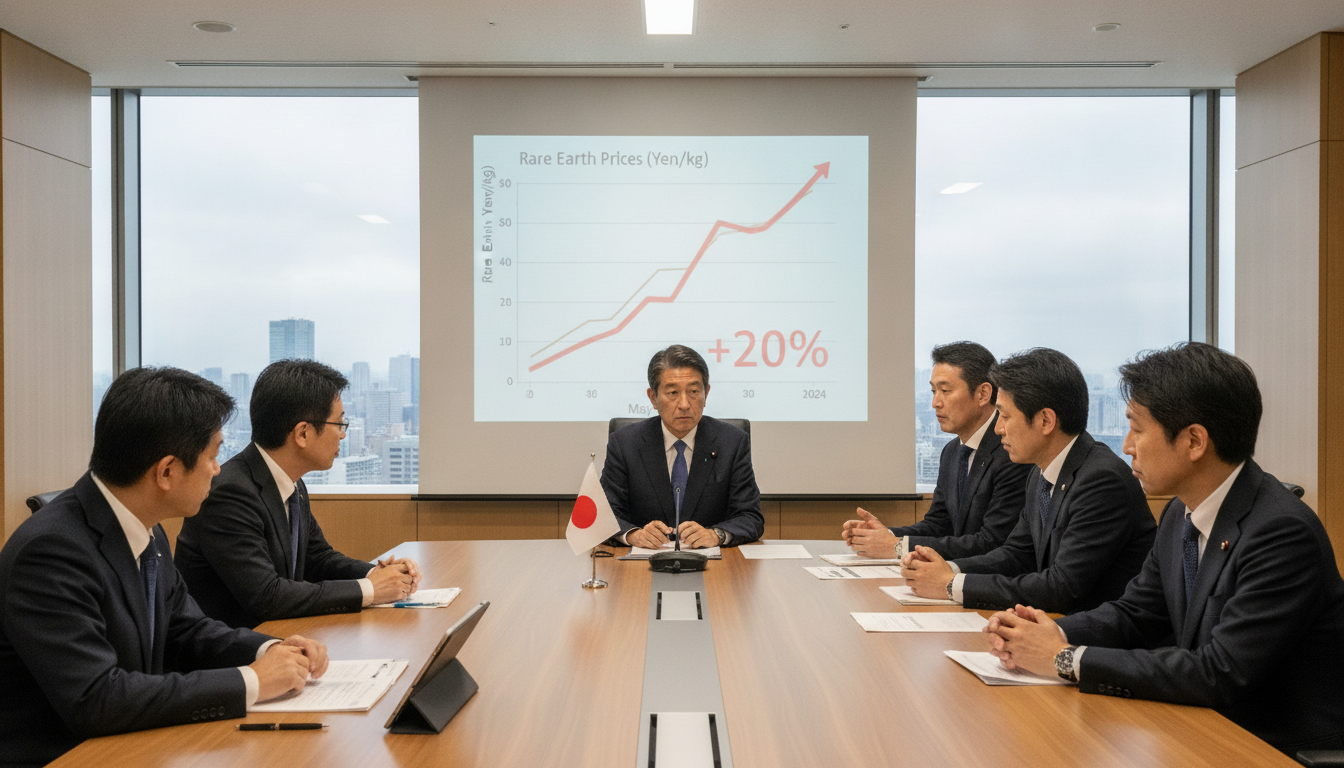
Japan firms face 20%+ jump in rare earths procurement as China tightens exports
Japanese firms face a 20%+ rise in rare earths procurement costs after China’s export curbs; survey shows high reliance on Chinese supply, pressuring margins.
The cost of procuring rare earths for Japanese companies has risen by more than a fifth year‑on‑year, according to a private‑sector survey, highlighting the immediate supply‑chain impact of China’s recent export restrictions. The survey found that one in ten firms said they were unable to pass on the extra costs to customers at all. This sharp increase in raw material prices is rippling through manufacturers and component suppliers across multiple sectors.
Procurement costs jump more than 20% year‑on‑year
The private survey reported an overall increase in rare earths procurement costs exceeding 20 percent compared with the same period last year. Companies cited tighter export controls from China as a primary driver of the price shock. Higher freight, insurance and compliance costs were also mentioned as compounding factors that have raised the landed cost of critical inputs.
Industry respondents described the rise as sudden and concentrated, with procurement teams scrambling to secure shipments already in transit. Several firms flagged contract exposure where long lead times and fixed‑price agreements limit their ability to respond quickly to the new cost environment.
China’s export restrictions tighten supply
Survey respondents attributed the cost surge directly to Beijing’s tighter export measures on some rare earth materials and related processing technology. Market participants said the curbs reduced available export volumes and produced short‑term scarcity in certain oxide and magnet feedstocks. The result has been stronger competition among buyers and upward pressure on spot prices.
Analysts tracking the market warn that restrictions focused on higher‑grade ores and downstream processing can quickly cascade through global supply chains. For buyers outside China, securing alternative processing capacity remains a slow and costly endeavor.
Dependence on Chinese rare earths persists
On average, 61 percent of rare earths imported by Japanese companies still originate from China, the survey showed, underscoring the depth of supply concentration. That reliance leaves many Japanese manufacturers exposed to policy shifts and export quota adjustments emanating from Chinese authorities. Even when firms seek non‑Chinese suppliers, they often face higher baseline prices and longer delivery schedules.
Several procurement managers reported that stockpiles held to smooth deliveries proved insufficient to absorb the scale of the recent price move. The survey indicates that building resilient off‑take arrangements will require larger inventories, longer contracts and closer collaboration with alternative producers.
Businesses struggle to pass on costs to customers
The survey found that about one in ten companies cannot transfer the additional expense to buyers at all, while others can pass through only a portion of the rise. Firms in competitive product segments said margin erosion was immediate, forcing them to trim costs elsewhere or delay investments. Smaller suppliers and subcontractors reported the greatest difficulty in renegotiating prices with larger customers.
Some companies have begun revising procurement strategies, prioritizing longer‑term contracts and seeking price‑indexation clauses to share future volatility. Others are accelerating efforts to redesign products to reduce dependence on scarce rare earth components where technically feasible.
Industry and government responses underway
Industry groups are urging acceleration of diversification efforts, including investment in recycling, downstream processing outside China, and development of alternative material technologies. Several trade associations have asked the government for support measures to dampen the short‑term shock, such as financing for stockpiling and incentives for domestic recycling initiatives. The private survey indicates growing interest in joint procurement arrangements among smaller firms to improve bargaining power.
Government officials have signalled that securing stable supplies of critical materials is a strategic priority, but public statements to date have focused on long‑term measures rather than immediate market interventions. Observers expect a mix of policy tools, including support for research and supply‑chain resilience, to be discussed in coming weeks.
Short‑term outlook for manufacturers and suppliers
In the near term, companies are likely to face continued margin pressure while adjusting contracts and hedging strategies to the new price reality. Those with diversified sourcing, larger inventories or stronger pricing power will be better positioned to weather the disruption. Conversely, smaller suppliers and exporters to price‑sensitive markets may have to accept lower margins or reduce output.
Market participants say a full rebalancing will depend on whether China eases export restrictions and on the speed with which new processing capacity and recycling flows come online. For now, procurement teams in Japan are reassessing risk models and updating contingency plans in response to elevated uncertainty.
As the industry adapts, the immediate priority for many companies remains stabilizing supply and protecting cash flow while policymakers and trade bodies weigh measures to reduce concentrated reliance on any single source of rare earths.

