
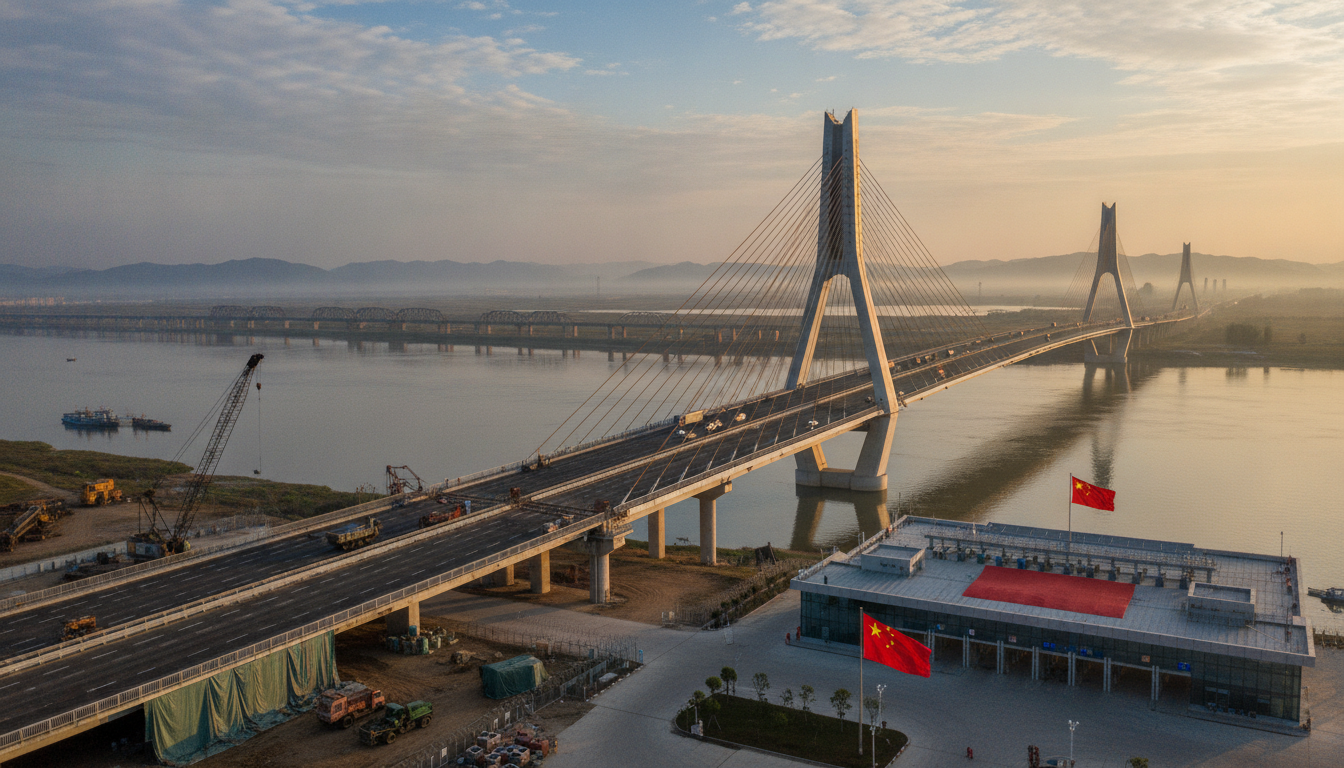
New Yalu River Bridge shows signs of preparation for opening after a decade idle
China and North Korea appear to be preparing the New Yalu River Bridge for possible opening, a move that could signal warming bilateral ties and renewed cross-border trade. The New Yalu River Bridge, completed in 2014 and spanning roughly three kilometres, has remained closed for more than a decade but now shows visible activity on the Dandong side. Local observers say the preparations, if followed by an official opening, would mark a major shift in the practical connectivity between the two neighbours.
Construction completed in 2014, entrance still closed
The New Yalu River Bridge was finished in 2014 but has not carried commercial traffic since completion. The three-kilometre structure was built to link Dandong in China with North Korea’s border region, yet it has stood unused while access roads and border facilities on the North Korean side remained unfinished.
Observers note that the long dormancy reflected a mix of practical and political obstacles, including infrastructure shortfalls on the DPRK side and constraints imposed by international sanctions. For more than a decade the span remained a visible but inactive testament to stalled cross-border ambitions.
Recent activity seen on the Dandong approach
Photographs taken in early August 2026 show increased activity near the Chinese approach to the bridge, with equipment and personnel visible around access points. The presence of workers and logistical material on the Dandong side has prompted speculation that Chinese authorities are preparing infrastructure or customs facilities ahead of a formal opening.
Local municipal sources and residents in Dandong report heightened inspections and maintenance work along roads leading to the bridge. While activity on the Chinese approach does not confirm an imminent bilateral agreement to open the crossing, it does indicate that authorities are taking steps to make the route operational if and when Pyongyang signals readiness.
Potential boost for cross-border trade and transport
An operational New Yalu River Bridge could provide a significant new channel for bilateral trade between China and North Korea, offering an alternative to the older Sino–Korean Friendship Bridge that connects the two countries nearby. Officials and traders have long viewed the new bridge as a conduit for cargo, timber, and manufactured goods, and as a possible route to support reconstruction and development projects in North Korea.
Restoring regular traffic would likely reduce pressure on existing crossings and could enable larger-volume shipments with modernised customs handling. However, the meaningful economic impact depends on complementary investments on both sides, including road upgrades, customs facilities, and regulatory coordination.
Diplomatic context and signs of warmer ties
Preparations around the bridge come amid broader signals of improving diplomatic engagement between Beijing and Pyongyang. State-level contacts, exchanges at provincial levels, and several rounds of talks in recent months have been reported by observers as part of efforts to stabilise relations and expand practical cooperation.
An opening of the New Yalu River Bridge would be a highly visible demonstration of that rapprochement, symbolising both trust and a willingness to resume deeper economic interaction. At the same time, such a step would require careful coordination with international partners and adherence to applicable sanctions, making the timing and scope of any opening politically sensitive.
Sanctions, regulatory hurdles and infrastructure gaps
Even if both governments agree to activate the bridge, legal and logistical constraints remain substantial. International sanctions on North Korea restrict certain categories of trade and financial flows, and any renewed cross-border commerce would need to navigate those restrictions to avoid international penalties.
On-the-ground obstacles persist as well: parts of the North Korean approach and connecting road network were never completed to a standard suitable for heavy traffic. Customs, quarantine procedures, and border management systems must be established or upgraded to handle an increase in people and goods, and both sides would have to settle operational questions such as inspection regimes and transit rules.
Security and regional implications for neighbouring states
A formal opening would draw attention from other regional capitals, which monitor Beijing–Pyongyang moves for their strategic implications. Enhanced physical connectivity can facilitate legitimate trade and humanitarian supplies, but it can also raise concerns about illicit flows and military logistics if not carefully regulated.
Regional stakeholders are likely to seek assurances about the scope of permitted traffic and the transparency of border operations. For China, balancing the economic advantages of increased trade with the need to manage diplomatic and security risks will be central to any decision to push the bridge into service.
Preparations at the New Yalu River Bridge are an early but notable development in Sino–North Korean relations, reflecting a pragmatic interest in restoring physical links after years of interruption. Whether those preparations result in a scheduled opening will depend on technical fixes on the North Korean side, bilateral agreements on customs and sanctions compliance, and broader geopolitical calculations.

