
Foxconn Says Scale Will Drive Growth in AI Servers Despite Rising Competition
Foxconn says it is not worried about rising competition in AI server production, citing scale, integrated supply chain and Nvidia’s new modular platform.
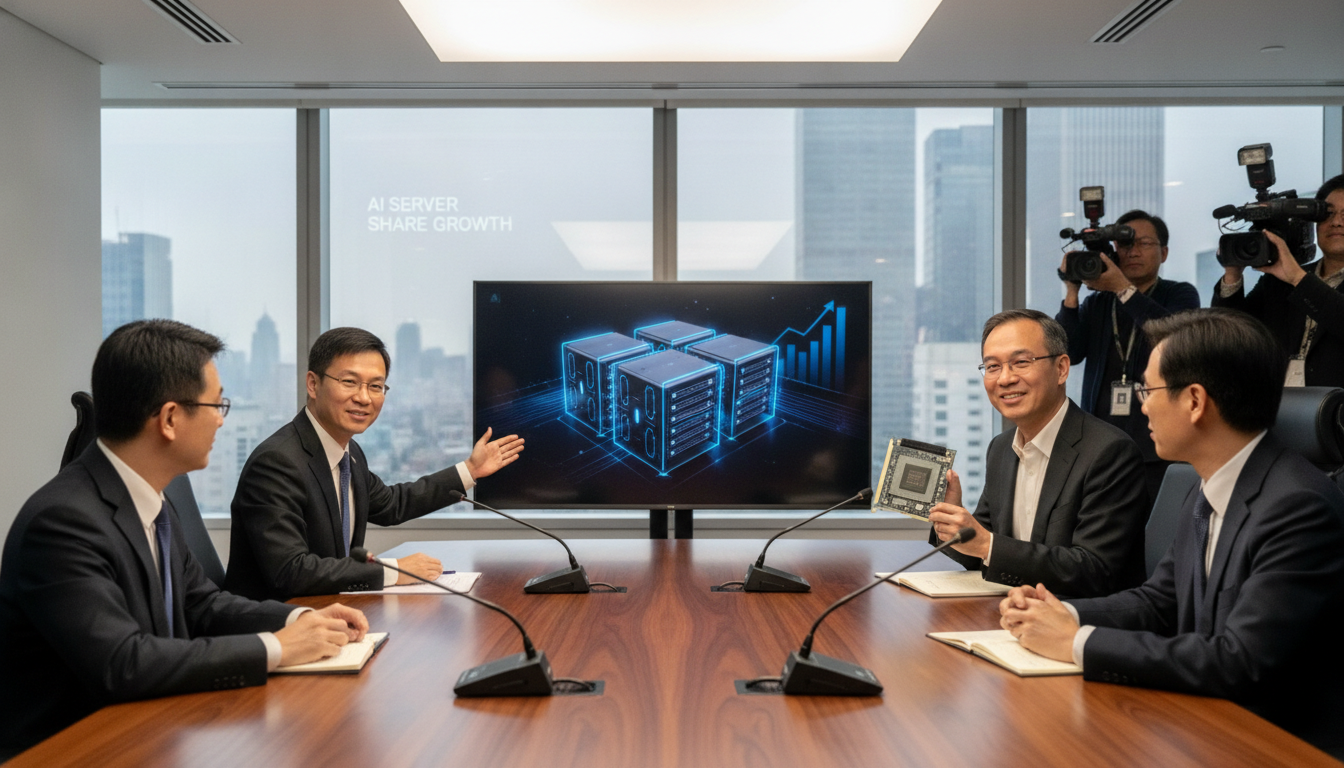
Foxconn AI servers are at the center of the company’s strategy to capture growing demand for computing infrastructure, the firm told investors on Aug. 12, 2026. The newly appointed rotating CEO Michael Chiang said Nvidia’s new modular AI server platform could expand opportunities for large contract manufacturers and help Foxconn increase its market share.
Foxconn’s public reassurance to investors
Foxconn framed its confidence around three pillars: production scale, supply-chain integration and long-standing relationships with component suppliers. Executives briefed investors with the view that those strengths will allow the company to compete effectively even as new entrants seek a slice of AI server orders.
Michael Chiang, who addressed shareholders on Aug. 12, stressed that the emergence of standardised, modular server designs can be complementary rather than threatening. He said the approach lowers engineering barriers and enables manufacturers with deep assembly capabilities to win larger volumes.
Nvidia’s modular platform as a market catalyst
Nvidia’s modular AI server architecture is designed to simplify deployment for hyperscalers and enterprise customers by standardising key subsystems. According to Foxconn’s presentation, that standardisation reduces the complexity of bespoke designs and increases the addressable market for contract manufacturers.
The company argued this trend shifts competition away from proprietary server engineering toward execution at scale and reliable supply logistics. Foxconn expects its high-volume facilities and logistics networks to make it a preferred partner for customers migrating to modular server builds.
Scale and integration as competitive advantages
Foxconn highlighted its global manufacturing footprint and integrated supplier network as decisive in meeting large, rapid orders. The company said its ability to source components, consolidate testing and deliver finished racks at scale gives it a cost and speed advantage over smaller newcomers.
Executives emphasized that vertical coordination — from board assembly to thermal engineering and final testing — reduces lead times and helps absorb supply shocks. That, the company said, is particularly important for AI servers where coordination across cooling, power and GPU subsystems is critical to performance.
New entrants and shifting customer demand
Industry observers have noted a surge of new players aiming to capitalise on AI infrastructure demand, including specialist OEMs and cloud providers building in-house capacity. Foxconn acknowledged the influx but framed it as validation of a structurally larger market rather than a zero-sum threat.
The company signalled it will compete on reliability, compliance and delivery rather than on proprietary hardware differentiation alone. That strategy positions Foxconn to bid for high-volume contracts where uptime guarantees and logistics matter as much as design.
Implications for Taiwan’s manufacturing sector
Foxconn’s push into AI server production underscores Taiwan’s role in the global electronics supply chain beyond consumer devices. The company’s focus on large-scale server assembly may drive more industrial investment and ancillary services in the region.
Local suppliers and test houses could see increased demand as server production requires specialised components and validation services. Foxconn’s expansion plans may also prompt other contract manufacturers in Taiwan to diversify toward infrastructure hardware.
Market outlook and strategic choices ahead
Foxconn indicated it will continue to invest in factory capabilities and partner ecosystems to capture growth in data-center hardware. The company plans to leverage existing OEM relationships while pursuing new agreements tied to modular server standards.
Analysts say execution will be tested by the pace of demand, the ability to secure high-end GPU supply and evolving customer preferences for in-house versus outsourced builds. Foxconn’s bet is that its operational scale will be the decisive factor in winning large, repeatable orders.
Foxconn’s public position is that rising competition in AI server production is a market-deepening development that plays to the firm’s strengths in scale and logistics, and that Nvidia’s new modular platform may accelerate demand that benefits established contract manufacturers.

