
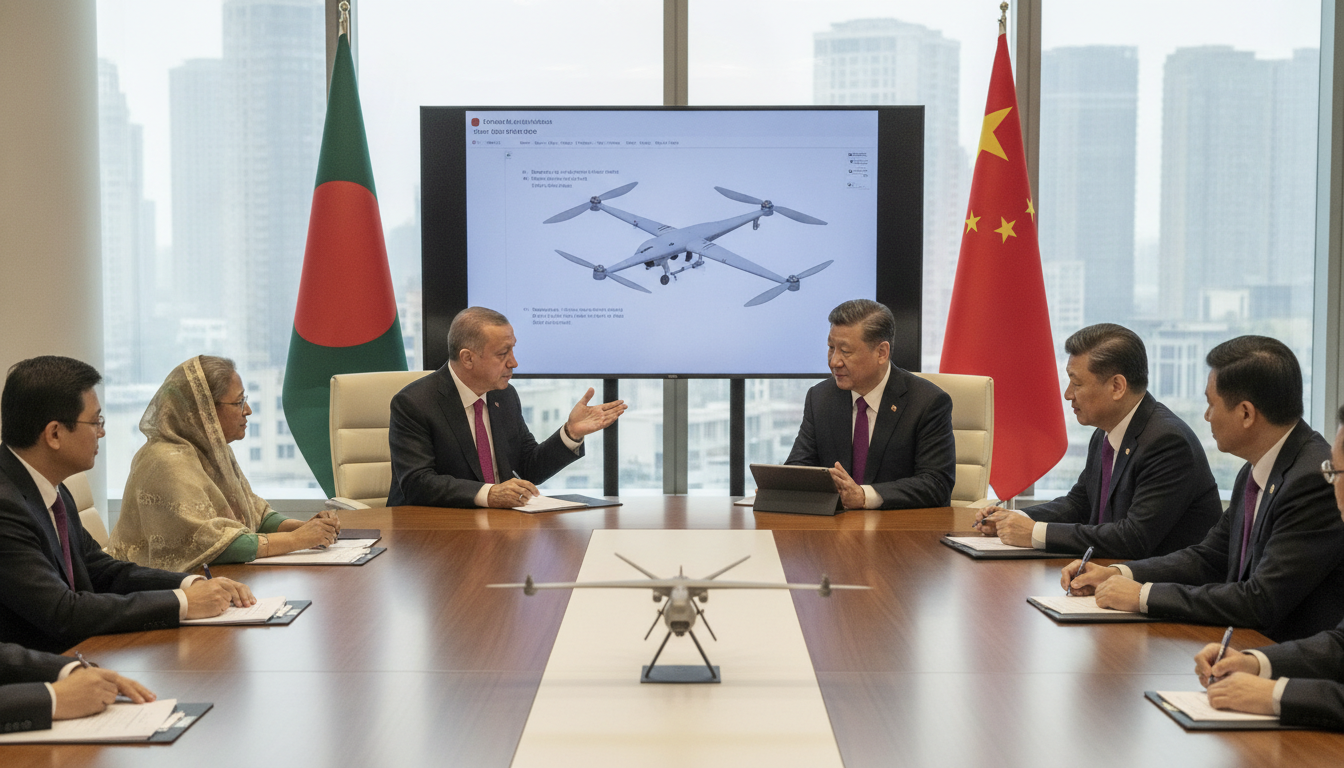
Bangladesh Accelerates Drone Manufacturing with Turkey and China Partnerships
Bangladesh to develop domestic drone manufacturing capability by partnering with Turkey and China, shifting from military imports to local production.
Bangladesh has moved to build a domestic defense industry focused on drone manufacturing, pursuing partnerships with Turkish and Chinese firms to transfer technology and produce unmanned aerial systems locally. The initiative marks a deliberate shift from reliance on imported military hardware toward creating domestic capacity in drone production, maintenance and potential export. Government and defense officials characterize the effort as a strategic investment in sovereignty, jobs and defence modernization.
Government outlines new industrial approach
The government has framed drone manufacturing as a central pillar of a broader defence-industrial strategy aimed at reducing import dependence and retaining more procurement value inside the country. Officials say the approach combines joint ventures, licensed production and technical cooperation to accelerate capability building.
This industrial approach prioritizes training, infrastructure and regulatory updates to support a nascent domestic ecosystem for unmanned systems. Ministries are coordinating with state-owned enterprises and private-sector partners to align investment, workforce development and procurement timelines.
Partnerships with Turkey and China announced
Bangladesh has engaged Turkish aerospace firms and Chinese defence manufacturers as primary partners in manufacturing and technology transfer discussions. Turkish Aerospace Industries and other Turkish suppliers have been cited by observers as natural collaborators given Turkey’s expanding UAV export profile.
Chinese firms are viewed as offering complementary strengths in electronics, systems integration and cost-effective production lines. Both partnerships are being positioned as pragmatic choices to secure rapid access to proven designs and manufacturing know-how.
Technology transfer and skills development
Central to the plan is meaningful technology transfer that enables Bangladeshi technicians and engineers to assemble, calibrate and maintain drones without long-term foreign dependence. Training programs and on-the-ground mentorship are being planned alongside factory set-ups to ensure the skills base keeps pace with hardware acquisition.
Officials emphasize that transfer agreements will cover software integration, avionics maintenance and quality control processes as well as assembly. The long-term objective is to move beyond assembly to design adaptations tailored to Bangladesh’s operational requirements.
Economic and industrial benefits expected
Proponents argue that domestic drone manufacturing will create high-skilled manufacturing jobs and spur ancillary industries such as avionics, composite materials and ground-control systems. Manufacturing locally could also preserve foreign exchange that would otherwise be spent on imports.
The defence sector push is intended to dovetail with civilian applications, where commercial drones can serve agriculture, disaster response and infrastructure inspection. Policymakers anticipate spillover effects to civilian technology clusters and export opportunities in the region.
Strategic and regional implications
The drive for indigenous production comes amid a regional environment where unmanned systems are increasingly seen as essential to maritime surveillance and border security. By building local drone capabilities, Bangladesh aims to strengthen its maritime domain awareness and improve responsiveness to natural disasters and security incidents.
Observers note that partnerships with Turkey and China reflect a pragmatic diversification of suppliers rather than alignment with a single external power. The choice of partners may also affect future export possibilities and interoperability with regional platforms.
Challenges in regulation and quality assurance
Scaling up production will require tightening regulatory frameworks for airspace management, export controls and domestic safety standards for unmanned aircraft operations. Authorities will need to establish certification processes and quality-assurance regimes to ensure systems meet military and civilian performance thresholds.
Budgetary discipline and careful contract management are being highlighted as necessary to prevent cost overruns and ensure that transfer agreements deliver the promised capabilities. Experts caution that effective governance will be as important as technical inputs in achieving sustainable production.
Bangladesh’s decision to develop local drone manufacturing through collaboration with Turkish and Chinese partners signals a new phase in its defence-industrial policy. If implemented effectively, the program could reshape procurement practices, stimulate technology-driven employment and enhance national resilience while also introducing complex regulatory and governance challenges that will require sustained attention.

