
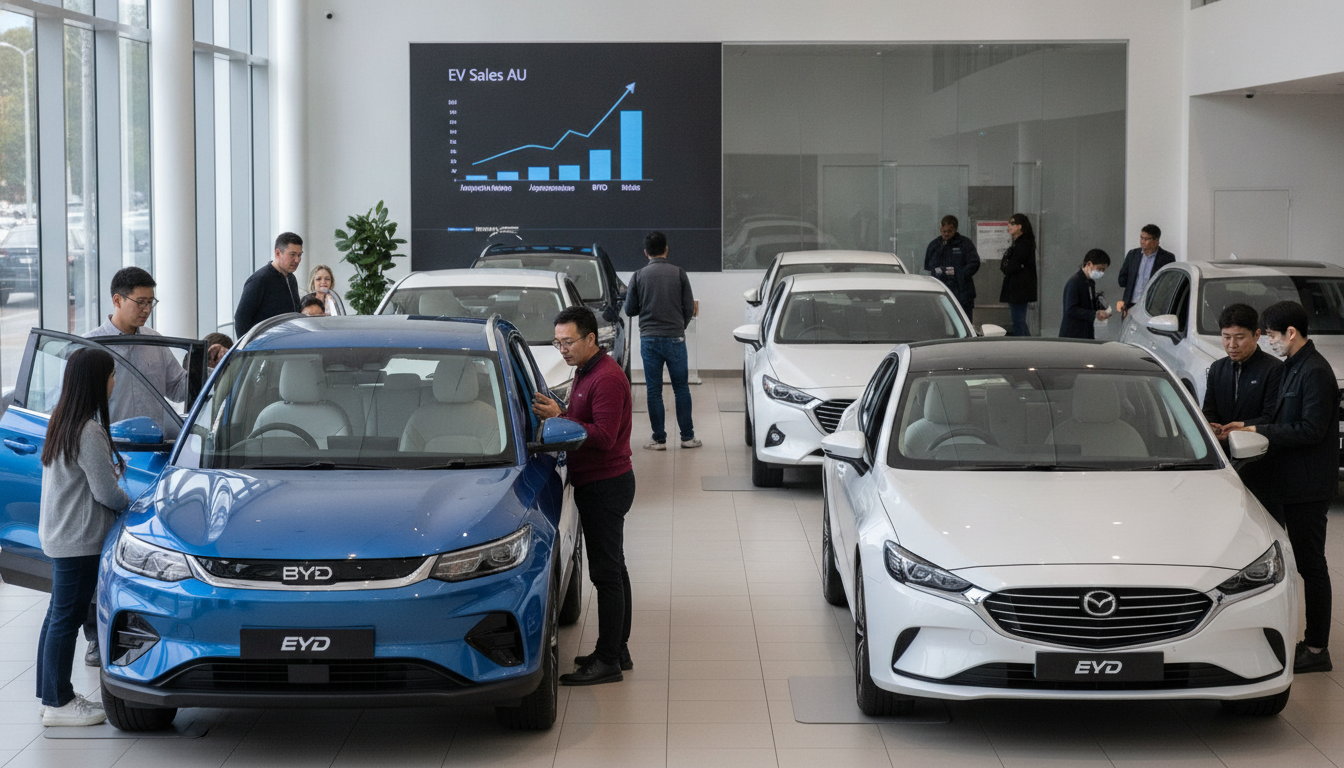
Electric vehicle sales in Australia surge as BYD and Chinese makers reshape market
Electric vehicle sales in Australia are surging as higher fuel prices and supportive policies accelerate adoption, with Chinese manufacturers such as BYD gaining market share and challenging established brands.
Australia’s shift toward electric vehicle sales in Australia has accelerated sharply over recent months, driven by rising petrol costs linked to Middle East tensions and a wave of competitively priced models from Chinese automakers. Industry analysts and dealers say favorable state and federal measures, combined with growing charging infrastructure, have reduced barriers for buyers and prompted fleets to increase EV purchases.
Sales Growth and Market Dynamics
Electric vehicle sales in Australia have moved from niche to mainstream as consumers respond to economic and technological signals. Dealers report stronger showroom traffic and faster turnover for affordable battery-electric models that undercut traditional petrol vehicles on total cost of ownership.
Market observers attribute the expansion to a combination of demand-side pressure from rising fuel prices and a supply-side influx of lower-priced EVs from Chinese manufacturers. This has reshaped the competitive landscape that for years favored Japanese brands and larger legacy automakers.
Role of Chinese Manufacturers
Manufacturers based in China, notably BYD, have used competitively priced models to penetrate segments previously dominated by internal-combustion vehicles. Their strategy focuses on offering long-range and feature-rich EVs at price points that appeal to mainstream Australian buyers.
These entrants have added pricing pressure and broadened the model mix available to consumers, prompting established brands to accelerate product launches, revise pricing strategies, and expand local sales and service networks.
Impact of Fuel Prices and Geopolitical Factors
Retail fuel prices rose after disruptions tied to the U.S.-Iran war, prompting many Australians to reassess running costs and vehicle choices. That spike increased interest in electric vehicle ownership as drivers sought to shield themselves from volatility in petrol markets.
Fleet managers, taxi operators, and logistics companies in several states reported renewed evaluations of electrification timelines, saying higher petrol bills make total-cost calculations for EVs more favorable in both metropolitan and regional operations.
Policy Measures and State Initiatives
Policymakers at federal and state levels have signaled support for electrification through a patchwork of incentives, regulatory targets, and charging network commitments. Analysts say these signals, even when modest, reduce purchase hesitancy and encourage investment in infrastructure.
State-level measures such as rebates, registration discounts, preferential parking or low-emission zones have been credited with nudging urban buyers, while procurement policies for public fleets are boosting early large-scale purchases by government agencies and utilities.
Charging Infrastructure and Consumer Confidence
Investment in charging infrastructure has accelerated, with private operators and utilities expanding fast chargers along major corridors and in metropolitan areas. Improved availability of public chargers has eased range anxiety for longer journeys and supported uptake outside capital cities.
Home charging remains the primary convenience factor for many new EV buyers, and industry players report higher demand for residential installer services. Combined with manufacturer warranties and longer battery guarantees, these developments have bolstered consumer confidence.
Implications for Dealers and Legacy Automakers
Dealership networks are adapting to a faster EV conversion by retraining staff, revising service offerings, and restructuring sales footprints. Some dealers have adjusted margins and finance packages to remain competitive against lower-priced imports.
For Japanese and European automakers that once dominated the Australian market, the immediate challenge is to accelerate local model introductions, offer compelling finance and warranty terms, and invest in aftersales to retain loyalty. Observers say those firms that move fastest to match value propositions will fare best.
The rapid change is also prompting broader discussion about the supply chain, local parts manufacturing, and the need for skills development in high-voltage systems, all of which will influence the long-term shape of Australia’s automotive sector.
Consumer sentiment is shifting as ownership economics improve and a wider selection of models becomes available. While price remains a deciding factor for many buyers, non-financial attributes such as technology, safety ratings, and brand trust continue to matter in purchase decisions.
As Australian drivers increasingly view electric vehicles as a viable alternative to internal-combustion cars, market participants expect the coming years to be shaped by competitive pricing, infrastructure rollout, and policy refinement that together determine the pace of electrification across the country.

