
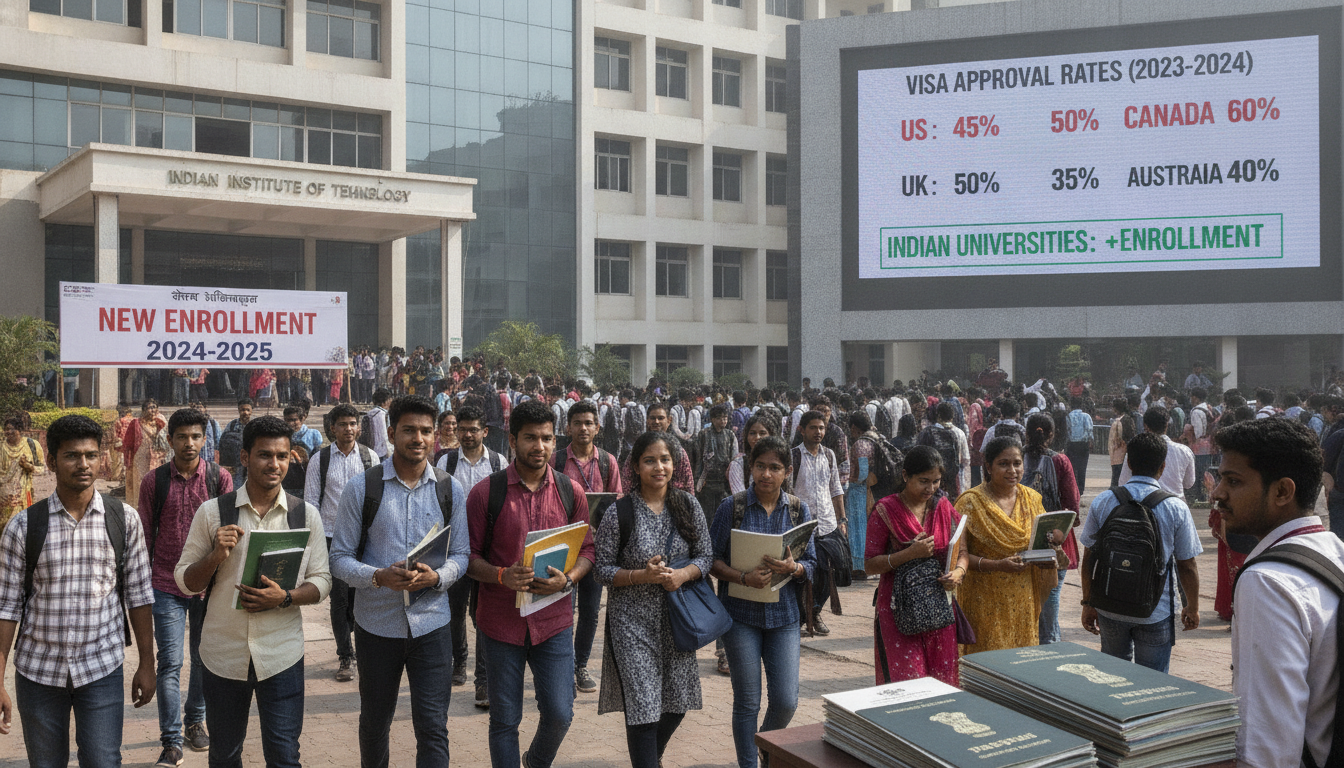
Indian students reconsider studying abroad as visa, cost and job concerns push demand toward domestic universities
Visa restrictions, rising costs and weak post-study job prospects are pushing Indian students to reconsider studying abroad, boosting demand at universities.
Indian students reconsider studying abroad as a growing number opt for domestic degrees amid tighter immigration rules, escalating living expenses and fears about finding work after graduation. Official and private surveys conducted this year show a notable shift away from the traditional “Big Four” destinations — the United States, the United Kingdom, Canada and Australia. Admissions officers and education consultants report an uptick in applications to Indian public and private institutions that offer expanded postgraduate and professional programs.
Surge in applications to Indian universities
Applications for master’s and professional programs at several Indian universities have risen sharply this admission cycle according to university officials. Institutions report larger applicant pools for engineering, business and data-science programs compared with the same period last year.
Private colleges and new ‘deemed’ universities are also seeing interest from students who previously targeted overseas campuses. Observers say increased marketing, partnerships with foreign institutions and bilingual program offerings have made domestic options more attractive.
Visa policy changes in key destination countries
Recent regulatory changes in the US, UK, Canada and Australia have reduced the attractiveness of studying abroad for many Indian families. Authorities in these countries have tightened student visa issuance criteria, restricted post-study work entitlements, or introduced more stringent employment-linked residency rules.
Students and advisers point to shorter or more conditional post-study work visas and more demanding proof-of-funds requirements as decisive factors in changing plans. The perception of greater uncertainty has led applicants to weigh domestic alternatives with clearer, more predictable outcomes.
Rising costs and employment uncertainty
Beyond visa rules, the cost of tuition and living overseas remains a major deterrent for families. Exchange-rate volatility, higher living costs in major cities and increased travel expenses have raised the financial barrier for middle-income households. As a result, the total budget required to complete a foreign degree is now unaffordable for a wider segment of prospective students.
Concerns about securing employment after graduation compound the problem. Reports of tighter hiring by multinational employers and a slower path from student status to stable work visas have reduced the economic return many families once expected from studying abroad. This shift in risk calculus is central to why more applicants are electing to stay.
Universities expand seats and tailor programs
Responding to demand, several Indian universities have increased seat capacity and introduced new postgraduate specializations aligned to market needs. Universities are launching applied programs in artificial intelligence, cybersecurity, fintech and healthcare management to attract students who might otherwise choose foreign campuses.
Some institutions are also offering international collaborations, short-term exchange programs and dual-degree pathways that combine domestic tuition savings with a period of study overseas. These hybrid models aim to give students global exposure while keeping costs lower and outcomes more certain.
Private sector and recruitment adjustments
Employers and recruitment agencies have begun adjusting to the shifting talent pipeline by scouting more actively within India. Technology firms, consultancies and startups report stronger campus recruitment drives at domestic colleges and an increase in early-career hiring locally.
Career services at Indian universities are expanding employer outreach and internship programs to improve graduate employability. Industry groups say closer engagement with campuses is helping address employer concerns about workforce readiness and is improving placement rates.
Policy and funding responses from government
Policymakers in New Delhi have highlighted the trend as an opportunity to strengthen India’s higher education system. Officials are increasingly focused on regulatory reforms, funding incentives and accreditation upgrades to raise the quality and global competitiveness of domestic institutions.
Programs that fund infrastructure, faculty development and research collaborations have been accelerated in several states. Education ministry sources say the aim is to turn rising demand into long-term capacity and to reduce dependence on overseas study for advanced skills development.
While the immediate driver is uncertainty abroad, experts note structural benefits if policy and investment sustain quality improvements. Enhancing domestic options could broaden access for students who previously could not afford or had no pathway to study overseas.
The trend of Indian students shifting away from traditional foreign destinations reflects a complex mix of policy, economic and labour-market changes. For many families, the calculus of cost, certainty and employability has shifted in favour of local universities that are expanding capacity and adapting curricula to modern skills demands. As regulators and institutions respond, the coming admissions cycles will show whether this is a temporary adjustment or the start of a longer-term rebalancing in international student mobility.

