
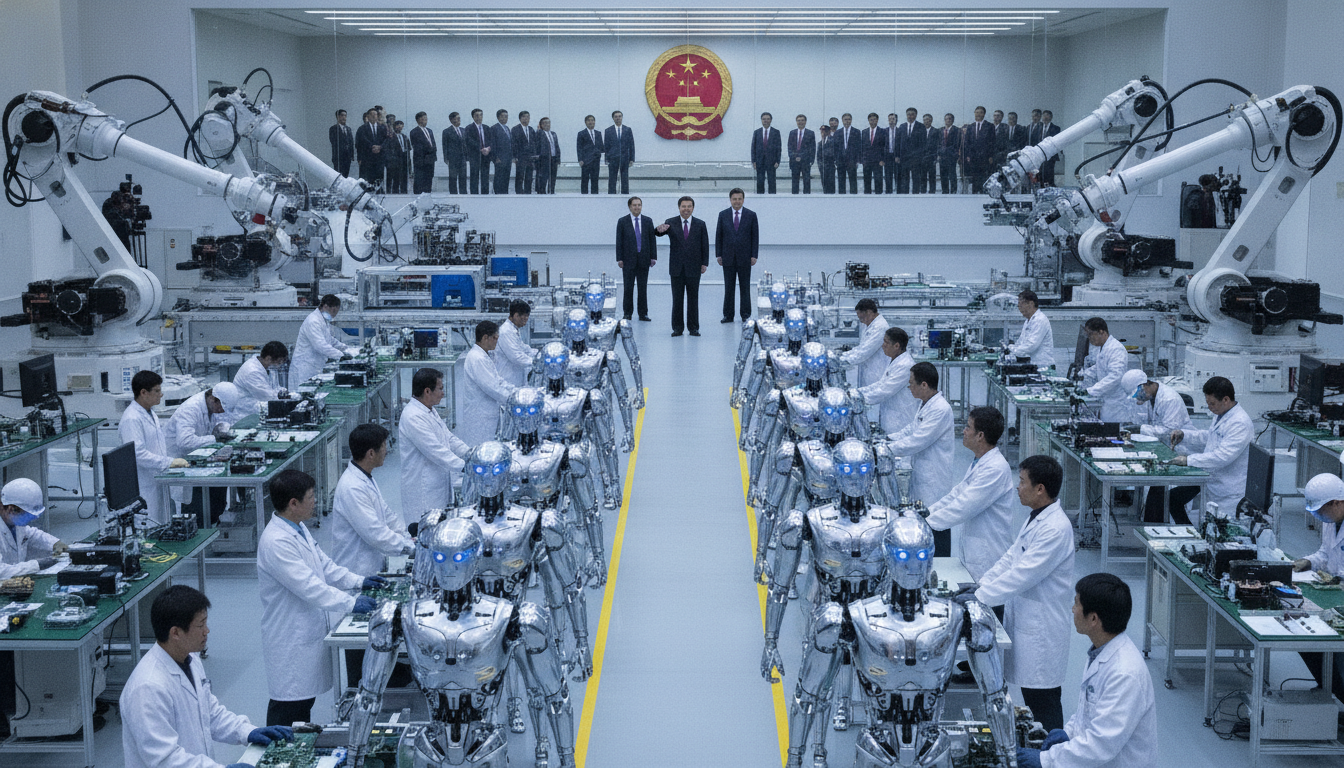
DSET Warns of ‘Whole‑of‑Nation’ China Push to Dominate Physical AI and Advanced Robotics
Taiwan’s DSET warns of a ‘whole-of-nation’ China push to dominate advanced robotics and physical AI, raising global tech and supply-chain concerns worldwide.
Taipei — Taiwan’s Digital Security and Technology think tank, DSET, warned on August 17, 2026 that Beijing is mounting a coordinated, "whole-of-nation" effort to lead in advanced robotics and physical AI. The assessment says China could trigger another global technology shock if its program overcomes current weaknesses in chips, sensors and precision machine tools. The report frames the push as comprehensive, spanning government policy, state-owned enterprises and private industry collaboration.
DSET issues assessment on China’s physical AI push
DSET’s report characterizes the campaign as an organized national strategy aimed at integrating robotics, automation and embodied artificial intelligence into both civilian and military sectors. Analysts say the initiative mirrors prior government-led efforts that accelerated China’s electric vehicle and drone industries. The think tank highlights that success will depend on closing critical hardware and manufacturing gaps.
The assessment cautions that, while software and systems integration have advanced rapidly, China still relies on foreign suppliers for high-end semiconductors, precision tooling and certain sensor technologies. Those shortfalls could slow large-scale deployment of cutting-edge humanoid and industrial robots. DSET argues the period ahead will test whether policy, capital and talent can compensate for those technical deficits.
Beijing’s whole-of-nation mobilization compared to EV and drone drives
DSET draws a direct parallel between the current robotics push and earlier state-backed campaigns that propelled China’s electric vehicle and drone sectors. In both cases, the government provided subsidies, procurement guarantees and preferential treatment for domestic champions. The think tank says similar measures are being tailored to accelerate development of physical AI ecosystems nationwide.
Officials and industry partners are reportedly aligning research priorities, scaling manufacturing clusters and coordinating standards. DSET warns that the cumulative effect could rapidly expand domestic capacity and encourage international acquisitions or partnerships to bridge remaining capability gaps. Observers say these tactics can compress what would normally be a multiyear industry maturation into months.
Technical strengths and persistent hardware gaps
China’s strengths include large-scale system integration, extensive data access for training embodied AI, and rapid application of automation in manufacturing and logistics. These advantages give Beijing leverage in deploying robots at scale for commercial and infrastructure projects. DSET notes substantial progress in software, algorithms and end-user applications that make physical AI increasingly practical.
Yet the report underscores important bottlenecks: advanced logic chips, high-precision machine tools and sophisticated sensors remain dominated by foreign suppliers. DSET suggests that without accelerated domestic development or reliable access to these components, China’s ambitions could stall at the system-assembly stage. The think tank emphasizes that hardware sovereignty will be crucial to sustaining long-term leadership.
Industry and supply-chain vulnerability
DSET warns that expanded Chinese capacity in robotics and physical AI could reshape global supply chains in manufacturing, healthcare and logistics. Companies worldwide may face new competition from lower-cost, state-supported Chinese producers. The report also highlights the risk that dependence on foreign inputs could expose global firms to supply disruption if geopolitical tensions escalate.
For technology suppliers and manufacturers, the emerging landscape presents both opportunity and risk. Some firms may benefit from growing Chinese demand for components and services, while others could see market share erode if Chinese systems reach parity in performance and cost. DSET advises international firms to reassess exposure and diversify critical supply sources.
Regional security and economic implications
Beyond commercial competition, the DSET assessment raises concerns about strategic and security implications of a rapid Chinese advance in physical AI. Autonomous systems and robotics have clear dual-use applications that could influence military capabilities and regional power projection. Taipei’s analysts urge policymakers to consider both economic resilience and defense readiness as the technology matures.
Neighboring economies and allies may need to weigh export controls, joint research safeguards and industry cooperation to maintain technological balance. DSET recommends clearer rules and multinational dialogue to manage risks while allowing legitimate scientific and commercial collaboration. The think tank stresses that unchecked acceleration could create destabilizing asymmetries in capability.
Taiwan and global policy responses
DSET calls on Taiwan and partner governments to bolster investment in foundational technologies such as advanced semiconductors, precision tooling and sensor research. Strengthening domestic industrial bases and supply-chain resilience are presented as immediate priorities. The report suggests targeted public-private programs to accelerate innovation without creating unnecessary market distortions.
International coordination could include joint funding initiatives, talent exchanges and shared standards development for safety and interoperability of physical AI systems. DSET also advises careful export control calibration to avoid unintended supply shortages while protecting key technologies. Policymakers are urged to act with urgency given the pace of change identified in the assessment.
The DSET assessment frames China’s physical AI push as a multifaceted campaign that could reshape industries and geopolitics if its hardware constraints are resolved. Observers say the coming months will be decisive in determining whether Beijing’s strategy translates into enduring global leadership or a costly scramble to catch up. Policymakers, industry leaders and regional partners will be monitoring developments closely.

