
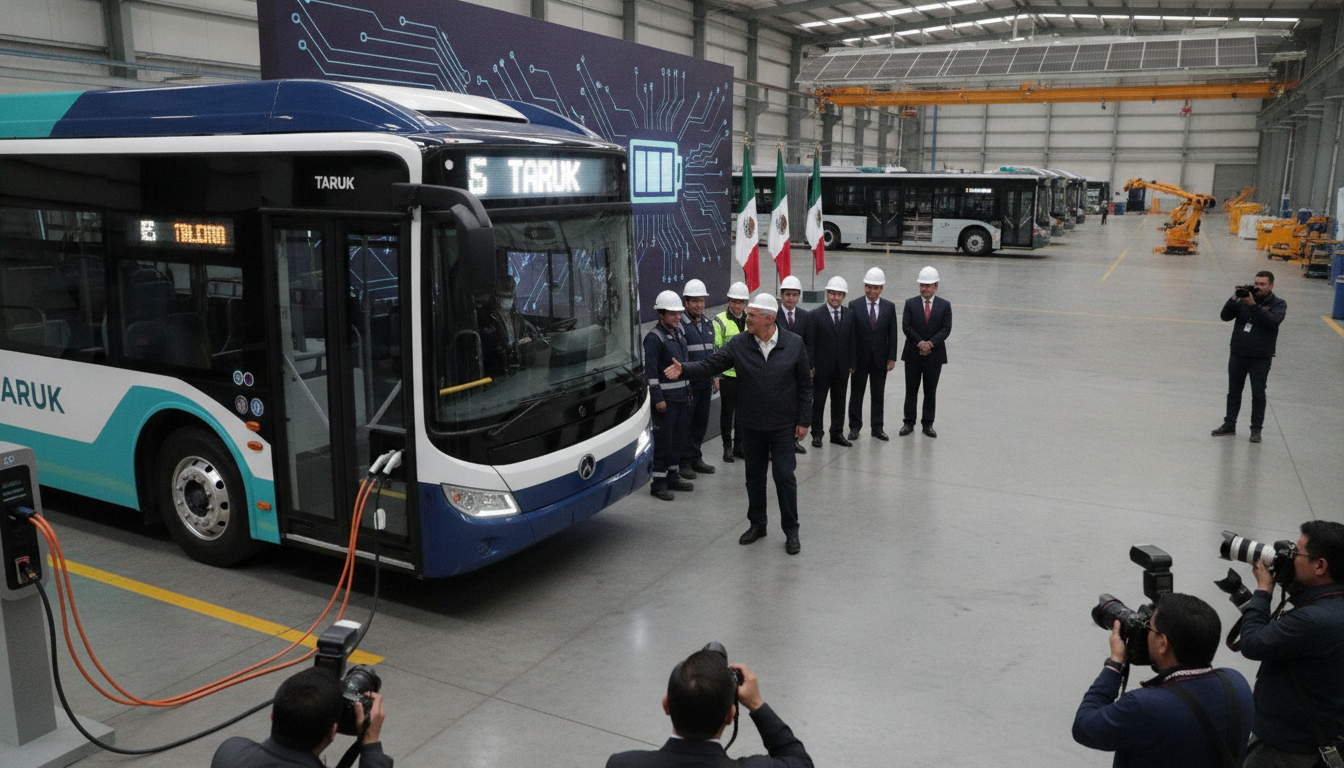
Mexico ramps up Taruk project to build Mexican-made electric bus and domestic battery industry
Mexico moves to localize EV supply chains with Taruk project, aiming for up to 80% component localization and a homegrown battery industry to reduce reliance on China.
Mexico City — The Mexican government has stepped up support for the Taruk project to develop a Mexican-made electric bus, with officials and industry backers seeking to localize as much as 80% of components and establish a domestic battery sector. The initiative, pushed forward as of August 17, 2026, is framed by authorities as a strategic response to growing global demand for clean transport and a desire to reduce reliance on Chinese suppliers. Proponents argue the move could capture more value in vehicle manufacturing and create new industrial linkages across Mexico’s automotive clusters.
Government backing and project mandate
The Taruk project is being promoted by Mexican authorities as a national industrial priority that aligns with broader economic and environmental goals. Government statements emphasize the dual aim of building domestic manufacturing capacity and accelerating the transition to zero-emission public transport. Support measures under consideration include incentives for local part production, regulatory adjustments for procurement, and coordination with state and municipal transit agencies.
Localization target and supply-chain strategy
A central pillar of the program is a target to localize up to 80% of the bus’s components, a benchmark meant to extend value capture beyond final assembly. Achieving that level of localization requires developing suppliers for motors, power electronics, chassis components and thermal systems, as well as integrating domestic fabricators into global certified supply chains. Officials say the project will prioritize partnerships between established automotive clusters in central Mexico and emerging suppliers, with staged milestones to verify content and quality.
Battery production as a strategic priority
Building a battery industry is presented as the linchpin of the Taruk strategy, given batteries’ outsized role in electric-vehicle costs and strategic autonomie. Project planners are pursuing domestic cell assembly and, ultimately, cell manufacturing capabilities to reduce dependence on imported battery modules and raw materials processed abroad. The move would also aim to spur investment in recycling, testing facilities and workforce training to meet the technical standards required for commercial transit fleets.
Trade implications and reduction of Chinese reliance
A stated objective of the initiative is to reduce Mexico’s reliance on Chinese manufacturers for key EV components and battery imports. Policymakers frame the Taruk project as a way to diversify suppliers while preserving access to major export markets, particularly in North America. Industry observers note that reshaping supply chains carries commercial and diplomatic implications, as Mexico balances trade ties with China against deep economic integration with the United States and Canada.
Industry response and workforce prospects
Automakers, tier-one suppliers and local parts makers have signaled interest in participating in the project, seeing opportunities to expand their role in electrified vehicle production. Investment in tooling, certification and staff upskilling will be essential to meet localization goals and global safety standards for mass transit vehicles. The Taruk project could generate new manufacturing jobs and value-added roles in engineering and battery services, although the pace and scale will depend on financing and the speed of technology transfer.
Infrastructure, financing and technical hurdles
Realizing a domestic battery industry and high localization rate involves significant hurdles, including securing capital for cell production, sourcing processed raw materials, and meeting stringent quality and safety benchmarks. Building the necessary testing labs, charging infrastructure and maintenance networks will require coordination across federal, state and municipal levels. Project architects acknowledge that phased investment and public-private collaboration will be necessary to de-risk manufacturing and encourage supplier commitments.
The Taruk project represents a calculated effort by Mexico to position itself more centrally in the global shift to electric mobility while preserving industrial sovereignty and economic benefits. If the localization and battery aims are met, the initiative could reshape regional supply chains and create new domestic capabilities for zero-emission transport. Continuous oversight, measurable milestones and clear financing structures will be critical as the program moves from planning to implementation.

