
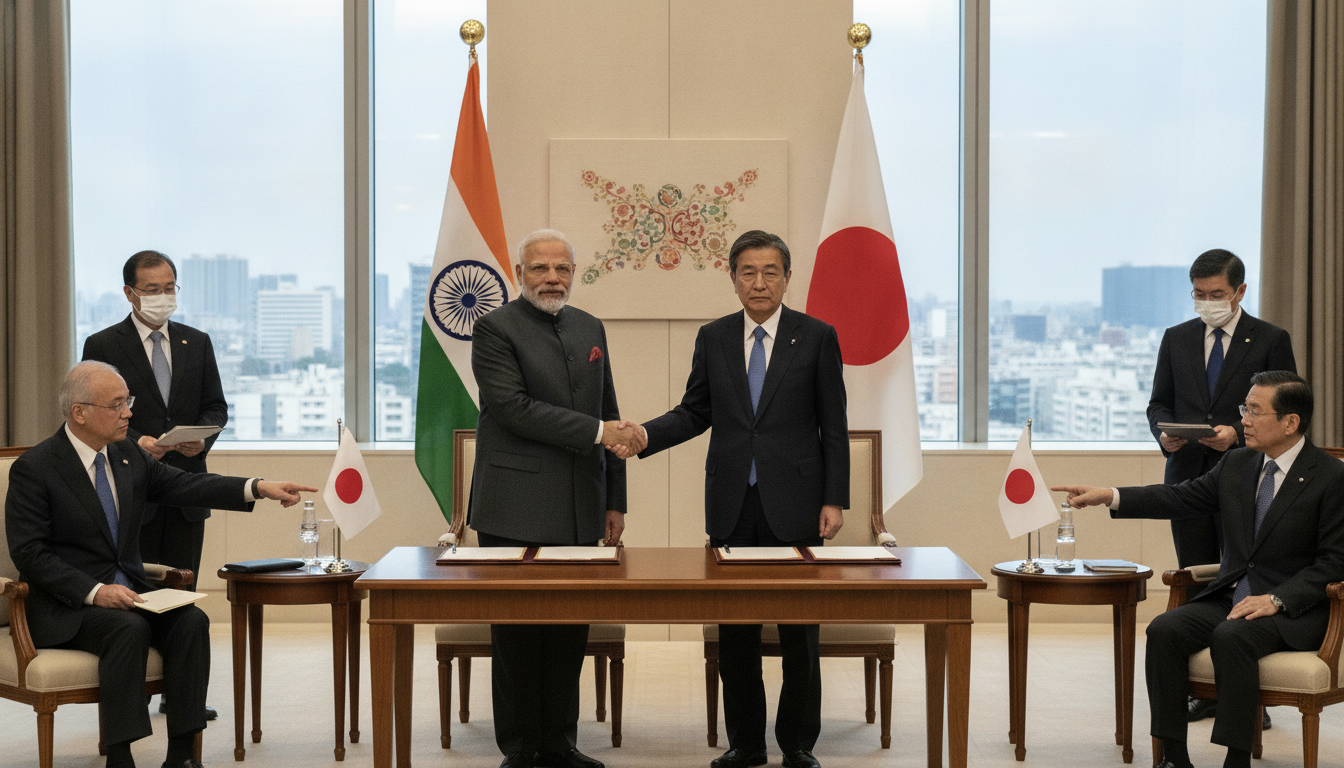
India-Japan maritime pact signed in New Delhi to deepen security cooperation and defense R&D
India-Japan maritime pact signed in New Delhi, pledging joint patrols, intelligence sharing and defense R&D to strengthen Indo-Pacific stability.
NEW DELHI — India and Japan on Thursday signed a landmark India-Japan maritime pact designed to deepen naval cooperation, intelligence sharing and joint research on advanced defense technologies. The agreement, concluded during talks between Indian Defence Minister Rajnath Singh and his Japanese counterpart Shinjiro Koizumi in New Delhi, commits both countries to broaden operational ties across the Indian Ocean and the broader Indo-Pacific. Officials stressed the pact blends immediate operational measures with longer-term defense research and development collaboration.
Terms of the pact and operational commitments
The agreement outlines a framework for expanded maritime domain awareness, coordinated patrols and accelerated information exchanges between naval and coast guard forces. It provides legal and procedural mechanisms for sharing classified maritime data, co-ordinating search-and-rescue operations and facilitating port calls and logistics support for each other’s vessels.
Signatories also agreed to streamline communication protocols and to conduct more frequent joint and multilateral exercises aimed at improving interoperability. The pact contains provisions to pilot cooperative activities such as coordinated anti-piracy patrols and synchronized monitoring of sea lines of communication.
Defense research and technology collaboration
A central feature of the India-Japan maritime pact is the pledge to deepen defense research and development cooperation in “state-of-the-art” technologies. Both governments committed to joint work on areas that include advanced sensors, unmanned maritime systems and artificial intelligence for maritime domain awareness.
Officials said new bilateral R&D initiatives will seek to accelerate co-development of equipment and platforms, enable industrial partnerships between defense firms, and promote reciprocal access to testing facilities. Funding and intellectual property arrangements were left to subsequent implementing agreements and interagency working groups.
Planned exercises, logistics and intelligence sharing
The pact formalizes plans for a stepped-up schedule of bilateral and trilateral naval exercises, including expanded scenarios that simulate humanitarian assistance, disaster relief and complex multi-threat environments. It also envisages greater sharing of maritime intelligence, including satellite and radar data, to improve early warning and maritime picture building.
Logistics cooperation was highlighted as practical enabler: both sides agreed to facilitate replenishment and port access and to negotiate reciprocal legal frameworks for military logistics support. Defence officials indicated these measures aim to shorten response times during crises and enable sustained presence in distant waters.
Strategic implications for the Indo-Pacific
Analysts and officials said the India-Japan maritime pact strengthens regional security architectures at a time of heightened competition in the Indo-Pacific. By integrating operational cooperation with technology partnerships, the agreement is designed to boost deterrence and crisis management capacity without forming a formal alliance structure.
Observers noted the pact aligns with Tokyo and New Delhi’s shared interest in safeguarding freedom of navigation, secure sea lines of communication and a rules-based regional order. The agreement is likely to complement existing security arrangements and multilateral dialogues involving other regional partners.
Statements from ministers and diplomatic context
At a joint appearance in New Delhi, Indian Defence Minister Rajnath Singh described the pact as “a milestone” in bilateral defense ties, emphasizing practical cooperation and mutual trust. His Japanese counterpart, Shinjiro Koizumi, said Tokyo views enhanced maritime cooperation with India as “essential” for regional stability and for addressing non-traditional threats at sea.
Diplomatic briefings following the signing said the pact reflects years of incremental security engagement between the two democracies. Officials framed the agreement as an effort to convert strategic convergence into tangible capabilities and routine cooperation across a wide maritime theater.
Implementation steps and timelines
Both governments announced the formation of a joint working group to produce detailed implementation plans within months, including pilot patrols and an initial R&D roadmap. The working group will be charged with drafting operational protocols, coordinating funding channels and setting timelines for phased capability development.
Defence ministries signaled an intention to begin joint exercises and intelligence exchanges under the new framework within the coming year, with pilot technology projects to follow once legal and procurement arrangements are finalized. Observers will watch closely for announcements on specific projects and public-private partnerships.
The India-Japan maritime pact represents a strategic deepening of bilateral ties that pairs operational cooperation with explicit commitments on defense research and technology. By linking immediate naval coordination with longer-term R&D collaboration, the agreement aims to strengthen both countries’ ability to respond to maritime challenges and to shape a more resilient security environment in the Indo-Pacific.

