
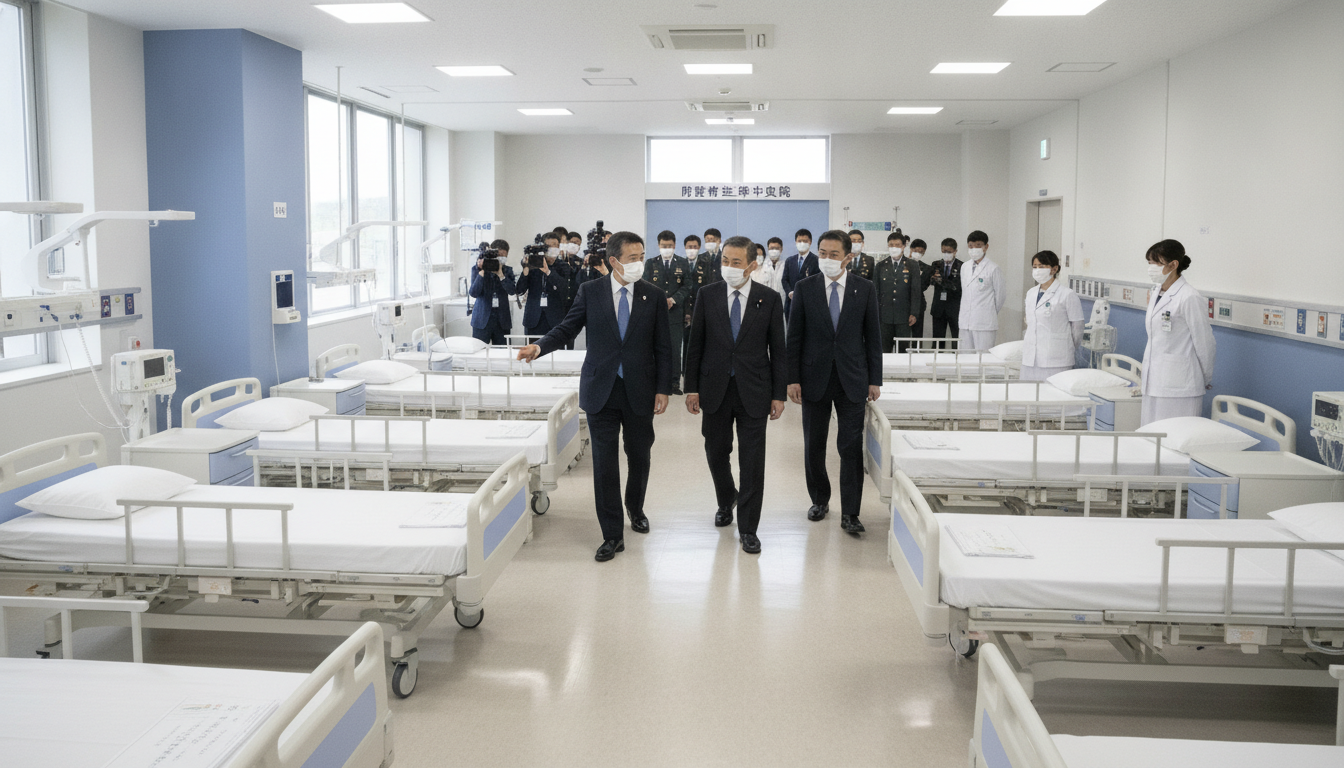
Japan to Expand SDF Hospitals’ Capacity with New Beds and Departments
Japan will expand SDF hospitals’ capacity, adding beds and new departments at three facilities from Okinawa to Tokyo to better treat casualties during emergencies.
Japan will increase bed capacity and establish new medical departments at three Self-Defense Forces hospitals, officials said, aiming to improve care for wounded personnel and civilians in crises. The expansion will cover facilities from Okinawa through to the Tokyo area and includes stepped-up stockpiles of supplies and enhanced training for medical teams.
Government orders expansion of SDF medical capacity
The Defense Ministry has directed a programme to enlarge hospital capacity within the Self-Defense Forces to ensure readiness for high-casualty scenarios. Officials described the move as part of broader efforts to bolster national resilience amid rising regional security concerns.
The directive prioritizes rapid treatment and stabilisation capabilities, with an emphasis on trauma care and surge bed capacity. Officials said the changes are intended to reduce reliance on overstretched civilian hospitals during large-scale emergencies.
Three hospitals targeted from Okinawa to Tokyo
Planners have identified three SDF hospitals for immediate upgrades, spanning Okinawa prefecture to the Tokyo metropolitan area. The selection reflects strategic considerations about likely casualty distribution in a mainland or southern island contingency.
Local commanders will coordinate with regional medical authorities to smooth patient flows and share specialized equipment. The ministry said the sites were chosen for their logistical links to military units and proximity to transport hubs.
New beds, departments and supply stockpiles
Upgrades will include the installation of additional inpatient beds, the creation of dedicated trauma and surgical departments, and the expansion of intensive-care capacity. The aim is to enable the hospitals to accept and treat simultaneous mass-casualty arrivals.
Authorities plan to increase holdings of blood products, antibiotics and field-ready surgical kits, alongside ventilators and monitoring equipment. Supply chain measures include secured warehousing and rotation schedules to ensure readiness without disrupting routine care.
Training and integration with civilian healthcare
Medical staff at the SDF hospitals will undergo new joint training exercises with civilian hospitals and emergency services to sharpen triage and evacuation procedures. Officials highlighted the importance of interoperability to prevent bottlenecks during crises.
Simulated mass-casualty drills will test patient transfer routes, triage protocols and rapid expansion of ward space. The exercises are also intended to improve communications between military and municipal health systems during complex emergency operations.
Budget, timeline and logistical challenges
Defense planners are working to fund the upgrades through a combination of reallocated ministry money and fiscal-year budget proposals. Officials expect phased implementation, with initial bed expansions completed within months and more complex department builds following in the next fiscal cycle.
Logistical challenges include short-term disruption to routine services as construction and equipment installation proceed. The ministry said it will stagger work and, where needed, temporarily shift patients to other units to minimise impact on care.
Security context and preparedness rationale
Officials framed the hospital expansion as part of a broader push to strengthen Japan’s defense posture and civil-military resilience. Rising regional tensions and the need for rapid medical response in the event of attacks or large-scale natural disasters were cited as drivers.
The upgrades are being coordinated with increased training activity across ground, maritime and air units, reflecting a whole-of-government approach to readiness. Defense planners said ensuring medical surge capacity is a practical step toward reducing avoidable deaths in high-casualty scenarios.
The planned expansion of SDF hospitals will expand immediate treatment options for both military personnel and civilian patients in emergencies, while reinforcing coordination between Japan’s defense medical system and regional healthcare networks.

