
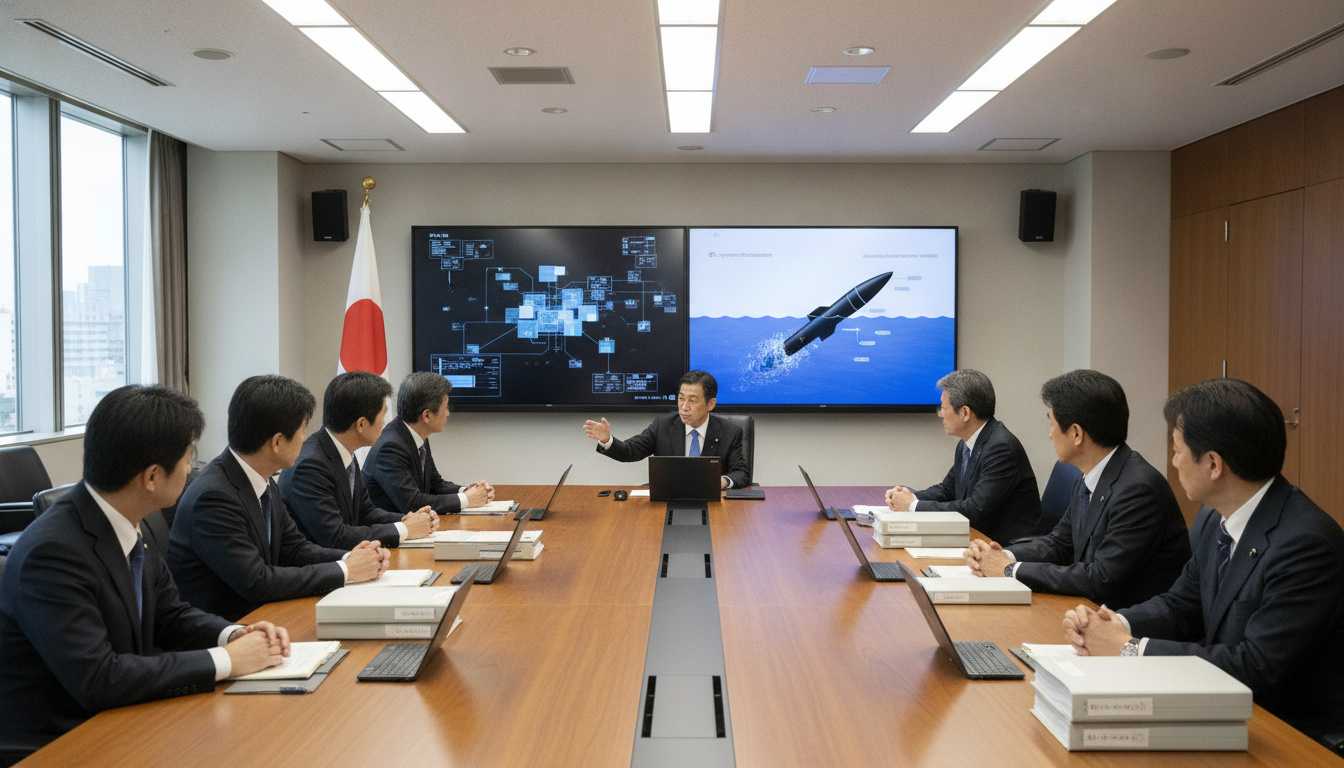
Defense Ministry Seeks AI in Japan’s Self-Defense Forces Command and Expands Long‑Range Unmanned Strike Programs
Defense Ministry’s 2027 budget request proposes AI in Japan’s Self-Defense Forces command along with long‑range drones and hypersonic submarine-launched missiles.
Japan’s Defense Ministry on August 31 submitted its fiscal 2027 initial budget request that proposes introducing AI in Japan’s Self-Defense Forces command and advancing long‑range strike systems. The request frames AI-enabled decision support for the Joint Operations Command as a priority and pairs that move with investments in unmanned platforms and hypersonic weapons. Many items are listed as non-monetary “item requests” ahead of a scheduled revision of Japan’s security policy documents later this year.
Defense Ministry’s 2027 Budget Request Adds AI to Joint Operations Command
The ministry’s concept calls for an AI-assisted decision support system to be integrated into the Joint Operations Command that coordinates the Ground, Maritime and Air Self-Defense Forces. Officials say the system would help synthesize large volumes of data and speed command decision-making under complex, fast-moving contingencies. The plan explicitly references recent conflicts abroad as drivers for changing how forces command and respond on short notice.
The proposal is presented largely as a “matters” request without firm cost figures, signaling policy intent rather than finalized procurement. The Defense Ministry states it intends to initially leverage existing overseas technologies to expedite capability deployment while developing domestic alternatives over time.
Plan to Import U.S. System While Building Domestic Alternatives
The request notes U.S. precedents for fielding analytics systems, citing the adoption by U.S. forces of commercial data platforms that fuse disparate data streams for operational use. Japan would accelerate early deployment by adapting such overseas tools, according to the documents released by the ministry. At the same time, the ministry seeks to promote Japan-based development with an eventual aim to replace foreign components with domestic systems.
Government sources identified a Tokyo-based AI firm as a candidate for future domestic work, reflecting a dual-track approach of immediate capability and longer-term industrial independence. That approach balances rapid capability needs with concerns over supply-chain and sovereignty risks in critical defense systems.
New Cloud Infrastructure for Sensitive Defense Data
To enable AI-driven command tools, the ministry is requesting establishment of a Defense Ministry cloud service designed to handle high-grade classified information. The cloud would host sensitive datasets required for machine-assisted analysis, simulations and secure information sharing across services. The ministry designates this infrastructure as essential for operational continuity and for safe deployment of AI tools within command processes.
The proposal emphasizes controlled use of private-sector cloud technologies under strict security and data-governance frameworks. Officials say rigorous safeguards will be put in place to prevent data leakage and to meet legal requirements for handling classified material.
Expanded Strike Capabilities: Hypersonic Submarine-Launched Missile
Alongside command and data initiatives, the budget request advances strike capabilities intended to keep adversaries at a distance. The ministry is seeking funding to begin developing a new underwater-launch hypersonic guided weapon that could be fired from submarines or unmanned underwater vehicles. The weapon is described as enhancing a “stand-off” defense posture by enabling intercepts from beyond the range of adversary systems.
The proposal frames submarine and unmanned undersea platforms as attractive launch points because of their stealth and survivability, which could increase the likelihood of successful delivery. The request forms part of a broader push to strengthen deterrent and counterstrike options while operating within Japan’s evolving security policy.
Unmanned Systems and Long-Range Attack Drones Included
The Defense Ministry’s papers also include plans to develop a range of unmanned platforms, from attack drones capable of extended flight to unmanned underwater vehicles with strike roles. These systems are positioned as part of a wider set of capabilities for distributed operations, precision effects and reduced risk to personnel. The request highlights lessons from conflicts where lower-cost, flexible unmanned systems were widely used and proved tactically significant.
Development and procurement for unmanned systems are similarly listed as matters requests, reflecting early-stage decisions pending further policy reviews and budget negotiations. Officials say the work will coordinate with partners and domestic industry to accelerate prototyping and testing.
Timeline, Budget Process and Strategic Context
The items are being advanced as the government prepares to revise three key security policy documents by the end of the year, a process intended to align force posture with changing strategic threats. By submitting many proposals as matters requests now, the Defense Ministry seeks to secure policy approval before allocating firm budgets later in the fiscal cycle. Lawmakers and budget officials will scrutinize which requests receive concrete funding during the Diet’s budget deliberations.
Analysts note the twin emphasis on AI-enabled command and long-range strike systems signals Tokyo’s intent to modernize command-and-control while expanding deterrent options. As debate continues over export controls, interoperability with allies, and the legal parameters for new capabilities, the ministry’s request sets a framework for contentious but consequential decisions ahead.
Japan’s defense posture is poised for substantive change if these proposals move forward, with AI in Japan’s Self-Defense Forces command and new strike systems among the most significant shifts. The coming months will determine which items are financed and how rapidly the ministry can translate its strategic priorities into operational capabilities.

