
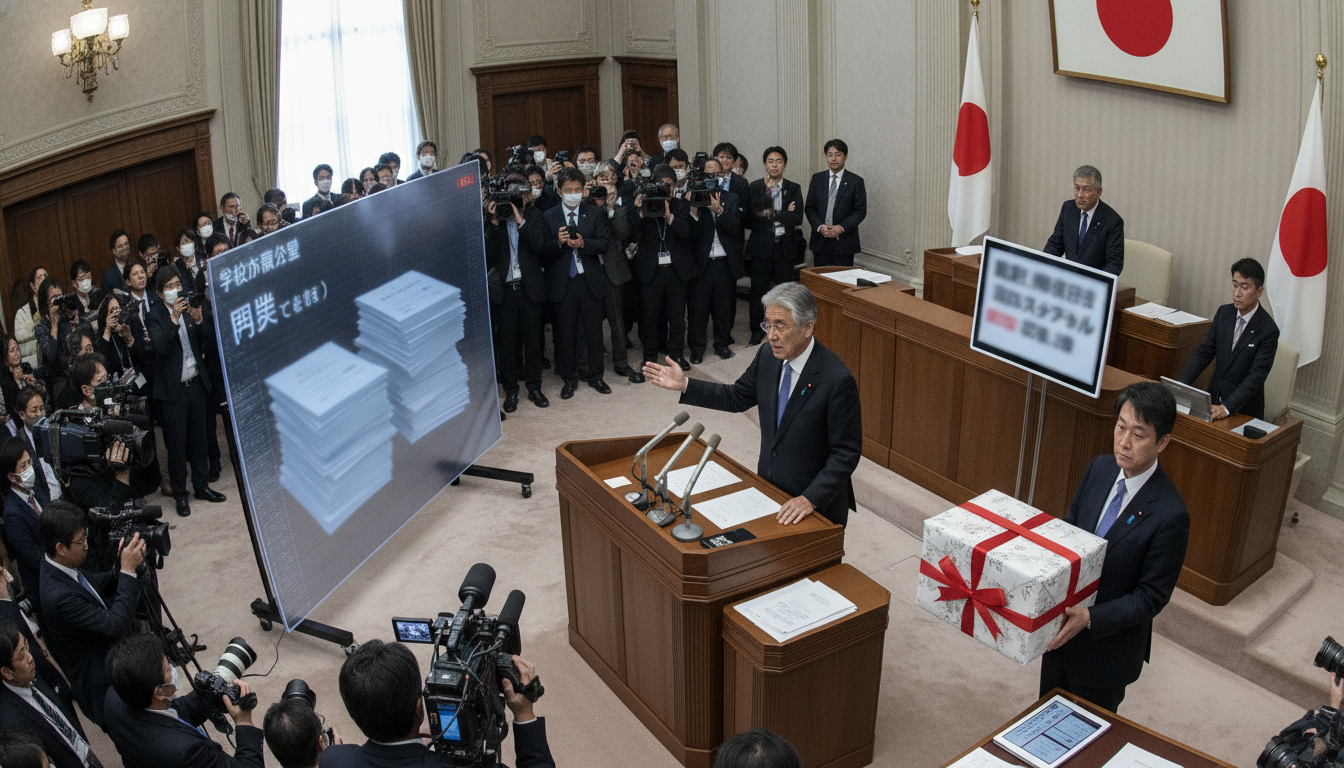
Ishiba administration’s rise stalled after document disclosure decision and gift-voucher scandal
Ishiba administration faced a brief approval spike after disclosing Moritomo-related documents, then plunged into controversy when gift vouchers to new MPs were revealed.
Prime Minister Shigeru Ishiba’s administration gained short-lived momentum in early 2025 after a decisive move to allow disclosure of contested Moritomo Gakuen documents, but that political high was undercut within weeks when a gift-voucher distribution to newly elected lawmakers became public. The Ishiba administration’s handling of both the Moritomo records and the March 3 reception exposed tensions between policy-driven decisions and campaign-era practices, producing rapid shifts in public support. The episode illustrates how a single personnel gesture can destabilize broader reform narratives at the center of a fragile coalition government.
Decision to allow Moritomo documents release
In late February 2025, just before a scheduled summit with the United States, Prime Minister Ishiba chose not to appeal an Osaka High Court ruling that found the state’s non-disclosure of documents in the Moritomo Gakuen case to be illegal. The choice was a political judgment taken over dissenting voices within the administration who urged an appeal, and it led to the eventual disclosure of the documents.
Ishiba framed the move as a matter of public trust in government institutions rather than a personal critique of predecessors, saying the decision responded to the bereaved family’s concerns and the need to uphold state credibility. That stance contrasted with expectations that his administration would defend the original non-disclosure, and it signaled an appetite for breaking with past practices tied to the previous administration.
Contact with the Akagi family
Shortly after the decision, Ishiba met with Masako Akagi, the widow of Toshio Akagi, the finance ministry official who died after alleging pressure to alter documents related to the Moritomo affair. The meeting, held within the Diet compound, reinforced the administration’s message that transparency and acknowledgment of victims’ families were central to its approach.
Ishiba later said he regarded responding to the bereaved family and honoring the late official’s memory as “a matter of human decency,” a phrase that helped shape the public narrative of moral responsibility around the disclosure. That framing resonated with sections of the electorate sensitive to government accountability.
Polls show brief rebound in support
The disclosure decision and the prime minister’s outreach were followed by a measurable uptick in public approval. A national poll conducted immediately after the summit showed cabinet support recovering to around 40 percent, a rebound analysts attributed both to the document disclosure and to positive reactions to Ishiba’s handling of international diplomacy.
The improved standing gave the Ishiba administration renewed leverage to pursue its legislative priorities, even as it remained a minority government dependent on external cooperation for key bills. Observers noted that the boost was fragile, tied closely to perceptions of integrity and the prime minister’s personal credibility.
Budget passage with Japan Innovation Party deal
In February 2025 the administration secured a crucial victory when it struck a deal with the Japan Innovation Party on a measure to expand free high school education, winning the backing needed to pass the initial budget. The agreement exposed the pragmatic side of the Ishiba administration: willing to negotiate policy trade-offs to maintain governance momentum.
That budget breakthrough helped sustain the narrative that the administration could convert political capital into tangible policy gains, at least temporarily. It also showed the limits of governing without a stable majority, where high-stakes compromises are often necessary to advance flagship spending plans.
March 3 reception and discovery of gift vouchers
The political high abruptly faltered after a March 3 reception at the prime minister’s official residence for 15 newly elected members of the House of Representatives. It later emerged that the Ishiba office had distributed department-store gift vouchers worth ¥100,000 to each participating lawmaker, placing them in large retailer paper bags and describing them as souvenirs.
A national newspaper report on March 13 revealed the distribution and triggered immediate controversy. Critics across the political spectrum questioned the appropriateness of handing substantial vouchers to newly elected officials, arguing the practice blurred the line between campaign gratuities and improper inducements.
Immediate political fallout and erosion of momentum
The revelation prompted sharp criticism from opposition parties and public concern about propriety, undercutting the goodwill Ishiba had built through the document disclosure and other policy moves. Calls for explanation mounted, and the administration’s approval ratings slipped as attention shifted away from policy achievements toward questions about campaign-era behavior and internal controls.
Even supporters who had praised Ishiba’s transparency on the Moritomo matter expressed disappointment at the optics of the voucher distribution, seeing it as a distraction that threatened the prime minister’s broader agenda. The episode highlighted how reputational gains tied to integrity can be quickly reversed by lapses perceived as irregular or transactional.
Despite the setback, the Ishiba administration retained allies in key policy areas and continued to pursue its legislative program, though with diminished political leverage. The juxtaposition of a high-profile pro-transparency decision and a low-grade ethics scandal underscored the fragility of popular support for a government navigating coalition politics.
The aftermath left the Ishiba administration with a narrowed window to translate legal and moral postures into durable political capital while repairing trust eroded by the gift-voucher controversy.

