
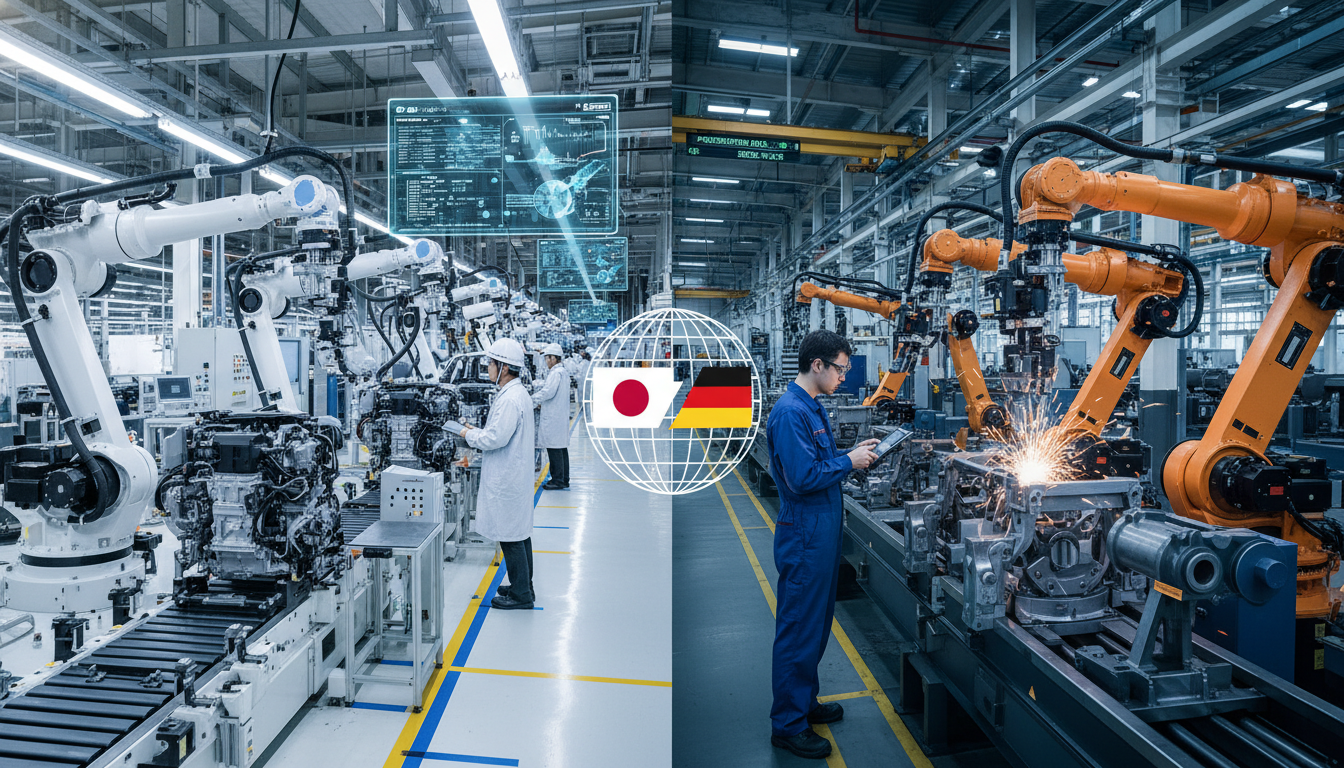
Japan and Germany Step Up Physical Artificial Intelligence on Factory Floors
Japan and Germany are adopting physical artificial intelligence on factory floors to boost speed and precision, now with AI-enabled robots and chipmakers.
Manufacturers in Japan and Germany are accelerating the deployment of physical artificial intelligence, applying machine learning directly to robots and production equipment to analyze real-world shop-floor data in real time. Industry leaders are pairing robotics firms with chipmakers to run increasingly sophisticated models at the edge, aiming to shorten cycle times and reduce defects. The shift reflects a broader move from lab-based AI to systems that control physical processes on assembly lines and test floors.
Companies pair robotics and chips to run AI at the edge
Fanuc and other robotics manufacturers have announced partnerships with semiconductor firms to embed AI capabilities inside controllers and vision systems. These collaborations place inference-capable processors close to sensors and actuators, enabling subsecond adjustments to motion and quality checks. By locating computation on the shop floor, firms reduce latency, protect sensitive data, and cut reliance on cloud connectivity for critical manufacturing tasks.
Shop-floor data drives faster, more precise production
Physical artificial intelligence depends on high-fidelity, time-series data from machines, cameras, and sensors, which manufacturers are now harvesting more systematically. Firms are using that data to train models that can detect tool wear, predict part defects, and optimize cycle parameters without human intervention. The result is a manufacturing feedback loop where AI refines processes continuously, shortening setup times and improving first-pass yield.
Robotics makers target new applications and services
Robotics companies are expanding beyond traditional automation into AI-enabled inspection, force control and adaptive assembly. Machines equipped with physical AI can sense variations in part tolerances or material behavior and adjust grip strength, speed, or trajectory on the fly. This capability opens new applications in electronics, automotive components and precision machining where small gains in accuracy translate into significant cost savings.
Integration and workforce implications for factories
Deploying physical AI requires integration across controls, software, and operations teams, and many plants are retooling IT/OT practices to support it. Engineers need to validate models against safety and compliance standards while maintenance crews learn to monitor AI-driven behaviors. Companies say that, rather than replacing skilled workers, these systems often shift human roles toward supervision, model validation and exception handling.
Supply chain and chip constraints shape adoption pace
The uptake of physical artificial intelligence is influenced by the availability of specialized chips and industrial-grade sensors that can operate reliably in factory environments. Supply constraints and long procurement cycles for semiconductor components can delay rollouts, prompting firms to prioritize pilot projects in higher-value lines first. Some manufacturers are exploring modular retrofits to bring AI to existing equipment while planning for broader fleet-wide deployments.
Standards, safety and testing remain central concerns
As control loops incorporate learned behaviors, regulators and industry groups are focusing on validation frameworks to ensure predictable and safe operation. Manufacturers are adopting staged testing, simulation and operator override mechanisms before granting full production authority to AI systems. Clear logging and traceability of model decisions are becoming standard practice to meet audit requirements and to facilitate continuous improvement.
Manufacturers cite measurable benefits from early implementations of physical artificial intelligence, including reduced scrap, higher throughput and faster changeovers. As firms scale successful pilots, the technology is expected to reframe competitiveness in precision manufacturing by combining robotics expertise with advanced semiconductor performance. The convergence of machine builders, chip vendors and plant operators marks a significant phase in industrial automation, with real-world shop-floor intelligence driving the next wave of productivity gains.

