
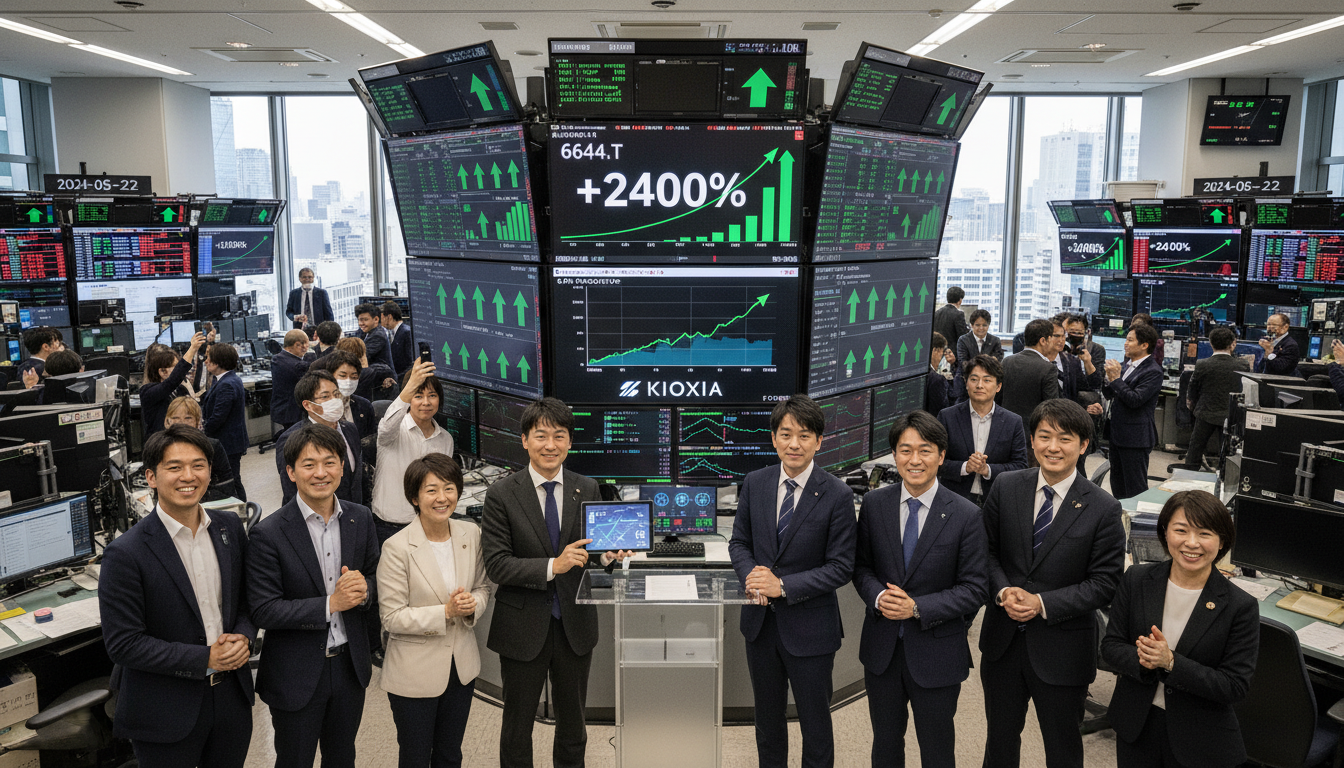
Kioxia stock rockets 24-fold year-on-year as AI demand fuels memory boom
Kioxia stock soars 24x year-on-year and nearly fivefold in 2026 as surging AI-related demand for high-density memory chips reshapes investor sentiment and industry plans.
TOKYO — Kioxia stock has surged dramatically, climbing 24 times year-on-year and nearly fivefold so far in 2026 as investors chase exposure to the growing artificial intelligence market. The sharp rally reflects renewed confidence in memory-chip makers that supply high-capacity NAND and related products used in data centers and AI infrastructure. The gain has put the Japanese firm at the center of market attention and reignited debate over valuations and long-term capacity strategies.
Market reaction and trading momentum
The recent jump in Kioxia stock price has been driven largely by speculative buying and fresh institutional interest in semiconductor suppliers linked to AI growth. Traders cited the company’s role in supplying NAND flash memory and other storage components essential for generative AI workloads as a key catalyst. Market liquidity and momentum trading have amplified price moves, pulling more retail investors into the stock.
Analysts note that the pace of buying has outstripped immediate fundamentals in some measures, producing volatile intraday swings alongside the upward trajectory. Despite the surge, turnover remains concentrated in certain investor segments, which could contribute to sharper corrections if sentiment shifts.
Demand fundamentals behind the rally
Underlying the share-price surge is a sustained increase in demand for high-density memory as cloud providers and AI developers scale up training and inference infrastructure. Modern large-language models and advanced AI systems require vast storage bandwidth and capacity, placing a premium on NAND and associated memory technologies. Kioxia’s product mix positions it to benefit from upgrades to data-center storage architectures.
Corporate customers have been prioritizing reliability and long-term supply commitments, prompting procurement cycles that favor established suppliers. That dynamic has improved near-term visibility for vendors like Kioxia but has also raised expectations for continued investment in manufacturing and R&D.
Production footprint and capacity constraints
Kioxia’s Kitakami plant in Iwate prefecture is a visible symbol of the company’s manufacturing presence in northern Japan, and its facilities have drawn attention from investors monitoring supply-side developments. Expanding output for high-density memory typically requires multi-year capital expenditures and complex process upgrades. Industry participants warn that supply cannot be ramped instantly to match demand spikes, which supports higher prices in the near term.
At the same time, capacity investment plans face long lead times and large costs, meaning companies must balance the opportunity presented by AI demand against the risk of future oversupply. Kioxia will need to manage that timing carefully to sustain margins without overcommitting to volatile market conditions.
Competition and global market dynamics
Kioxia operates in a highly competitive field alongside major global players, including South Korean and U.S.-based memory manufacturers. Those competitors are also targeting AI-driven opportunities, intensifying pressure on pricing, technology road maps, and supply agreements. Geopolitical factors and trade policies continue to shape investment and sourcing decisions across the industry.
The memory market’s cyclical nature adds another layer of complexity: when multiple suppliers move to expand capacity simultaneously, the sector can swing from tightness to oversupply, compressing prices and returns. Investors are watching how Kioxia and its peers coordinate investment pacing and product differentiation.
Valuation concerns and investor cautions
While the rally has created substantial gains for shareholders, some investors and analysts warn that the valuation now embedded in Kioxia stock may reflect overly optimistic expectations. High multiples driven by momentum can reverse quickly if demand growth slows or if technological shifts alter product mix. Risk factors include changes in AI investment cycles, competition from alternative memory technologies, and operational setbacks during factory upgrades.
Institutional investors emphasize the importance of monitoring order books, capital expenditure plans, and customer concentration to assess the durability of revenue growth. Prudent risk management and clear communication from Kioxia on its long-term strategy will be critical to maintaining investor confidence.
Broader implications for Japan’s tech sector
Kioxia’s dramatic share-price surge has broader symbolic value for Japan’s technology sector, signaling renewed investor appetite for domestic semiconductor champions. Policymakers and industry groups have been promoting advanced manufacturing and innovation in semiconductors as strategic priorities, and strong market performance can boost momentum for further public and private support. The rally may also encourage other Japanese tech firms to accelerate plans tied to AI and data-center supply chains.
However, translating market enthusiasm into sustainable industrial leadership requires continued investment in talent, R&D, and global partnerships. The path from a stock-market rally to lasting competitiveness is neither automatic nor guaranteed.
As Kioxia navigates the rapid upswing in its share price, the company faces the twin tasks of meeting heightened customer demand and justifying elevated market expectations. Investors and industry observers will be closely tracking production updates, capital-spending disclosures, and sales performance in coming quarters to judge whether the AI-driven boost can support a durable revaluation of the business.

