
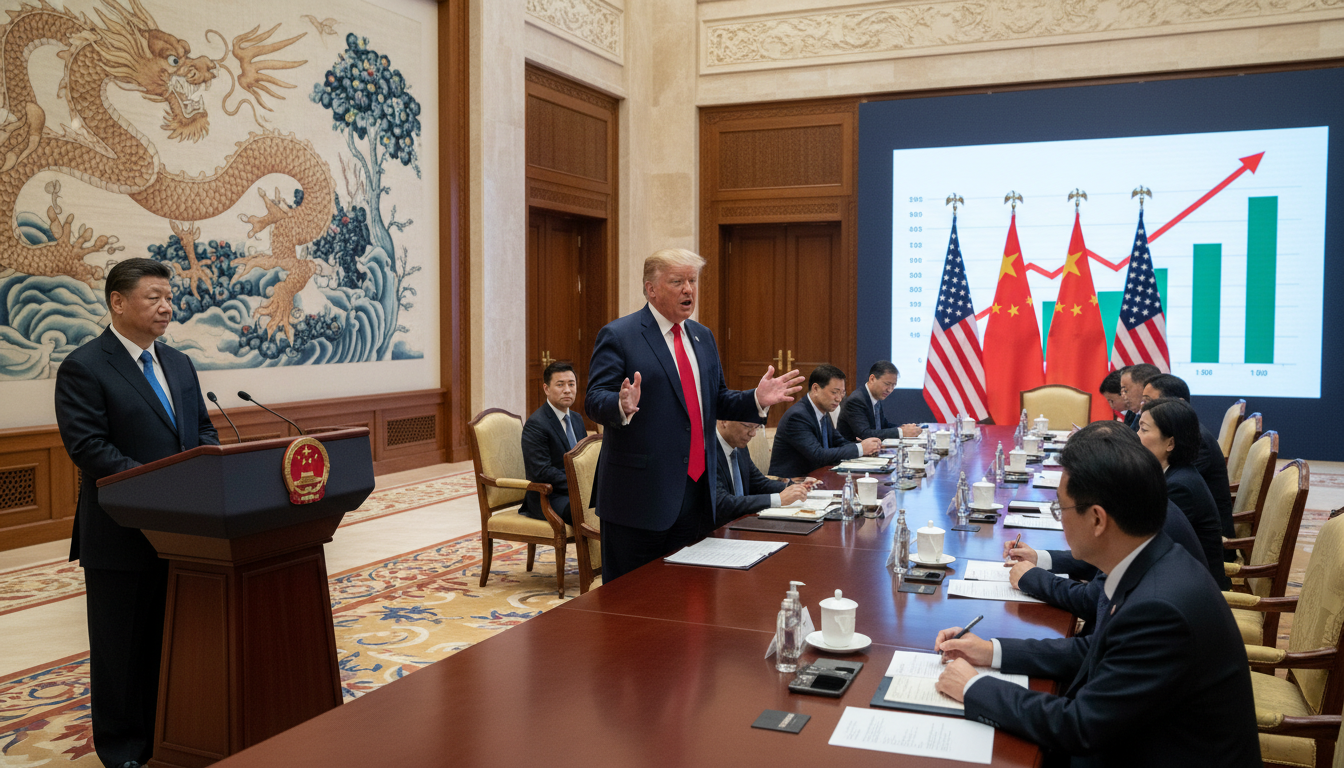
U.S.-China Summit in Beijing Yields Limited Tangible Results as Both Leaders Seek Stability
U.S.-China summit in Beijing on May 14, 2026 saw President Trump and President Xi Jinping emphasize stability and dialogue, but produced few concrete outcomes and highlighted divergent approaches.
Summit Opens at the Great Hall of the People
On May 14, 2026, the U.S.-China summit in Beijing began with a ceremonial welcome at the Great Hall of the People. President Xi Jinping descended to greet President Donald Trump, and the two exchanged a brief handshake before moving past a group of children carrying flags and flowers. The opening optics underscored a mutual desire to present a stable, controlled meeting amid heightened global tensions.
The ceremony set a diplomatic tone but masked underlying differences in priorities between the two leaders. Chinese officials framed the encounter as a step toward steady, reciprocal ties, while the U.S. side emphasized transactional diplomacy. Observers noted the careful choreography of public gestures even as negotiations remained guarded.
Xi Frames Talks Around “A Once-in-a-Century” Challenge
President Xi used the summit to warn of what he called a once-in-a-century shift in international affairs, urging both countries to stabilize bilateral relations. Beijing presented the talks as an effort to manage competition responsibly and to secure predictable channels of communication. Chinese state commentary emphasized the need for a relationship between the two powers based on parity and mutual respect.
Domestic political considerations shaped Xi’s posture, as Chinese leaders sought to project confidence at home and abroad. The message to both domestic and international audiences was that China prefers managed rivalry and institutionalized mechanisms to reduce the risk of miscalculation. Analysts in Beijing said this rhetorical framing aims to shore up China’s negotiating leverage without conceding core policy positions.
Trump Maintains Deal-Making, Prioritizes Economic Terms
President Trump approached the summit with a deal-centric style, pressing bilateral trade and economic issues while signaling readiness to negotiate on specific items. U.S. officials described the visit as an opportunity to extract concrete commercial benefits and to revisit longstanding grievances on market access and intellectual property. Trump’s direct, transactional rhetoric contrasted with Xi’s emphasis on strategic stability.
Despite the public emphasis on deals, U.S. participants acknowledged limited room for sweeping new agreements during a single visit. The American delegation focused on attainable outcomes — narrow trade concessions, enforcement mechanisms, and commitments on business facilitation — rather than broad strategic compromises. Sources close to the talks said negotiators aimed to convert political momentum into practical follow-up processes.
Strategic Stability and the Taiwan Question Were Addressed
Both leaders discussed regional security issues, including the status of Taiwan, and signaled an interest in reducing the risk of inadvertent escalation. Officials stated that Washington and Beijing agreed to pursue “constructive, strategic stability” measures, though descriptions of specific steps were cursory. The talks included exchanges intended to clarify red lines and mechanisms for crisis communication.
Observers cautioned that agreement on the language of stability does not amount to a change in core policies on Taiwan or regional deployments. While the summit produced joint statements on dialogue, it stopped short of binding commitments that would alter the underlying military or diplomatic calculus across the Taiwan Strait. Analysts said that any substantive progress will require detailed follow-up and verification processes.
Few Concrete Deliverables, Emphasis on Follow-Up Talks
Publicly released outcomes from the summit were limited, with officials from both sides pointing to future working groups and technical talks as the likely venues for implementation. The meeting produced symbolic gestures and a common statement on pursuing stable relations, but little in the way of immediate, verifiable deliverables. Business leaders and diplomats were left to gauge whether rhetoric will translate into measurable changes.
The lack of headline agreements reflects the complexity of U.S.-China ties, which encompass trade, technology, military competition, and global governance. Both capitals preferred to avoid committing to sweeping steps that could provoke domestic backlash or strategic risk. Instead, the summit appeared designed to buy time and to set terms for a longer, incremental negotiation process.
Domestic and International Reactions Diverge
In Beijing, official commentary highlighted the summit as a diplomatic success that affirmed China’s growing global confidence. The ceremonial welcome and Xi’s framing were presented as evidence that China can shape the agenda on its terms. State media underscored narratives of parity and the need for an orderly international environment in the face of systemic change.
In Washington, reactions were more mixed, with supporters pointing to maintenance of open channels and critics noting the absence of hard concessions. U.S. business groups welcomed signals of economic engagement but pressed for enforceable commitments. Allies in the region watched closely, assessing whether the summit would alter security dynamics or embolden unilateral moves.
The summit therefore served multiple audiences: domestic constituencies in both countries, regional partners, and global markets. Its primary immediate achievement was to re-establish high-level contact and to replace escalating rhetoric with managed engagement, while leaving substantive policy disputes to subsequent rounds of negotiation.
As the leaders departed Beijing, both capitals stressed the importance of follow-up talks and technical working groups to operationalize the summit’s promises. The U.S.-China summit on May 14, 2026 reinforced a shared interest in avoiding direct confrontation, but it also underscored how divergent priorities — strategic stabilization for China and transactional gains for the United States — will shape the next phase of a complex and consequential bilateral relationship.

