
Ananya Donapati Builds a Creative Career in Tokyo After Leaving Silicon Valley
Ananya Donapati moved to Tokyo in 2023 and turned Japanese fluency into a creator business, courses, brand partnerships and a podcast shaping careers in Japan.
Ananya Donapati arrived in Tokyo in 2023 after years of study and an earlier visit in 2017, and within a short period she converted language skills into a sizable creator business and public profile. Her audience has grown into the hundreds of thousands across Instagram and YouTube, and she now balances paid partnerships, an online Japanese course and a podcast while navigating visas and local business culture. The shift from a corporate job in San Francisco to full-time creator work in Japan frames a broader story about how foreigners build sustainable creative careers in Tokyo today.
Ananya Donapati’s move and rapid audience growth
Ananya Donapati’s path to Tokyo began long before she relocated, anchored by roughly a decade of Japanese study and an early high-school homestay in Yokohama that left a lasting impression. She says the pandemic and the practicalities of youth delayed a longer-term move, but by 2023 she chose to make the leap and pursue opportunities on the ground. Once in Tokyo, audience growth accelerated: social channels that had climbed steadily surged after she began producing Japan-focused content, adding significant followers within her first year on location.
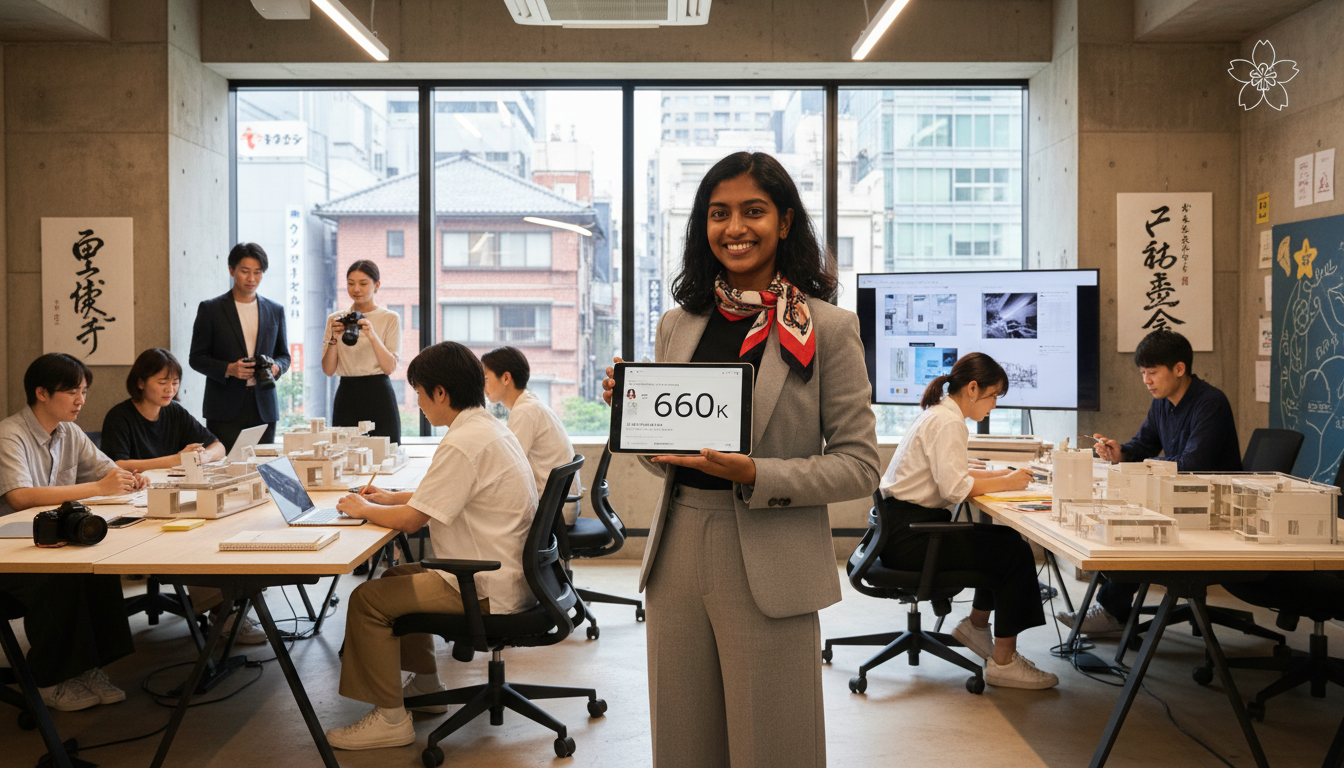
That early spike in reach helped shift the calculation from experimentation to a professional focus, as the numbers began to demonstrate viable demand for content about language, daily life and local culture. Donapati’s follower base now spans multiple platforms and countries, giving her a cross-border audience that supports both digital products and brand collaborations. The visibility also opened doors to regional tourism promotion and collaborations with agencies looking to reach English- and Japanese-speaking audiences simultaneously.
Her initial employment in Japan—working with a startup called Woodstock.club—served as the formal entry point into Tokyo’s tech and creator ecosystem, but Donapati rapidly layered freelance and independent projects on top of that role. That combination of startup experience and creator momentum created the conditions that allowed her to consider leaving corporate employment and pursuing a full-time creative business.
Leaving corporate Silicon Valley for content entrepreneurship
Donapati’s decision to leave a corporate position in San Francisco followed a period of weighing risk against opportunity, informed by clear audience signals and a personal readiness to change course. She describes being logical about the choice: monitoring follower growth, assessing brand interest and only committing to a full-time creative pivot once she saw sustained momentum. The move from a structured corporate environment to the open-ended demands of creator entrepreneurship required both financial planning and a tolerance for uncertainty.
The transition was not purely a financial calculus; it also reflected a desire to align daily work with language skills and cultural interests that had been cultivated for years. Leaving Amazon and Silicon Valley culture behind meant exchanging formal schedules for a creator’s blend of content production, community engagement and business development. That freedom came with immediate trade-offs: less predictable income streams, no employer-provided rhythms and the need to self-impose structure to avoid burnout.
Donapati’s experience illustrates a common pattern among creators who make location changes: early corporate or startup experience provides useful discipline and networks, but sustained creative careers depend on converting attention into repeatable income sources. Her path shows how measured risk-taking—backed by data and a small runway—can enable a permanent shift from employee to entrepreneur.
Business model: Japanese course, brand partnerships and Tokyo Talks
At the center of Donapati’s business is a beginner-focused Japanese language course she operates under the name Japanese with Ananya, which she says serves learners in over 40 countries. The course offers a steady revenue stream and positions her as both an educator and cultural translator, while also feeding audience loyalty that supports other projects. That recurring product revenue helps stabilize income that would otherwise rely wholly on one-off brand deals.
Brand partnerships make up a substantial portion of her commercial work, spanning global tech firms and fashion retailers as well as local government tourism campaigns. Clients have ranged from multinational companies to municipal PR agencies seeking to reach international visitors and expatriates, and Donapati’s bilingual approach allows her to bridge those markets. She describes working with both global names and regional organizations, highlighting how creators can monetize expertise through sponsored content, ambassadorships and campaign collaborations.
Beyond courses and campaigns, Donapati is developing longer-term intellectual property and experimentation, including a podcast called Tokyo Talks and plans for a physical product. She treats content as the primary acquisition channel, using short-form video to surface ideas and then testing which concepts can scale into products or services. That mix of education, brand work and product development reflects a diversified creator-business model designed to reduce single-point dependence and increase long-term resilience.
A creator’s daily workflow and timing strategy
Donapati’s production schedule is built around audience behavior and the practical realities of single-operator content creation, with mornings reserved for product and business strategy and evenings devoted to editing and publishing. She typically spends one to two hours each morning on product development and planning, follows with on-location shoots, meetings or interviews during the day, and edits late in the evening to align publish times with her U.S. audience. That pattern—batch filming, daily editing and late-night posting—illustrates how creators optimize for reach across time zones.
Batching production reduces the friction of setup and allows for consistent content flow, while evening editing sessions become the linchpin for releasing polished short-form videos and reels at peak viewing times. Donapati notes that editing is the more laborious part of the process, while filming is the fun, creative component; this dynamic is common among solo creators who must balance creative energy with the operational grind. Her schedule also reflects a deliberate choice to prioritize audience availability over local office hours, a trade-off that supports growth but can complicate personal routines.
That schedule requires disciplined boundaries to prevent overwork, especially when the incentives of follower growth and sponsor deadlines encourage continuous output. Donapati has adapted by setting limits—most notably by protecting weekends—and by learning to delegate or plan downtimes, even as she remains hands-on with editing and creative decisions. The result is a pragmatic workflow designed to sustain consistent publishing while leaving space for strategic work and rest.
Visas, language requirements and practical steps for foreigners
Visa status has been a practical determinant of how Donapati organizes her time in Japan, and she attributes part of her ability to experiment to a permit known as the J-FIND visa, which she says provided flexibility while she developed her business. That kind of interim permission, she argues, can reduce the pressure to make immediate, irreversible choices about employment or residency. At the same time, she cautions that visa rules and options vary widely by case and that prospective movers should investigate pathways suited to their own professional profiles.
Language competence is another core requirement in many of her projects; almost all of Donapati’s professional work in Japan is conducted in Japanese, which has been both a barrier and a competitive advantage. She recommends that creatives invest in language learning early, because fluency expands the range of potential clients, eases day-to-day logistics and deepens access to cultural nuance. When Japanese skills are limited, she advises focusing on community-building and finding collaborators who can complement linguistic gaps.
Practical steps Donapati highlights for those considering Japan include researching visa types, reaching out to people already working in the local creative scene, and building a small runway before making big commitments. Networking—through messages, cold emails and local introductions—remains a primary engine for opportunity, as many off-cycle roles or freelance projects arise from personal connections rather than formal job listings. She urges planning and experimentation: try short stays, build relationships and iterate on business models before committing long term.
Adapting to Japanese business culture and protecting your time
Donapati emphasizes that Japanese business norms come with a distinctive emphasis on detail, formality and relationship practices that differ from many Western tech settings, and adaptation requires attention to relatively small gestures. Rituals such as omiyage, carefully formatted emails and phone etiquette are not trivial; they shape perceptions and can materially affect partnership outcomes. She advises selective adaptation—taking the elements that strengthen professional trust while retaining authenticity to one’s own style.
Setting boundaries has been a critical lesson in balancing local expectations with personal well-being, especially given the ease with which independent creators can blur work and life. Early in her transition, Donapati acknowledges overworking and describes how instituting weekend breaks and clearer schedules improved productivity and mental health. For foreign creatives, learning to say no to opportunistic but unsustainable projects and enforcing rest periods is as important as mastering formal etiquette.
The ability to adapt also extends to aesthetic and editorial choices: Tokyo’s creative neighborhoods and everyday scenes provide abundant inspiration, but successful creators translate that inspiration into original storytelling rather than simple replication. Donapati blends observation with experimentation, borrowing functional elements of local business practice while shaping a content voice that reflects her background and objectives. The balance between respect for local norms and personal authenticity is a recurring theme in her approach.
Advice to aspiring creatives considering Japan
Donapati’s central counsel to aspiring creatives is practical and community-focused: build relationships, test ideas and prioritize language learning where possible. She stresses that pathways into Japan are diverse and that learning from peers—both successes and failures—helps prospective movers identify strategies suited to their goals. Cold outreach works more often than people expect, she says, and many collaborations begin with short messages that lead to substantive opportunities.
She also urges persistence and iterative learning: not every product or idea will work, but each attempt yields insights that inform the next pivot. Donapati encourages newcomers to treat content as a means to build credibility and to diversify income streams early, combining courses, partnerships and experimentation to reduce reliance on any single source. Finally, she frames the Japan experience not as a single plan to be executed perfectly but as a sequence of manageable experiments that, over time, create a sustainable creative career.
Tokyo’s creative ecosystem, she believes, rewards curiosity and adaptability, and her own trajectory—from prolonged language study to a multi-faceted creator business—offers a practical template rather than a prescriptive formula. For those willing to do the language work and the networking, Donapati’s experience suggests that a viable, fulfilling career in Japan is within reach.
Ananya Donapati’s story highlights the pragmatic contours of modern creator careers in Tokyo: a combination of language proficiency, diversified revenue, deliberate scheduling and culturally informed relationship-building can enable foreign creators to convert audience attention into a sustainable business while maintaining personal boundaries.

