
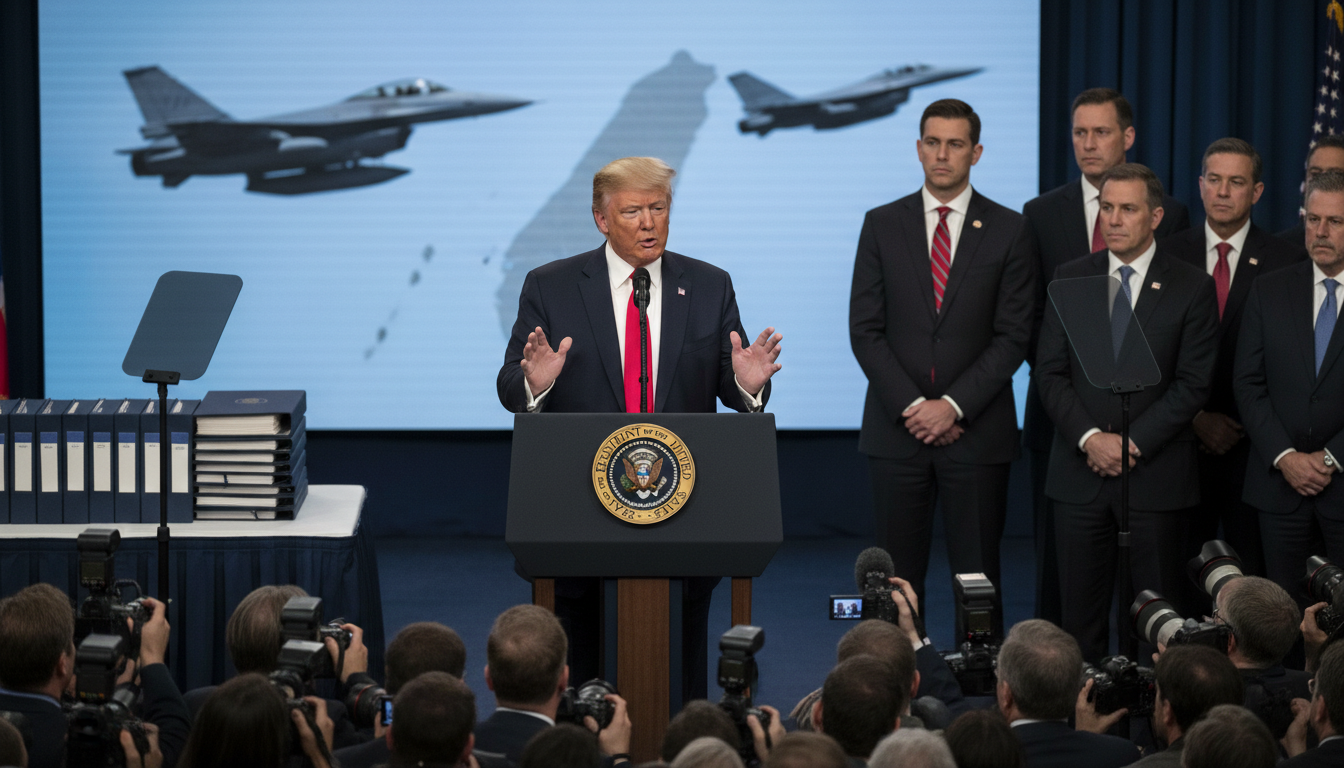
Trump says Taiwan arms sale “depends on China,” calls it bargaining chip
Trump says Taiwan arms sale “depends on China,” calling a $14 billion package a bargaining chip with Beijing, prompting concern in Taipei and Washington.
President Donald Trump said on May 15 that a pending Taiwan arms sale “depends on China,” suggesting approval for the $14 billion package could be used as leverage in talks with Beijing. The remark, made in a FOX News interview and repeated to reporters after his summit with Chinese leader Xi Jinping, signals a potential shift in U.S. practice on Taiwan arms sales. The comments have reignited debate in Washington and Taipei over long-standing norms that have kept such sales free from direct negotiations with China.
Trump frames arms sale as negotiation leverage
Trump described the weapons package as a tool that could be held in reserve depending on Chinese behavior, saying he could either approve or withhold the sale. His comments came after a face-to-face meeting with Xi in Beijing, where he said the topic was discussed in detail. By tying an arms transfer to broader bilateral talks, the administration risks blurring a tacit line that has governed U.S. policy on Taiwan for decades. Critics say the move could make Taiwan’s security contingent on the ebb and flow of U.S.-China relations rather than on statutory commitments.
Details of the proposed $14 billion package
U.S. officials have reported that the package under review would total roughly $14 billion in defense equipment and support for Taiwan. While specific systems have not been publicly confirmed by the White House, such packages typically include surface-to-air missiles, patrol aircraft, and artillery systems designed to bolster Taiwan’s defensive posture. Congressional notification and formal clearance processes remain part of the usual arms sale pathway, but the president’s framing raises questions about whether those steps will proceed on the usual timetable. Taipei’s response has been cautious but firm, underscoring reliance on U.S. assurances.
Departure from decades-old practice of non-consultation with Beijing
Since the Reagan administration articulated the so-called “Six Assurances” in 1982, successive U.S. presidents have followed the practice of not consulting Beijing in advance about arms sales to Taiwan. Trump’s remarks — including a comment that “the 1980s are a long time ago” — suggest a willingness to depart from that precedent. Policy experts warn that consulting China in advance would mark a significant change in the balance between deterrence and diplomacy. Such a shift could complicate relations with Congress and with Taiwanese authorities who view arms sales as a key element of their security.
Talks with Taiwan’s president would risk Beijing backlash
Trump also indicated he might discuss the arms sale directly with Taiwan’s leader, suggesting engagement with President Lai Ching-te. Direct contact between a sitting U.S. president and a Taiwanese president has historically been a sensitive matter that Beijing treats as a challenge to its sovereignty claims. Taiwan’s leaders and diplomats have in the past faced diplomatic pushback from Beijing for elevated exchanges with U.S. officials. Any move to consult Taipei openly about a sale while simultaneously using the package as leverage with Beijing could heighten regional tensions.
Taipei urges Washington to uphold Taiwan Relations Act
Taiwan’s presidential office and foreign ministry issued public statements emphasizing that arms sales are an obligation under the U.S. Taiwan Relations Act, and they urged Washington to maintain its commitments. Taipei framed the arms transfer as part of a legal and security guarantee rather than a bargaining chip, calling for clarity and continuity. Taiwanese officials expressed concern that making approval contingent on bilateral negotiations with China would undermine deterrence and erode trust. Diplomatic sources say Taipei is pressing for both a firm U.S. commitment and clear timelines for delivery.
Ambiguity on U.S. intervention pledge remains intact
Despite his comments on arms sales, Trump reiterated to reporters that he would not spell out whether U.S. forces would intervene in a Taiwan contingency, thereby keeping the longstanding policy of “strategic ambiguity.” That posture, which leaves Washington’s response to hypothetical conflict deliberately undefined, is intended to deter both unilateral moves toward formal independence by Taipei and coercive action by Beijing. Analysts note that while ambiguity remains official policy, treating arms sales as negotiable could nonetheless change Taiwan’s calculus and Beijing’s perceptions of U.S. resolve. Lawmakers in both parties have warned that unpredictability on security guarantees could undermine regional stability.
U.S. and Taiwanese officials now face a narrow window to balance diplomatic engagement with deterrence, as members of Congress monitor the administration’s decisions and Taiwan seeks reassurances. The debate over whether arms transfers should be used as leverage highlights the broader challenge for policymakers trying to manage competition with China while preserving security promises to partners. As the situation evolves, both Taipei and Washington will be watching for concrete steps that indicate whether the administration intends a strategic reorientation or only temporary bargaining posture.

