
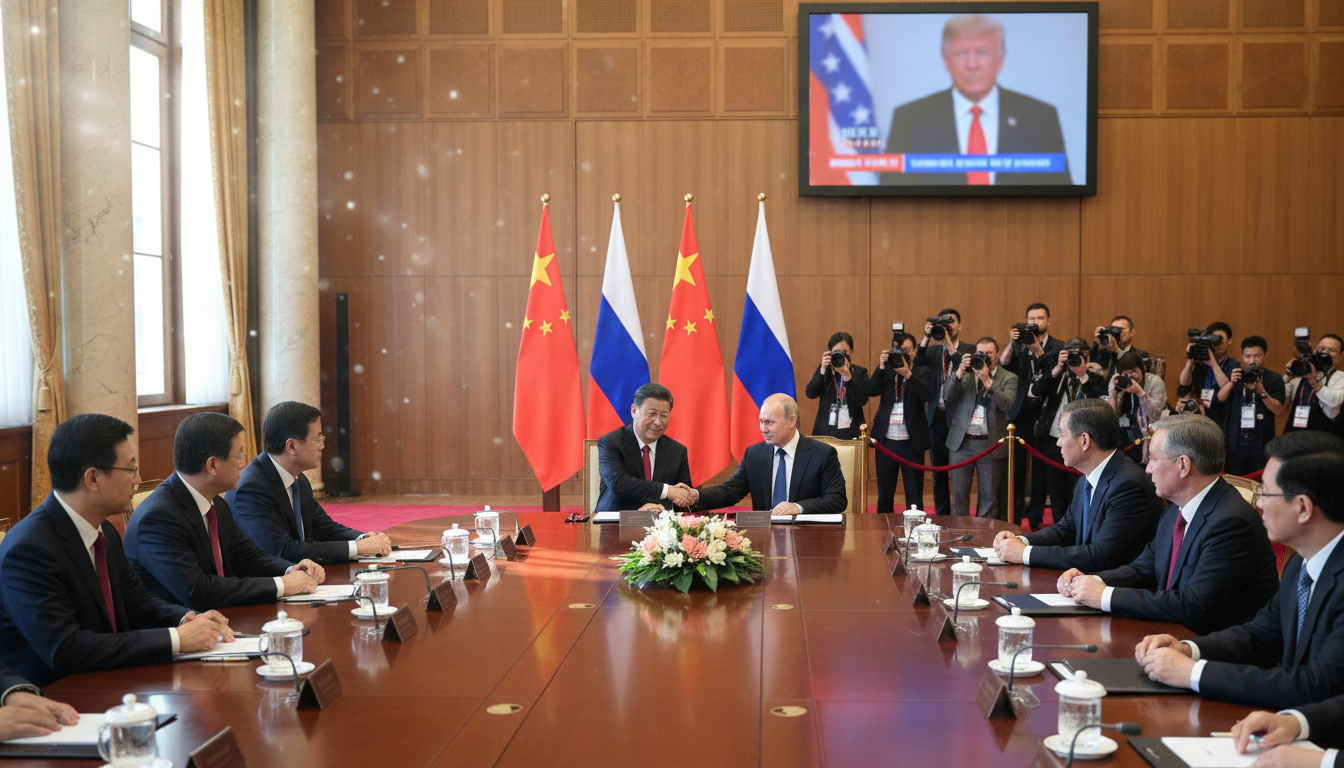
Xi-Putin summit in Beijing underscores closer China-Russia ties days after Trump visit
China and Russia leaders meet in Beijing to discuss strategic cooperation and regional security following U.S. President Donald Trump’s visit.
Leaders meet in Beijing days after U.S. visit
Chinese President Xi Jinping is meeting Russian President Vladimir Putin in Beijing in a summit that reconnects the two capitals just days after U.S. President Donald Trump’s visit to China. The Xi-Putin summit brings the leaders together for high-level talks expected to cover political, economic and security cooperation. Officials from both countries framed the encounter as part of a continuing strategic partnership rather than a response to any single external event.
The timing of the visit underscores the intensifying diplomatic calendar in the region and highlights Beijing’s role as a hub for major bilateral diplomacy this week. While officials have given limited public detail ahead of formal sessions, the meeting is widely viewed as an opportunity to consolidate areas of mutual interest.
Agenda points likely to include energy and trade
Energy cooperation and trade are expected to top the agenda at the Xi-Putin summit, reflecting long-standing ties between Moscow and Beijing. Russia has been a major supplier of oil and gas to China, and both sides have deepened commercial links in recent years through pipelines, commodity deals and currency arrangements.
Economic planners from the two nations are likely to discuss ways to expand trade, investment and joint infrastructure projects as part of a broader effort to insulate commerce from Western sanctions and supply-chain disruptions. Observers say any announcements could range from memorandum-level agreements to longer-term frameworks for increased bilateral business.
Security and military posture to be discussed
Security cooperation and regional stability are also likely focal points for the two presidents, particularly given ongoing tensions in Europe and Asia. Beijing and Moscow have coordinated on defense issues in recent years, conducting joint exercises and exchanging military-technical information, and officials may explore further practical cooperation.
Analysts say the Xi-Putin summit will be watched closely for language on strategic deterrence and crisis management, especially in relation to hotspots such as Ukraine and the Korean Peninsula. Any moves to deepen military coordination would carry diplomatic implications for neighbours and NATO partners.
Signal to Washington and the international community
The summit sends a diplomatic signal to Washington and other capitals about the alignment between China and Russia, observed by many foreign policy experts as a balancing act in global geopolitics. Coming so soon after President Trump’s trip to Beijing, the meeting will be interpreted as part of a broader triangular dynamic among the United States, China and Russia.
Chinese and Russian leaders are unlikely to portray the talks as confrontational, but they may emphasize shared views on sovereignty, development and critiques of external interference. Such framing aims to strengthen public narratives at home while projecting a united diplomatic front abroad.
Regional implications for East Asia and Taiwan
Regional leaders and policy teams in East Asia will be parsing the outcomes of the Xi-Putin summit for implications related to Taiwan, maritime disputes and North Korea. Beijing’s posture on Taiwan is a central concern for many countries in the region, and any coordination with Moscow on related diplomatic messaging could affect crisis calculations.
At the same time, Asian markets and trade partners will monitor whether agreements reached in Beijing influence energy flows, commodity prices or supply-chain routes that directly affect regional economies. Governments in Tokyo, Seoul and ASEAN capitals are expected to review the summit’s communiqués for policy signals.
Limited public details but wide geopolitical interest
Both Beijing and Moscow have released only brief statements ahead of the meeting, providing limited specifics about the schedule and exact topics. This approach is consistent with how major summits are often staged, leaving room for private negotiation and managed disclosure of outcomes.
Despite the paucity of immediate detail, international observers and diplomats emphasize the symbolic weight of face-to-face engagement between the two presidents. The Xi-Putin summit is therefore significant both for immediate policy coordination and for the message it conveys about bilateral priorities.
The leaders’ discussions in Beijing will be followed by analysts and foreign ministries worldwide for any concrete measures on trade, energy supply, defense cooperation or diplomatic alignment. The Xi-Putin summit represents a high-profile moment in Sino-Russian relations and will likely influence diplomatic calculations across multiple regions.

