
Nvidia posts record quarter and lays out plan to capture $200bn CPU market while trimming China data-center outlook
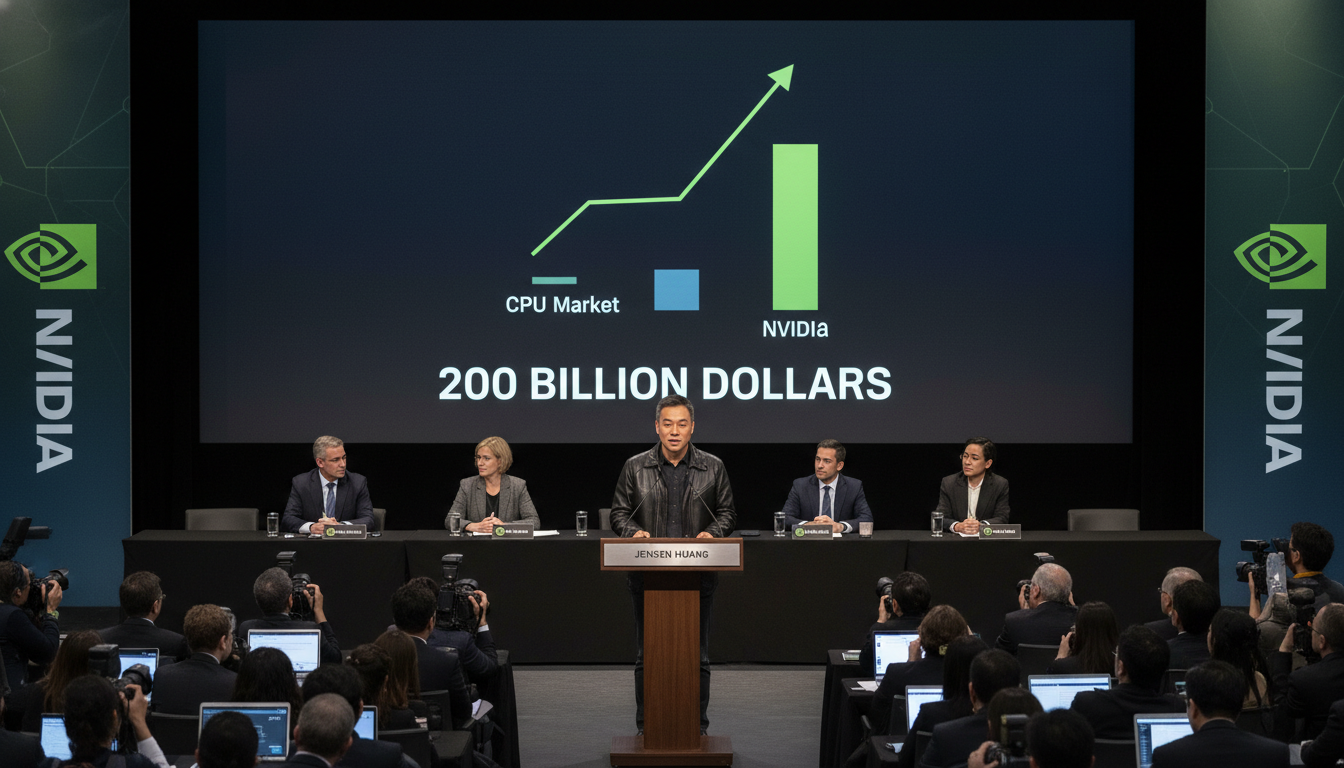
Nvidia reports another record-breaking quarter on May 21, 2026, and signals a strategic push into a $200 billion CPU market while excluding China data center revenue from its near-term outlook.
Nvidia posts record quarterly results
Nvidia on May 21 announced another record quarter, driven by continued demand for artificial intelligence accelerators and related systems. The company said revenue and performance exceeded analysts’ expectations, underscoring robust adoption of its GPU-based AI platforms. Management framed the results as validation of Nvidia’s dominant position in AI computing despite lingering investor concerns about an AI market correction.
The quarterly beat arrived as markets debated the sustainability of AI-driven growth, but Nvidia presented results and commentary that suggested momentum remains strong. The company’s announcement emphasized both near-term strength and longer-term strategic opportunities beyond GPUs.
Outlook excludes China data center revenue
In a notable caveat to its guidance, Nvidia said it would exclude data center revenue from China when framing its near-term outlook. The firm cautioned that demand visibility in China’s data center market remains uncertain and cited regulatory and supply-chain complexities affecting revenue predictability.
By separating China data center revenue from its outlook, Nvidia signaled a more cautious public posture while still acknowledging the region’s strategic importance. Analysts said the move helps investors assess core performance without conflating global and region-specific risks.
Push into CPUs targets $200 billion market
Nvidia reiterated ambitions to expand beyond GPUs and become a leading supplier of central processing units, targeting a roughly $200 billion new market for CPUs and adjacent compute products. The company’s road map aims to broaden its addressable market by integrating CPU, GPU and networking capabilities for AI and cloud workloads.
Executives framed the CPU push as a natural complement to Nvidia’s AI stack, allowing the company to supply more of the foundational compute layers used by hyperscalers and enterprise data centers. If successful, the strategy would intensify competition with established CPU suppliers and reshape pricing and architecture choices across the cloud ecosystem.
CEO Jensen Huang’s diplomatic engagement in Beijing
Nvidia founder and chief executive Jensen Huang traveled with a U.S. presidential delegation to meet Chinese leadership, underscoring the interplay between business strategy and geopolitics. Huang’s participation in the summit highlighted Nvidia’s role as a pivotal technology provider with deep commercial ties to both U.S. customers and Chinese partners.
The trip comes amid heightened U.S.-China tensions over semiconductor exports and market access, which have complicated supply chains and commercial planning for major chipmakers. Nvidia’s public positioning and engagement at the diplomatic level reflect an effort to manage these cross-border pressures while pursuing global growth.
Investor reaction and company guidance
Investors have oscillated between exuberance and caution as AI-related earnings cycles unfold, and Nvidia’s statement addressed both perspectives. While the company’s quarterly performance reassured many stakeholders about underlying demand, the selective exclusion of China data-center revenue from forward guidance injected a note of prudence into its messaging.
Nvidia’s dual approach—highlighting structural opportunities while carving out regional uncertainty—aims to provide clearer expectations for capital markets. Market watchers said the guidance posture will be closely scrutinized in subsequent quarters to gauge the persistence of AI-driven spending and the pace of Nvidia’s CPU rollout.
Implications for suppliers and competitors
Nvidia’s ambitions to take a leading role in CPUs and broader systems-level compute will have ripple effects across the semiconductor supply chain. Suppliers of wafers, packaging, memory and networking components could see shifting demand patterns as the company integrates more functionality into its platforms.
At the same time, incumbent CPU vendors and other chipmakers will likely respond with new products and partnerships to defend market share. The evolving dynamic may accelerate consolidation, strategic alliances and investments in new architectures tailored to large-scale AI and cloud workloads.
Nvidia’s recent quarter and strategic statements therefore matter not only for the company’s near-term results but also for how the industry allocates capital and designs future data-center infrastructure.
Looking ahead, Nvidia faces the twin tasks of delivering on immediate revenue expectations while executing a complex expansion into CPU markets and managing geopolitical uncertainty around China. The company’s May 21 report framed the coming period as one of disciplined growth and calculated risk management as it seeks to convert AI momentum into a broader computing franchise.

