
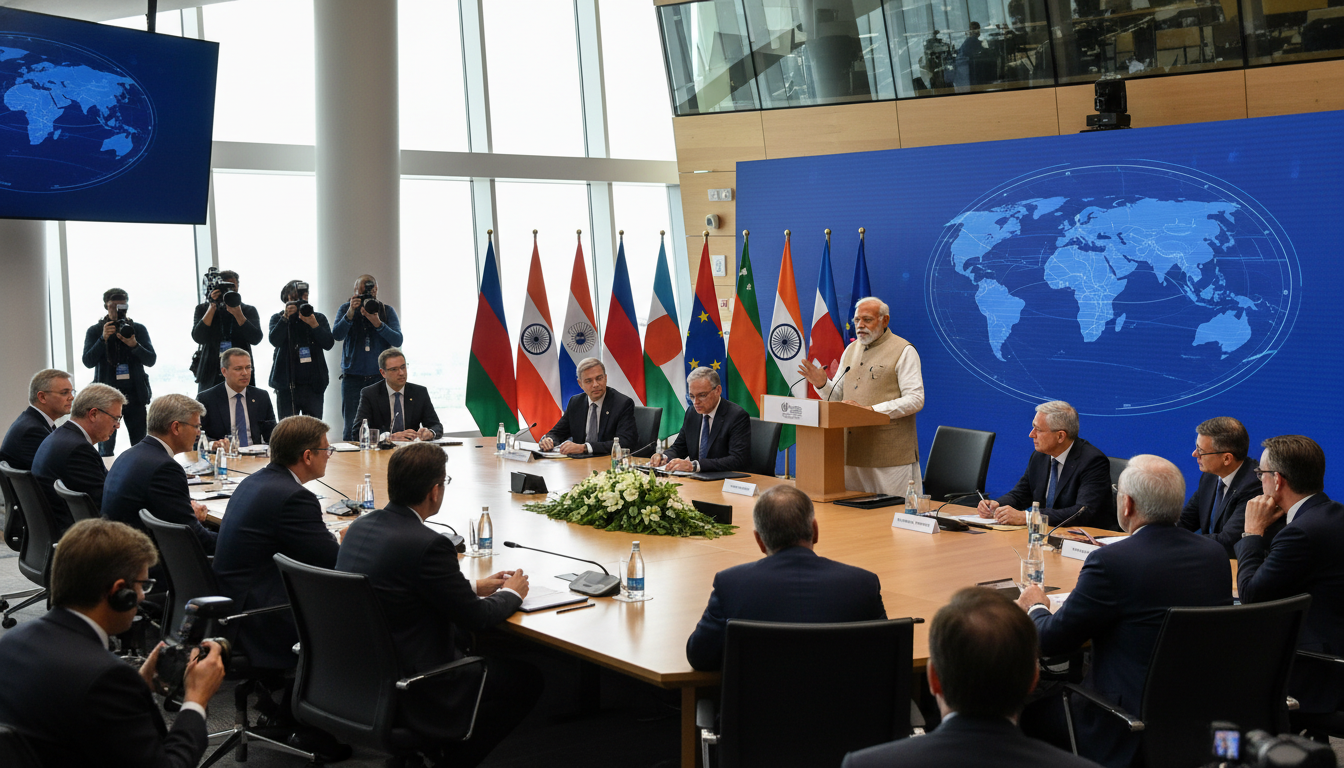
Modi’s European tour underscores India push to diversify supply chains
Modi’s European tour highlights India’s drive to reduce reliance on China and the U.S., securing an ASML-Tata electronics deal and deepening ties with Nordic countries and Italy.
Indian Prime Minister Narendra Modi’s European tour over the past week has sharpened a strategic push to diversify India’s trade and technology partnerships, officials and business leaders say. The trip, which included visits to Nordic capitals and Italy, placed supply‑chain resilience and industrial cooperation at the centre of bilateral talks. Modi’s European tour also saw a landmark commercial move as Dutch chip‑equipment maker ASML agreed terms with India’s Tata Electronics, signalling new momentum in semiconductor collaboration.
Deal with ASML seen as industrial turning point
The agreement between ASML and Tata Electronics was announced during meetings that followed Modi’s engagements in The Hague. Industry executives described the pact as a concrete step toward building higher‑end manufacturing capacity in India and reducing dependence on a narrow set of global suppliers.
Officials said the arrangement focuses on joint production and technology transfer rather than a simple buyer‑seller relationship, with an emphasis on assembling and eventually fabricating components used in lithography equipment. While details on timelines and investment levels remain limited, analysts noted the symbolic importance of the partnership for India’s semiconductor ambitions.
Economic outreach to Nordic nations aimed at diversification
Modi’s schedule included multiple stops in Nordic capitals, where discussions ranged from green technology to defence industrial ties. Delegations at several meetings pushed for expanded cooperation on renewable energy, battery supply chains and critical minerals — sectors viewed as essential to decoupling from single‑source dependencies.
Nordic governments and companies signalled interest in deeper engagement, particularly in research partnerships and clean‑tech investments. Business leaders who accompanied the prime minister stressed that creating alternative supply routes for components and raw materials is now a strategic priority for both sides.
Engagement with Italy broadens industrial and diplomatic agenda
In Rome and other Italian settings, the focus shifted toward manufacturing, defence procurement and advanced engineering collaborations. Modi’s discussions in Italy reinforced a push to link India’s large domestic market with European industrial capacity, offering mutual commercial benefits.
Italian firms raised the prospect of joint ventures in sectors such as aerospace and industrial machinery, aiming to combine European technological know‑how with India’s scale. Diplomats said the Italy leg of the tour also helped consolidate political support for closer economic ties across the European Union.
Business leaders underline urgency to reduce strategic exposure
Corporate representatives travelling with Modi argued that recent global shocks have made diversification an economic imperative rather than a policy option. They urged faster deployment of investment incentives, streamlined regulations and clear procurement policies to attract long‑term manufacturing projects to India.
Several CEOs highlighted the ASML‑Tata arrangement as an example of the type of engagement they want to see scaled up, with more European suppliers establishing local design and production hubs. Private sector sources said predictable policy and protections for high‑tech transfers would be critical to securing further commitments.
Analysts warn about geopolitical balancing and implementation risks
Foreign‑policy experts cautioned that constructing an alternative supply‑chain front will be complex and politically sensitive, given deep trade ties with both China and the United States. They warned that efforts to diversify must be managed carefully to avoid economic disruption and unintended diplomatic strains.
Analysts also pointed to operational hurdles such as technology access, workforce training and the long lead times required to establish sophisticated manufacturing ecosystems. They recommended that Delhi and partner capitals set clear, measurable milestones to assess progress and maintain investor confidence.
Diplomatic follow‑ups and the next phase of cooperation
Officials indicated that the tour will be followed by working groups and ministerial exchanges designed to translate high‑level commitments into contracts and projects. Indian ministries and European counterparts are expected to set timelines for the semiconductor collaboration and for joint initiatives in green technology and critical minerals.
Observers said the real test will be the speed at which agreements are implemented and whether they can attract further private investment. If momentum holds, the tour could mark the start of a sustained campaign to build alternatives to existing global dependencies.
The outcomes of Modi’s European tour reflect a broader strategic recalibration in New Delhi’s external economic policy, balancing the need for market access and technology with the desire for greater autonomy in critical sectors.

