
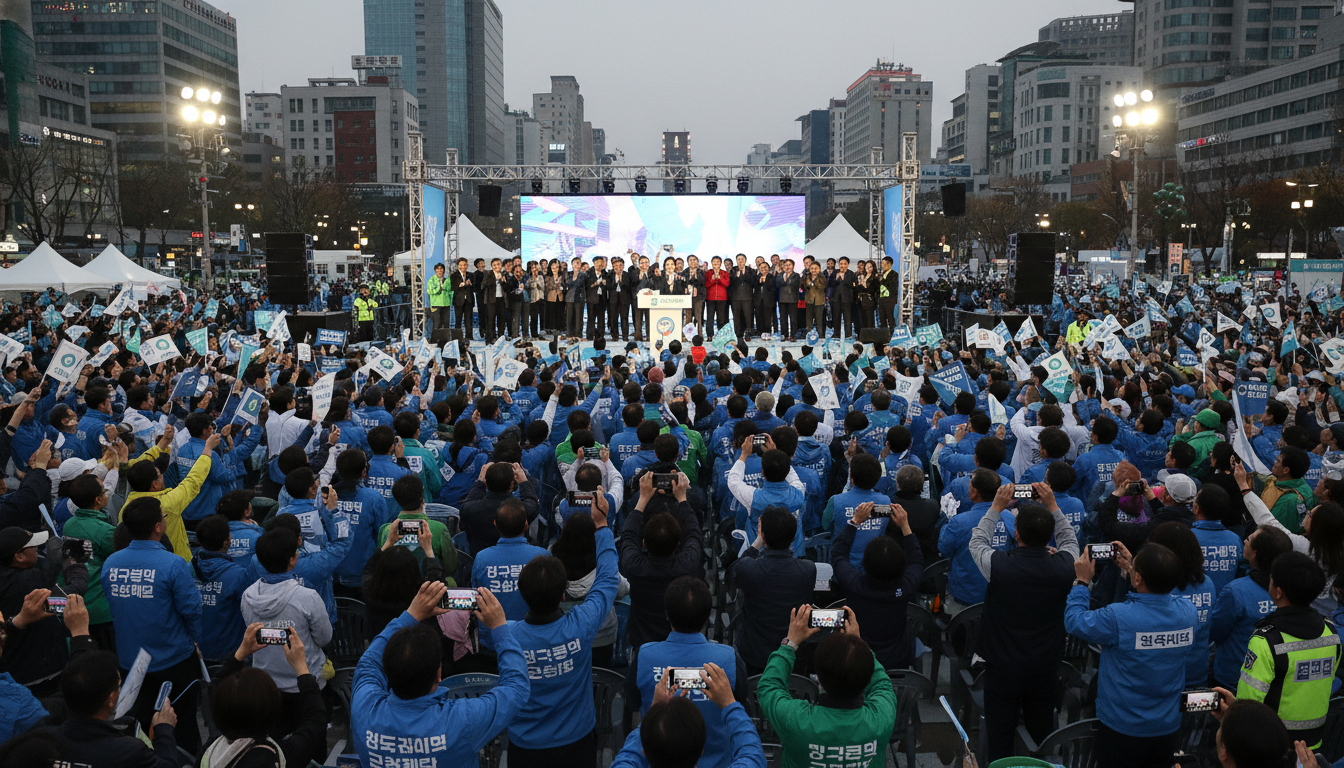
Daegu Mayoral Race Tightens as Progressive Kim Boo-kyum Challenges Conservative Stronghold
A high-stakes Daegu mayoral race pits progressive candidate Kim Boo-kyum against conservative Choo Kyung-ho, testing a decades-long right-wing bastion in South Korea.
City’s Political Identity Under Scrutiny
Daegu has long been viewed as a reliable base for conservative politics in South Korea, where voters traditionally deliver strong support to right-leaning parties.
That history makes the current contest unusually consequential; a win by the progressive candidate would mark a significant break from established voting patterns in the region.
The campaign has sharpened attention on whether local concerns or broader national sentiment will determine the outcome.
Observers say the result could reshape how both major political blocs approach strategy in provincial cities going forward.
Candidates’ Profiles and Campaign Lines
Kim Boo-kyum, running as the progressive challenger, is emphasizing local revitalization, social services, and addressing younger residents’ economic anxieties.
He positions himself as a pragmatic reformer seeking to translate national progressive priorities into concrete city-level policies.
Choo Kyung-ho, the conservative contender, is campaigning on continuity, economic stability, and Daegu’s traditional values.
Choo frames his platform around defending the city’s industrial base and preserving policies that he argues have sustained Daegu’s growth.
Local Issues Driving Voters
Housing affordability, jobs for younger residents, and urban redevelopment have emerged as the central issues shaping voter decisions in Daegu.
Longstanding industrial districts face calls for modernization while residents seek improvements to public services and transport links.
Public sentiment toward national economic management also filters down to municipal choices, with many voters weighing local solutions against wider perceptions of party competence.
Additionally, demographic shifts—an aging population alongside an urbanizing youth cohort—are complicating electoral calculations for both campaigns.
Campaign Tactics and Voter Outreach
Both campaigns have intensified grassroots outreach, deploying town halls, neighborhood visits, and targeted messaging to swing precincts.
Kim’s team is investing in younger voter engagement and social media outreach, aiming to mobilize first-time and infrequent voters.
Choo’s campaign is relying on established party networks, faith-based community ties, and constituency organizations to secure turnout.
Each side is also staging high-visibility events designed to underscore competence on the economy and public safety, core concerns for undecided voters.
Electoral Mechanics and Turnout Considerations
Turnout patterns will be decisive in determining the Daegu mayoral race outcome, with both sides focusing on boosting sympathetic voters while persuading moderates.
Lower turnout historically benefits well-organized parties with reliable voter lists, but a surge among disaffected or younger voters could tilt the balance.
The distribution of support across municipal wards matters as much as citywide totals, prompting tailored campaigning in areas where margins may be tight.
Analysts note that even modest shifts in participation or preference in a few precincts can change the race’s trajectory.
National Political Ramifications
A progressive victory in Daegu would reverberate beyond city hall, signaling potential vulnerabilities for conservative parties in their traditional strongholds.
Such an outcome could prompt national parties to reassess candidate selection, messaging, and coalition-building strategies ahead of future elections.
Conversely, a conservative win would reinforce the status quo and likely be read as an endorsement of the party’s approach to local governance.
Either result will be interpreted by party leaders and campaign strategists as a barometer of public sentiment ahead of larger contests.
The Daegu mayoral race has become a focal point for broader debates about regional identity, generational change, and the balance between local priorities and national politics.
As residents head to the polls, parties on both sides will watch turnout and early returns closely, aware that the outcome could influence political calculations across South Korea.

