
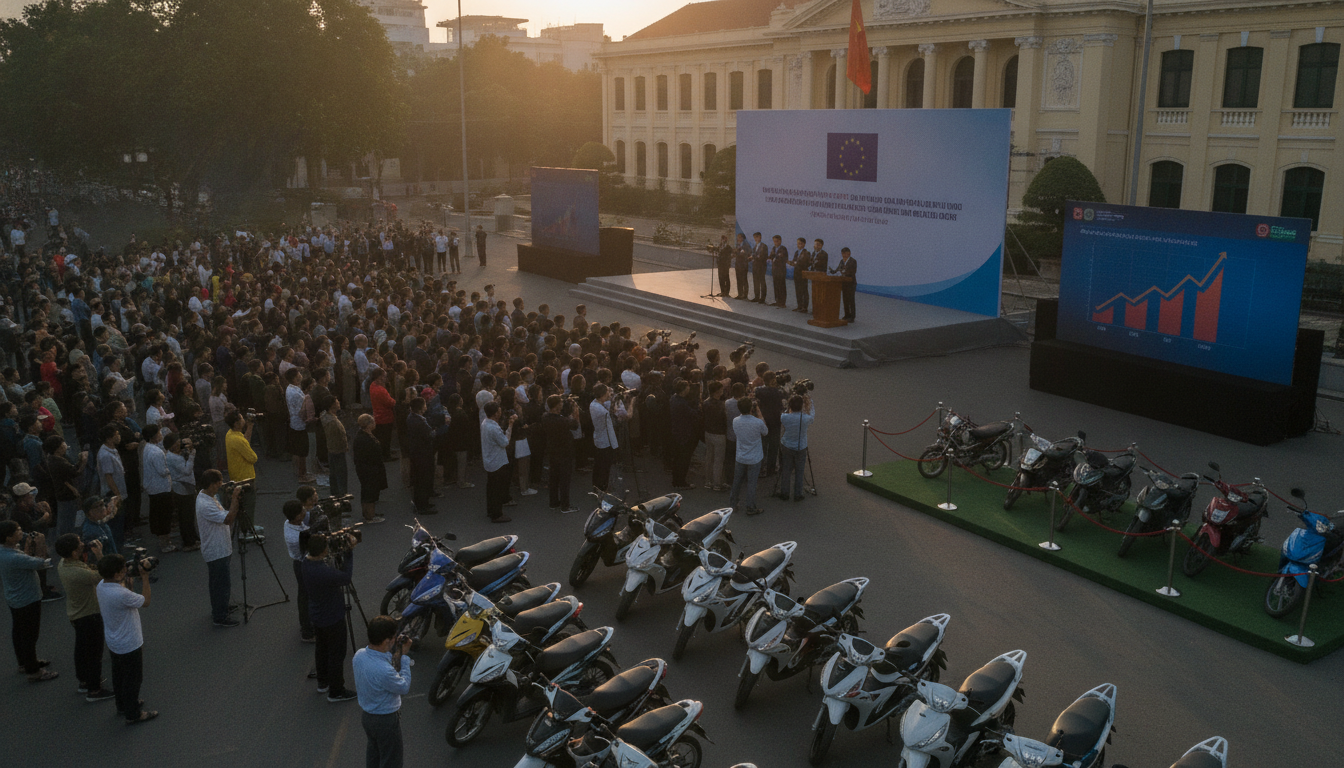
Hanoi softens roadmap for gasoline-powered motorcycles while keeping EU emissions standards
Hanoi has unveiled a revised roadmap to restrict gasoline-powered motorcycles, opting for a slower, more gradual transition that keeps EU emissions standards in place to tackle worsening air pollution without causing abrupt disruption.
Revised plan aims for gradual transition
Hanoi city authorities presented a softened strategy that delays abrupt bans on gasoline-powered motorcycles in favor of phased measures and targeted restrictions.
Officials emphasized the need to balance environmental goals with the daily realities of a city where two- and three-wheeled petrol vehicles remain the primary means of transport for millions.
The revision retains the European Union emissions standards for new vehicles, signaling that tighter pollution limits will persist even as the timeline and enforcement approach are adjusted.
Motivation: air quality and public pressure
Air pollution in Hanoi has become a recurrent public-health and policy concern, with authorities citing transport as a major contributor to urban smog.
City officials said the move to curb gasoline-powered vehicles forms part of a broader effort to reduce local emissions while avoiding sharp shocks to commuters and informal economies.
Keeping EU standards sends a strong regulatory signal that new motorcycles must meet stricter emission thresholds even as the phase-out pathway becomes more measured.
Practical challenges in a motorbike-dominated city
Motorbikes dominate Hanoi’s streets and are integral to livelihoods, from delivery riders to small-scale vendors, complicating any rapid restriction on gasoline-powered motorcycles.
City planners acknowledged logistical hurdles including vehicle turnover rates, limited access to affordable electric alternatives, and the need for expanded charging and battery infrastructure.
Officials said the revised roadmap will seek to gradually incentivize cleaner models and improve public transport options rather than impose sudden prohibitions.
Economic and social considerations for riders
Policymakers flagged potential economic hardship for lower-income riders and small repair businesses if gasoline-powered motorcycles were removed too quickly.
The softer approach is intended to allow time for subsidies, trade-in schemes, and vocational support so affected workers can transition to electric vehicles or alternative employment.
Analysts warn that without concrete support measures, enforcement alone risks deepening inequality and disrupting informal urban transport networks.
Implementation measures and enforcement signals
The revised roadmap outlines a mix of regulatory standards and phased restrictions, combined with pilot zones and targeted bans in high-pollution districts.
Authorities plan to pair these measures with incentives for electric motorcycle adoption, investments in charging infrastructure, and improvements to bus and rail services to absorb commuter demand.
Enforcement will reportedly focus first on new vehicle sales and emissions inspections, while broader curbs on existing gasoline-powered motorcycles will be paced to allow market adjustments.
Regional and environmental implications
Hanoi’s decision reflects a growing trend in Asian cities to address transport-related pollution while managing social and economic trade-offs.
By retaining EU emissions standards, the city signals alignment with international benchmarks that could influence manufacturers, import policies, and regional supply chains for cleaner motorcycles.
Environmental advocates welcomed the continued adoption of stringent emissions criteria, while urging clearer timelines and concrete measures to accelerate the shift to zero-emission transport.
The revised roadmap represents a pragmatic recalibration that seeks to reconcile Hanoi’s urgent air-quality challenges with the everyday mobility needs of its residents, leaving detailed sequencing and support mechanisms to forthcoming municipal regulations and stakeholder consultations.

