
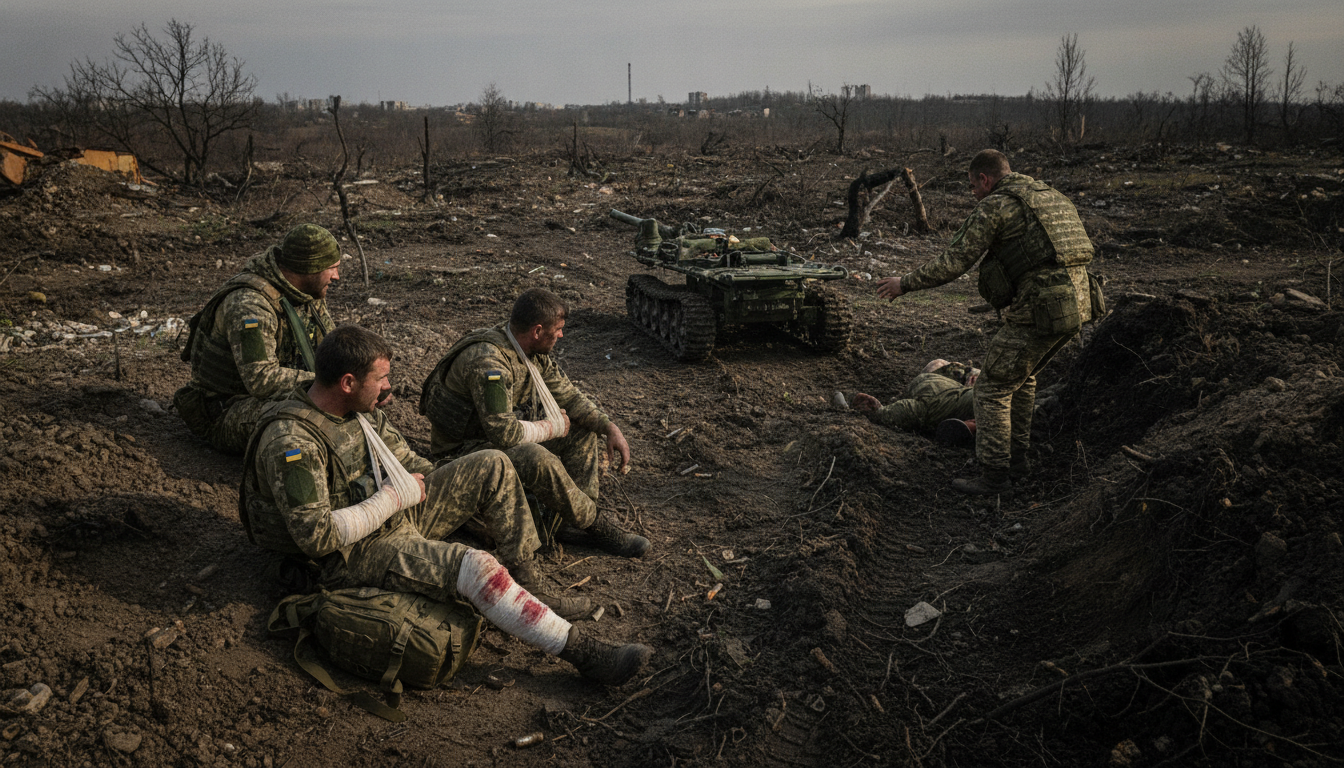
Wounded Soldiers in Eastern Ukraine Wait for Unmanned Ground Vehicles as FPV Drone Threats Rise
Wounded soldiers in eastern Ukraine face delayed evacuations as unmanned ground vehicles are deployed to lower exposure to FPV drones and frontline fire.
Russian and Ukrainian front-line firefights have forced medics and commanders to rely increasingly on unmanned ground vehicles to retrieve the wounded, but delays and new battlefield threats are complicating casualty care. On April 26, an artilleryman from Ukraine’s 32nd Brigade, Roman Kryshnya, was critically injured when a first-person view (FPV) drone struck the vehicle he was riding in near the front; the driver was killed and Kryshnya sustained catastrophic arm injuries. Military medics say that waiting for UGVs to clear landing zones or traverse contested ground can extend the time injured soldiers spend exposed to secondary strikes, creating a fraught trade-off between speed and safety.
Front-line evacuation delays
Front-line units report that traditional casualty evacuation under fire has grown riskier as small, low-flying drones and artillery complicate movement. Medics who once raced to extract wounded by vehicle or on foot now often hold position until an unmanned ground vehicle can be sent, according to battlefield accounts. That pause can mean the difference between life and death for critically injured personnel, and commanders must weigh the immediate danger of exposure against the potential for a safer robotic retrieval.
The risk calculus has shifted because adversaries increasingly use FPV drones to target convoys and ambulances, while artillery and mortar fire remain constant threats. In some sectors, remote retrieval is seen as the only way to limit further casualties among medics and drivers. However, UGVs are not a panacea: terrain, mines, and electronic warfare can limit their usefulness and delay response times.
FPV drones and new battlefield hazards
FPV drone strikes have emerged as a notable threat to personnel and vehicles along the front, often delivering explosives with precision at close range. These drones are small, agile and difficult to detect with traditional air-defense systems designed for larger aircraft. The result has been a marked change in how forces plan movement and medical response near the front lines.
Operators on both sides are adapting tactics to mitigate drone risks, including dispersal of vehicles, camouflage measures, and stricter movement windows. Yet when a soldier is gravely wounded, those adaptations often translate into longer waits for recovery teams or for unmanned systems to be deployed, increasing the window for secondary attacks or environmental exposure.
Soldiers’ experiences and medical consequences
First-hand accounts from the front describe the psychological toll of waiting for remote retrieval systems while injured and exposed. Wounded soldiers report fear, confusion and the physical agony of delayed treatment when an evacuation convoy is held back until a UGV can secure the route. In Kryshnya’s case, the severity of his injury and the volatile conditions around the site illustrate the urgency that medics face on a daily basis.
Medical staff note that delays in evacuation complicate immediate life-saving procedures such as hemorrhage control and airway management. Field medics perform critical interventions under fire when possible, but prolonged extraction times can worsen outcomes, increase infection risk and complicate later surgical treatment. The tension between protecting medical teams and delivering rapid care is a persistent feature of the current battlefield environment.
Military adoption of unmanned ground vehicles
Armed forces on both sides have accelerated procurement and field trials of unmanned ground vehicles to reduce human exposure to frontline hazards. These platforms range from small, remote-controlled stretchers to larger robotic machines designed to tow casualties to safety. Commanders say UGVs can operate in conditions too dangerous for crewed vehicles and can be fitted with cameras, sensors and defensive systems to navigate contested terrain.
Despite rapid adoption, UGV deployment faces logistical and operational constraints. Limited battery life, communication vulnerabilities and the need for skilled operators restrict how quickly and widely robots can be used. Units also report challenges integrating unmanned systems into established casualty evacuation protocols, requiring new training and coordination between combat, medical and technical teams.
Operational challenges and safety concerns
The introduction of unmanned ground vehicles has raised questions about reliability and battlefield ethics, including how robots fare under artillery, electronic jamming or improvised explosive devices. Mines and rough terrain can immobilize a UGV, leaving wounded personnel stranded farther from help than before. Additionally, adversaries may target robotic retrievals precisely because they signal the presence of injured soldiers.
Commanders balancing these factors often set strict rules of engagement for UGV missions, prioritising assessments of route safety and enemy activity. The decision to wait for a UGV instead of attempting a rapid human evacuation is increasingly shaped by real-time reconnaissance, drone surveillance and battlefield communication, but the unpredictable nature of combat still forces split-second choices.
Training, maintenance and future improvements
Military officials say that to maximise the effectiveness of unmanned ground vehicles, investing in operator training, spare parts logistics and resilient communications is essential. Improved sensors, longer-range power systems and better obstacle-negotiation software could reduce mission failures and shorten evacuation times. Some units are experimenting with hybrid approaches that pair UGVs with aerial drones to scout routes and provide overwatch during retrievals.
Innovation also includes modular designs that enable quick adaptation for medical loads, ammunition resupply and casualty transport. As systems mature, commanders hope response times will shrink and fewer wounded will be forced to wait in exposed positions. Nonetheless, integrating these technologies into a chaotic battlefield remains a work in progress.
The conflict in eastern Ukraine continues to underscore the difficult trade-offs between speed and safety in casualty evacuation. As unmanned ground vehicles are more widely deployed, commanders, medics and engineers will be pressed to adapt tactics and technologies to ensure that wounded soldiers receive timely care without putting rescue teams at undue risk.

