
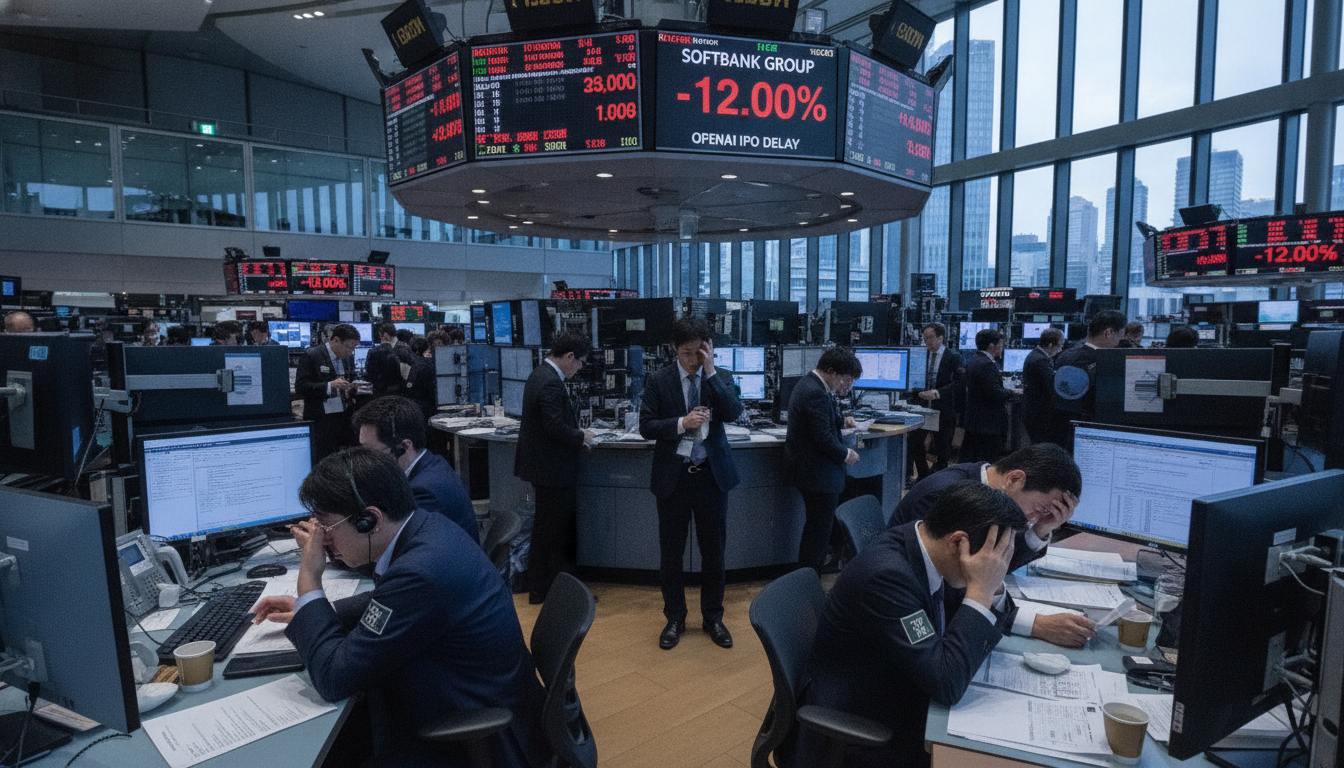
SoftBank Group Shares Tumble After Report OpenAI IPO May Be Delayed
SoftBank Group plunged more than 12% on June 26, 2026, after a report that OpenAI is considering postponing its market debut, dragging the Nikkei average down about 4% and rattling Asian tech investors. The share slump came as investors moved to take profits on holdings tied to artificial intelligence and growth equities. Market participants said the uncertainty around the OpenAI IPO amplified existing concerns about stretched valuations across the technology sector.
SoftBank Group Shares Fall More Than 12%
SoftBank Group shares fell sharply on the Tokyo market, marking one of the largest single-day declines for the conglomerate in recent sessions. Traders cited the report about OpenAI as the immediate trigger, given SoftBank’s high-profile bets in AI-related ventures and visibility in global tech investing.
The drop reflected both a direct reassessment of exposure to a potential OpenAI listing and broader risk-off positioning among momentum investors. Selling appeared concentrated in large-cap tech names, where rapid gains earlier in the year prompted profit-taking.
Tech Stocks Pull Nikkei Down Around 4% as KOSPI Drops 6%
The weakness in SoftBank coincided with a wider sell-off in technology shares that pushed the Nikkei average down roughly 4% on the day. South Korea’s benchmark KOSPI declined about 6%, amplifying losses across regional markets and highlighting investor sensitivity to AI-related headline risk.
Declines were strongest among companies with direct or perceived links to generative AI and cloud services. The move late in the trading week erased part of the earlier run-up in tech valuations and injected caution into Asian equity markets heading into the weekend.
Profit-Taking and Positioning Explain Immediate Investor Response
Market participants described the initial reaction as classic profit-taking intensified by headline risk, rather than a reassessment of long-term fundamentals. Investors who had chased recent momentum were among the quickest to reduce positions, according to brokers familiar with trading flows.
Hedging activity and stop-loss orders likely exacerbated intraday volatility, particularly in high-beta names. The result was a cascade of selling pressure across a narrow subset of growth stocks that had driven index gains in prior weeks.
OpenAI IPO Report Sparks Uncertainty Over Timing and Valuation
The report that OpenAI may delay any planned initial public offering introduced fresh uncertainty about the timing of a widely anticipated deal. Market participants had priced in the possibility of a large, high-profile US listing that could set new benchmarks for AI company valuations.
A postponement would leave investors re-evaluating expectations for near-term liquidity events tied to major AI investments. For companies and investment vehicles positioned to benefit from an OpenAI listing, the delay could mean a prolonged window of valuation reassessment and strategic recalibration.
Implications for SoftBank’s Strategy and Regional Markets
SoftBank Group’s decline underscored how single-company headlines can ripple through diversified investment houses with concentrated thematic exposure. The conglomerate’s public stance and prior investments in AI-related ventures have increased its sensitivity to developments around flagship AI firms.
Regional market volatility may lead asset managers to reassess allocation to tech-heavy strategies in the near term. Policy makers and central banks were not reported to have intervened, leaving price discovery to market mechanisms and investor sentiment into the close of the trading week.
Where Markets Might Move From Here
Traders said the path forward will hinge on clarity from OpenAI and any official statements regarding an IPO timetable, alongside broader economic data and corporate earnings. If the reported delay is confirmed, markets could treat the move as a temporary adjustment that lifts over time as fundamentals reassert themselves.
Conversely, renewed uncertainty or additional negative headlines could prolong risk aversion and weigh on liquidity-sensitive parts of the market. For now, investors appear focused on re-establishing risk limits and waiting for concrete signals on the status of major AI-related listings.
SoftBank Group’s stock move and the accompanying market reaction illustrate how concentrated narratives around new technology leaders can rapidly reshape investor behavior. As trading resumes next week, market participants will be watching for confirmations from company reports and for any shifts in investor positioning that could either amplify or dampen the recent volatility.

