
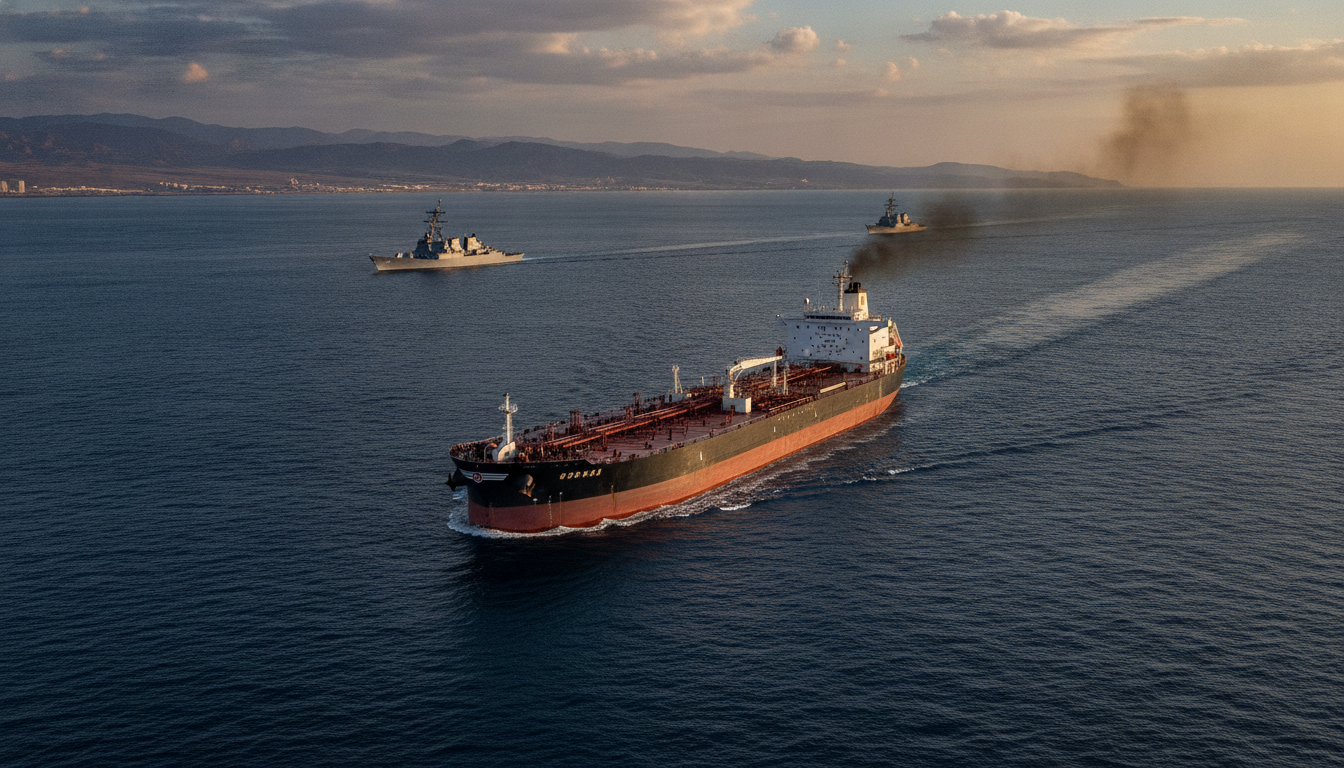
Japanese tankers reroute and idle as U.S.-Iran exchanges resume
Resurgent U.S.-Iran hostilities have forced Japanese tankers to change course, slow or anchor, with MarineTraffic and PortWatch data showing interrupted voyages and reduced Strait of Hormuz transits.
The renewed exchanges between the United States and Iran have disrupted routings for Japanese tankers, forcing operators to delay or alter voyages to avoid high-risk areas. MarineTraffic vessel-position data and industry trackers show an Idemitsu Kosan-linked very large crude carrier (VLCC), Apollo Energy, and a Nippon Yusen supertanker, Tenki, changing speed and course in June and July. These movements underscore how maritime security tensions translate quickly into operational choices for ships carrying crude bound for Japan.
Apollo Energy alters long-range course after leaving Tomakomai
MarineTraffic records indicate the Apollo Energy departed Tomakomai in early June and, after transiting the Malacca Strait around June 20, set a course that took it toward the Cape of Good Hope rather than the Persian Gulf. The vessel’s apparent decision to aim for the Atlantic approaches suggests operators were seeking to avoid passage near the Strait of Hormuz amid renewed threats. Such a detour adds significant distance and voyage time compared with the usual Middle East–Japan shuttle.
The VLCC’s recent movements diverged from its prior pattern of regular two-month rotations between the Middle East and Japanese ports. The ship had made round trips to Saudi Arabia earlier in the year, but lingered in Japanese coastal waters after the initial U.S.-Iran outbreak, making the June–July long-haul its first extended voyage since hostilities escalated. That context helps explain why the vessel’s charted routing drew attention from analysts and market watchers.
Vessel pauses and reversals coincide with flare-ups in Gulf
On June 23 the Apollo Energy dramatically reduced speed and remained stationary in the Indian Ocean west of Sumatra, a behavior consistent with vessels waiting out a security lull. After a period ashore and apparent easing, it steamed again toward the Middle East and by July 6 had reached waters near Sri Lanka. Renewed exchanges between U.S. and Iranian forces around July 10 coincided with another speed reduction and an eastward return; as of July 15 the ship had reported positions back toward the Malacca Strait.
Those stop-and-start movements mirror a pattern seen across the fleet: ships will advance toward the Persian Gulf when perceived risk falls, but are prepared to slow, anchor or divert rapidly when tensions spike. For long-haul crude carriers, the choice to pause at sea can reflect a calculation about safety, insurance exposure and the economics of a risky transit.
NYK tanker Tenki slows off Oman, appears to loiter offshore
A Nippon Yusen (NYK) supertanker, Tenki, also adjusted its operations in late June and early July. After departing waters near Malaysia toward the Middle East in late June, Tenki reached the approaches off Oman by July 10 but then sharply reduced speed amid the renewed exchanges. Its filed destination remains an Omani port located seaward of the Strait of Hormuz, but AIS positions show the vessel spending extended time offshore rather than proceeding into the strait.
Such offshore loitering is a common precaution when crews, owners and charterers are weighing the risk of passage through a narrow, contested waterway. The choice to await better conditions or further instructions can protect crew and cargo, but it also contributes to delays and scheduling uncertainty for refiners and traders reliant on timely deliveries.
PortWatch data shows drop in Strait of Hormuz transits
Aggregated monitoring by PortWatch, a vessel-tracking platform used by international agencies and market observers, shows Strait of Hormuz traffic rebounded only partially after a brief lull. PortWatch reported that transits recovered to roughly 30 percent of normal levels following a ceasefire understanding, but that the volume fell again once exchanges resumed in early July. The data point highlights how quickly maritime throughput responds to security developments.
The uneven recovery of transit numbers underscores the fragile nature of commercial navigation in and out of the Persian Gulf while hostilities are unresolved. Even modest fluctuations in passage rates can ripple through global crude flows because the strait is a chokepoint for a substantial share of seaborne oil exports.
Rerouting around Africa raises time and cost for oil shipments
When operators elect to bypass the Gulf and sail via the Cape of Good Hope, voyages lengthen by weeks and fuel and charter costs rise accordingly. For Japanese refiners and fuel suppliers this translates into higher delivered costs or the need to tap alternative inventories. A single VLCC reroute can affect scheduling across a chain of shipments, pushing refiners to rebook slots and adjust processing plans.
Insurance and war-risk premiums also increase when ships transit contested regions, prompting owners to seek routes that reduce exposure. That economic calculus — balancing route length, premium hikes and potential delays — is now an active part of voyage planning for Japanese tankers serving the country’s import needs.
Insurers and shippers heighten caution amid maritime uncertainty
Shipowners, charterers and insurers report heightened vigilance, with many adopting conservative operational measures such as slower speeds, offshore standby and alternative port calls. War-risk surcharges and contingency clauses in charter parties are being revisited, and data platforms like MarineTraffic have become central tools for real-time decision making. Governments and maritime agencies are likewise stepping up monitoring and advisories to help commercial operators assess risk.
For Japan, whose energy imports remain heavily reliant on seaborne crude, these operational adjustments present a test of supply-chain resilience. Industry contacts say companies and authorities will continue to coordinate closely, balancing safety imperatives with the need to maintain fuel flows to domestic refineries and consumers.
The situation remains fluid and dependent on developments in the U.S.-Iran exchanges, with Japanese tankers likely to continue adapting routes and schedules as events unfold. Close tracking of vessel positions and transit statistics will be essential for companies and policymakers managing the impact on Japan’s energy supplies.

