
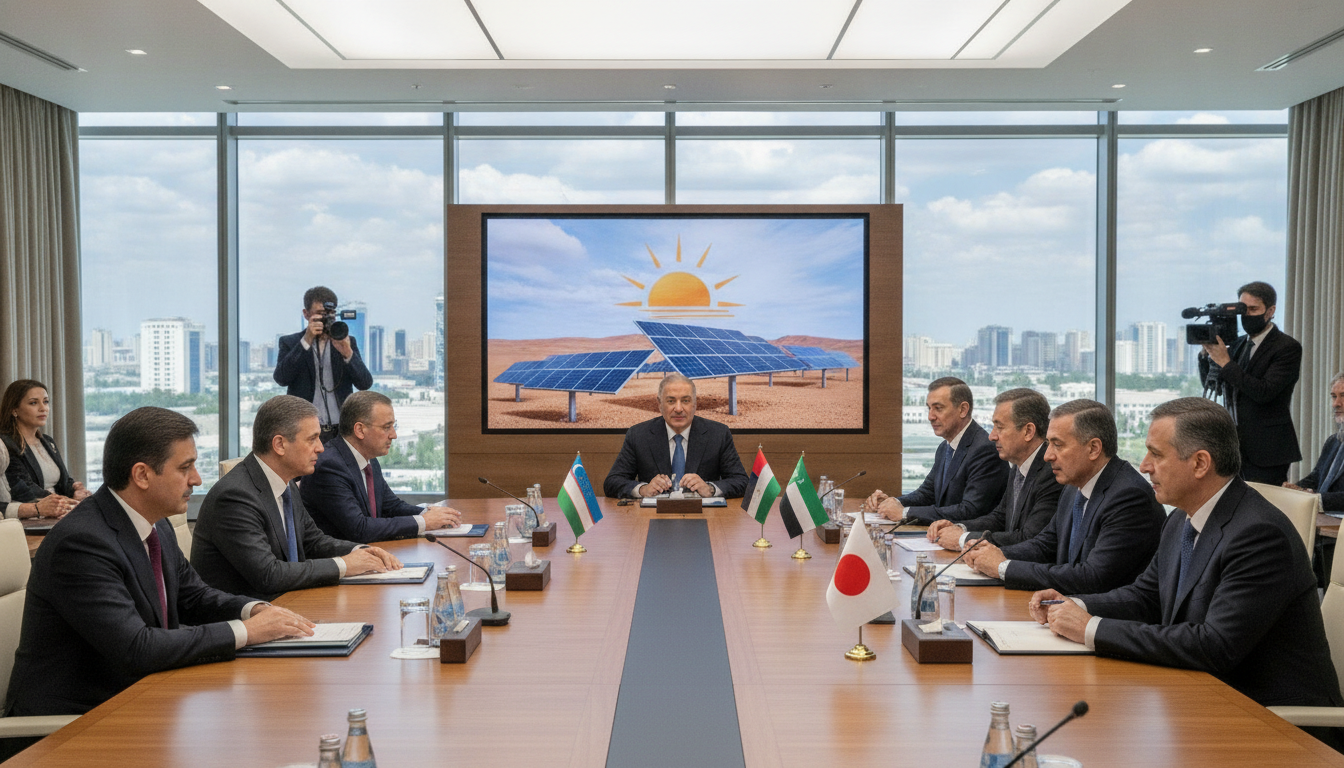
Uzbekistan Renewable Energy Boom Draws Saudi, UAE and Japanese Investors
Uzbekistan renewable energy is attracting a surge of foreign capital as Saudi, UAE and Japanese companies move into large-scale solar and wind projects, transforming the country’s power mix since 2020.
Rapid influx of green deals since 2020
When regional executives describe the flow of clean-energy agreements into Uzbekistan after 2020, they call it a tsunami of investment. The country’s combination of policy shifts and abundant solar resources has prompted international developers to sign and plan projects at an unprecedented pace.
The wave of deals has covered both utility-scale solar and emerging wind farms, with governments and private firms from the Gulf and East Asia taking leading roles. This momentum has refocused investor attention on Central Asia as a practical market for renewable energy deployment.
Gulf and Japanese capital take the lead
Major energy groups from Saudi Arabia and the United Arab Emirates have been among the first movers, bringing financing capacity and project experience. At the same time, Japanese companies have shown interest in technology transfer, financing structures and long-term power purchase arrangements.
Regional developers emphasize that this mix of investors — from sovereign-backed Gulf funds to experienced Japanese utilities — creates diverse funding and operational expertise. That mix is helping accelerate construction timelines and reduce project risk for large photovoltaic and wind installations.
Solar potential underpins project economics
Uzbekistan benefits from more than 300 days of sunshine annually, making solar power especially attractive for large-scale plants. Developers point to high irradiance and relatively flat land as core economic drivers that cut levelized costs and shorten payback periods.
Combineable with declining panel and inverter costs, those natural advantages have made Uzbekistan one of the more compelling markets in Central Asia for renewable energy. Investors say that reliable sunlight data and straightforward land availability have turned theoretical potential into bankable projects.
Key players and announced projects
Regional firms with a track record in the Middle East and Asia are reported to be advancing multiple bids and contracts in the country. Project sponsors are structuring deals that include construction, operation and long-term power sales to local utilities and industrial customers.
Some of the investments are being presented as public-private partnerships, while others are pure private ventures backed by export-credit agencies and multinational development banks. The combination aims to spread construction risk, secure favorable financing, and ensure technical oversight through the build-and-operate phases.
Grid integration and infrastructure challenges
Despite the investment momentum, integrating intermittent solar and wind generation into Uzbekistan’s grid poses practical challenges. Grid upgrades, transmission expansion and better demand-management systems are needed to accommodate large volumes of variable power.
Officials and developers acknowledge that new transmission lines and substation capacity must be prioritized to avoid curtailment and to maximize the value of renewables. Coordinated planning between ministries, utilities and investors will be critical to match generation growth with grid reinforcement.
Economic and social implications for Uzbekistan
The inflow of renewable projects is expected to generate jobs in construction, operations and maintenance, and to develop local supplier networks. Authorities are promoting the deals as a pathway to diversify the economy and reduce reliance on fossil fuel-fired power.
Local capacity building is also a stated goal, with many investors proposing training programs and joint ventures to increase domestic participation. For Uzbekistan, the renewable push aligns with broader objectives to attract foreign direct investment and modernize its energy sector.
Financing models and regional cooperation
Deal structures vary from power purchase agreements to build-own-operate contracts backed by long-term off-takers. Gulf sovereign wealth and energy firms bring deep pools of capital, while Japanese banks and trading houses contribute project finance expertise and equipment sourcing.
Regional cooperation is emerging as an enabler, with cross-border financing and shared technical assistance helping smaller developers meet international standards. This blended-finance approach reduces single-party exposure and helps projects secure the credit ratings needed for cheap long-term capital.
With multiple investors racing to lock in sites and contracts, Uzbekistan renewable energy has moved from potential to momentum in a short span of years. The combination of strong solar resources, diverse foreign capital and supportive policy has positioned the country as a new hotspot for green power investment.
As projects transition from planning to construction, the coming 12 to 24 months will be decisive for how quickly new solar and wind capacity comes online and how effectively the grid is prepared to absorb it. Policymakers, developers and financiers say coordinated action now will determine whether the current surge becomes sustained growth for Uzbekistan’s power sector.

