
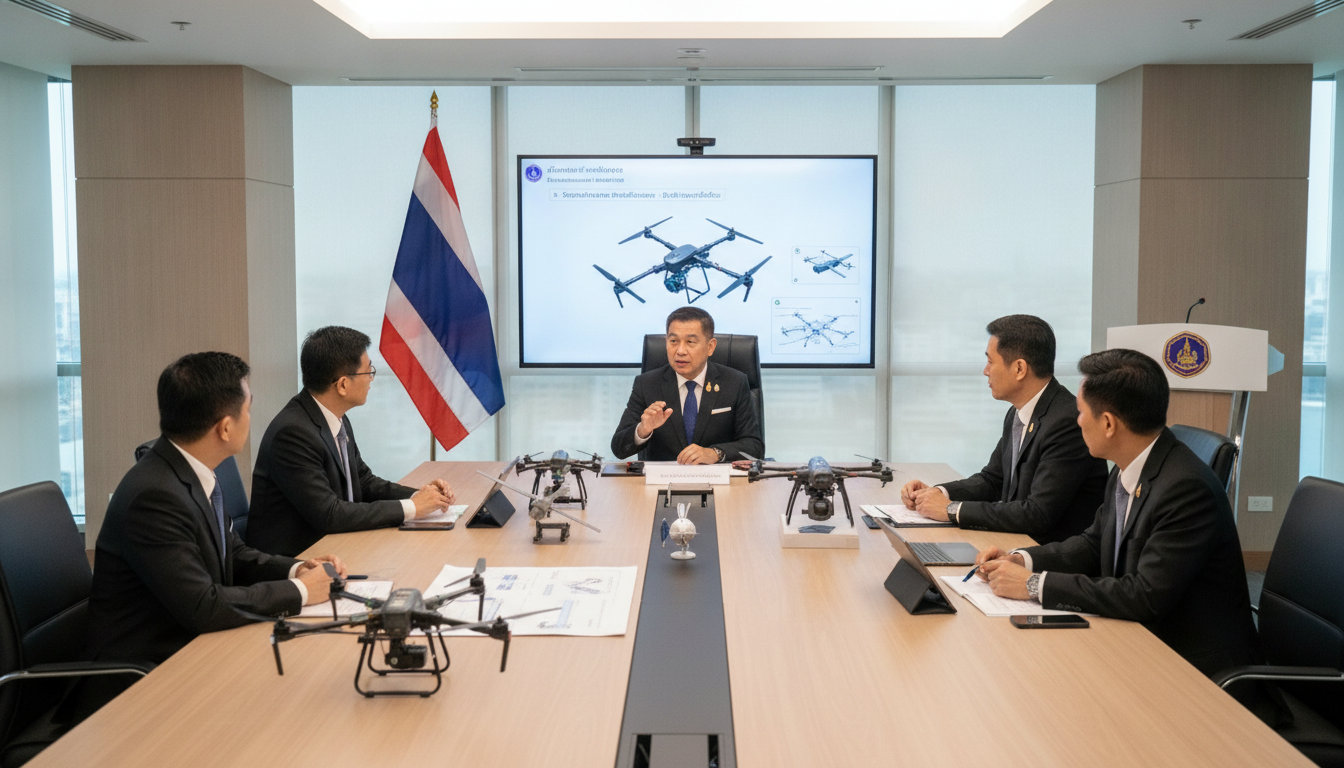
Thailand local defense procurement drive draws drone and satellite firms into military market
Thailand boosts local defense procurement, spurring drone and satellite firms to seek military contracts as policy, certification and export hurdles grow.
Thailand’s stepped-up push for local defense procurement has opened new business avenues, with agricultural drone makers and satellite service providers increasingly pursuing military contracts. The policy shift toward buying domestically produced equipment is reshaping supplier strategies and drawing attention at recent defence exhibitions in Bangkok. Companies that once focused on civilian markets are now adapting technologies and business models to meet ministry requirements for national security purchases.
Government sets procurement targets to boost local industry
The Thai government has signalled a strategic intent to increase the share of defence spending awarded to domestic firms, prompting ministries and state agencies to align procurement rules with that objective. Officials say the move aims to strengthen the local industrial base, preserve jobs and reduce reliance on foreign suppliers for critical systems.
This policy has introduced new procurement mechanisms and preferences for locally manufactured items, creating predictable demand that companies can plan around. However, exact targets and implementation timetables remain under discussion, and businesses are watching policy guidance closely for clarity on contract sizes and qualification criteria.
Civilian drone makers pivot toward military orders
Manufacturers of agricultural and commercial drones are among the fastest to pivot, citing overlapping technical capabilities such as payload integration, endurance and remote-control systems. Firms that previously sold to farmers or logistics firms now see a viable market in surveillance, logistics support and force-multiplication roles for the armed forces.
The transition involves more than repackaging hardware; companies must adapt to different operational standards, hardened communications and upgraded software for secure mission profiles. Several small and medium enterprises have begun hiring engineers with defence experience and forming partnerships to bid for tenders that previously favoured foreign suppliers.
NacDrone outlines plans after Bangkok defense expo
At a defense industry exhibition in Bangkok in early July, NacDrone’s CEO Asawin Rompasert showcased the company’s intention to move from agricultural applications into defence contracts. Company representatives described demonstrations of modified airframes and mission systems designed to meet surveillance and tactical logistics roles for security forces.
NacDrone’s presence at the exhibition underlines how civilian-focused companies are using industry shows to secure pilot projects and build relationships with procurement officials. Executives say early-stage pilot contracts or government-backed test programmes are essential first steps to winning larger, long-term military orders.
Certification, testing and procurement timelines pose obstacles
Industry executives caution that meeting military certification and testing standards is time-consuming and costly, creating a bottleneck for firms seeking rapid entry into defence markets. Requirements for electromagnetic compatibility, secure communications and interoperability can substantially extend development cycles compared with civilian products.
Procurement processes themselves can be lengthy and bureaucratic, with multi-stage evaluations, field trials and oversight from defence agencies and parliament on larger expenditures. Smaller suppliers say they need clearer timelines and streamlined testing frameworks to convert interest into signed contracts.
Budget multipliers and supply-chain opportunities for Thai firms
Analysts argue that directing defence procurement to domestic firms could generate wider economic benefits if managed carefully, creating demand for components, software and maintenance services. Local supply chains for sensors, propulsion components and command systems could expand as prime contractors seek domestic partners to meet localisation requirements.
The effect on employment and technology transfer depends on whether procurement policy prioritises indigenously designed systems or permits local assembly under foreign licensing. Incentives for research and development, together with government-backed financing or guaranteed purchase orders, would accelerate capability building within the Thai defence industrial base.
Neighbouring markets and export ambitions in Southeast Asia
Beyond domestic opportunities, companies adapted for defence roles see potential to export to neighbouring countries with similar security needs and budget constraints. Regional militaries in Southeast Asia are modernising, and some analysts expect demand for cost-competitive, locally supported systems to grow in the coming years.
Export ambitions, however, face regulatory and diplomatic considerations, including end-user certifications and alignment with international arms-control norms. Firms and policymakers will need coordinated export strategies to avoid adverse political fallout while maximising commercial gains.
Thailand’s local defense procurement push is already nudging market behaviour, creating a pipeline of new entrants from civilian sectors and prompting established defence contractors to rethink partnerships. Success will depend on clear policy signalling, efficient certification regimes and sustained investment in skills and supply chains.
The coming months will test whether pilot contracts and early procurement rounds translate into a durable domestic defence industry, and whether Thai companies can convert exhibition demonstrations and initial trials into long-term revenue streams at home and abroad.

