
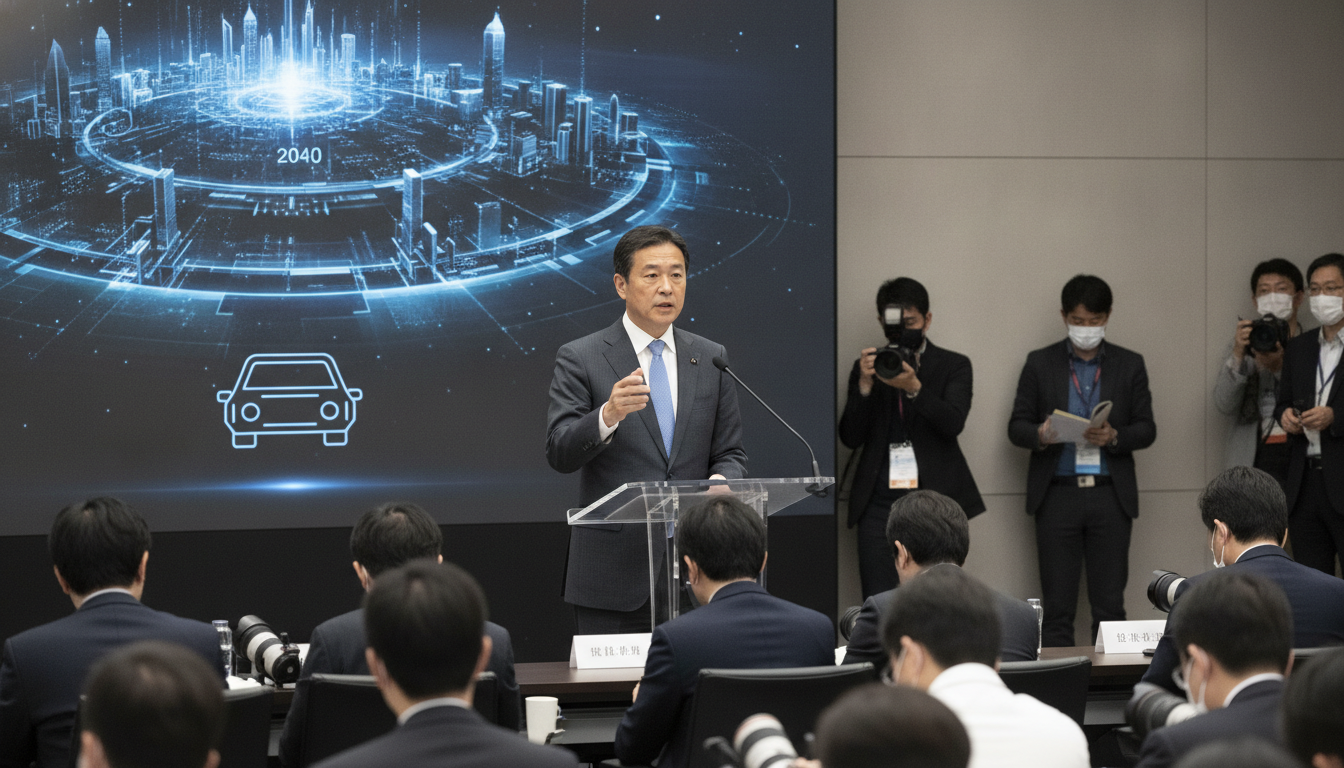
Foxconn Executive Says Level 4 Autonomous Driving Will Go Mainstream by 2040
Jun Seki of Foxconn predicts Level 4 autonomous driving will be mainstream by 2040 as sensor costs fall, reliability rises and regulations adapt globally.
Foxconn’s electric vehicle strategy chief, Jun Seki, told Nikkei Asia in Tokyo on July 21 that Level 4 autonomous driving is likely to reach mainstream adoption by 2040. He said the shift will be driven by falling hardware costs and steady improvements in system reliability, accelerating deployment in passenger and commercial electric vehicles. The prediction frames Foxconn’s long-term investments in vehicle platforms and autonomous technology as part of a broader industry transition.
Foxconn Executive Predicts Level 4 Uptake by 2040
Jun Seki’s assessment places a concrete timetable on a technology many had expected to develop more slowly. He identified cost reductions and reliability improvements as the twin forces that will move Level 4 autonomous driving from pilot programs into mass-market offerings. Seki’s comments reflect Foxconn’s strategic emphasis on integrating software, sensors, and vehicle manufacturing to capture growth in electric and autonomous mobility.
His remarks also underline a shift in industry expectations about the pace of autonomy. Rather than a gradual trickle of incremental automation, Foxconn anticipates a more pronounced acceleration once component prices hit key thresholds and systems demonstrate consistent safety in diverse conditions. That view informs the company’s decisions on partnerships, production capacity, and R&D priorities.
Cost Reductions and Technological Reliability
Seki pointed to declining prices for radar, cameras and high-resolution mapping as essential to mainstreaming Level 4 systems. Economies of scale in sensor production and maturation of perception algorithms will reduce the per-vehicle cost premium for advanced autonomy. As component costs fall, manufacturers can justify broader deployment across vehicle segments beyond premium models.
Reliability gains are equally crucial, he said, noting that engineers must demonstrate consistent performance in complex urban and highway environments. Improvements in software validation, simulation testing and over-the-air updates will help systems handle rare or unexpected situations more robustly. Regulators and insurers will require demonstrable safety outcomes before approving widespread commercial use.
Foxconn’s EV Strategy and Partnerships
Foxconn has been positioning itself as a systems integrator in the EV supply chain, combining electronics manufacturing know-how with vehicle assembly capabilities. Seki’s role as chief strategy officer for EVs signals the company’s intent to shape product road maps that incorporate autonomous stacks from an early stage. Integrating autonomy at the platform level can reduce integration costs and shorten time-to-market for partners and branded vehicles.
The company’s approach emphasizes modular platforms that accommodate different autonomy levels and powertrain configurations. That flexibility aims to attract automakers and mobility service providers looking for scalable solutions. Foxconn’s pitch rests on its ability to deliver manufacturing scale and electronic systems expertise under a single roof.
Regulatory and Infrastructure Challenges
Despite technological optimism, Seki acknowledged significant non-technical hurdles remain, especially in the regulatory and infrastructure domains. Governments will need to update rules on vehicle certification, liability and data governance to reflect higher levels of automation. Harmonizing standards across jurisdictions will be a slow, politically charged process that could affect rollout timelines.
Infrastructure upgrades — from high-definition maps to dedicated lanes and smart traffic controls — will also play a role in enabling safe Level 4 operations. Public investment and coordination between cities, telecom providers and vehicle makers will influence where and how quickly autonomous services expand. Seki suggested that targeted deployments in controlled environments or specific corridors may precede broader urban rollouts.
Market Impact for Automakers and Suppliers
Widespread Level 4 adoption would reconfigure competitive dynamics in the automotive sector, shifting value toward software, data and sensor suppliers. Traditional automakers may partner with electronics integrators to remain competitive, while new entrants and mobility operators could gain scale through services built on autonomous fleets. Suppliers that can reduce sensor costs and provide validated autonomy stacks stand to win significant business.
For consumers, the economics of autonomy could change the proposition for vehicle ownership, especially in urban areas where robo-taxi services offer door-to-door mobility. Commercial applications — logistics, last-mile delivery and shuttle services — are likely to be early beneficiaries, driving demand for vehicles equipped with reliable Level 4 capabilities. Seki framed these market shifts as opportunities for Foxconn to supply the underlying platforms and integration expertise.
Timeline, Pilots and Consumer Acceptance
Seki outlined a phased adoption path that begins with expanded pilot programs and fleet deployments in constrained settings. As systems accumulate miles and regulators gain confidence, deployments would broaden to more complex urban and highway scenarios. Consumer acceptance will hinge on transparent safety records, clear liability frameworks and demonstrable benefits in cost and convenience.
He emphasized that mainstreaming by 2040 does not mean Level 4 will be ubiquitous everywhere overnight, but that it will be commercially viable and widespread in many markets by that date. The transition will be uneven, shaped by local regulation, infrastructure readiness and market demand.
Foxconn’s forecast places the company squarely in the middle of a technological and economic transformation of mobility. Its strategy to combine electronics manufacturing scale with vehicle integration positions it to supply both hardware and platform services as Level 4 autonomous driving moves from experiment to everyday reality.

