
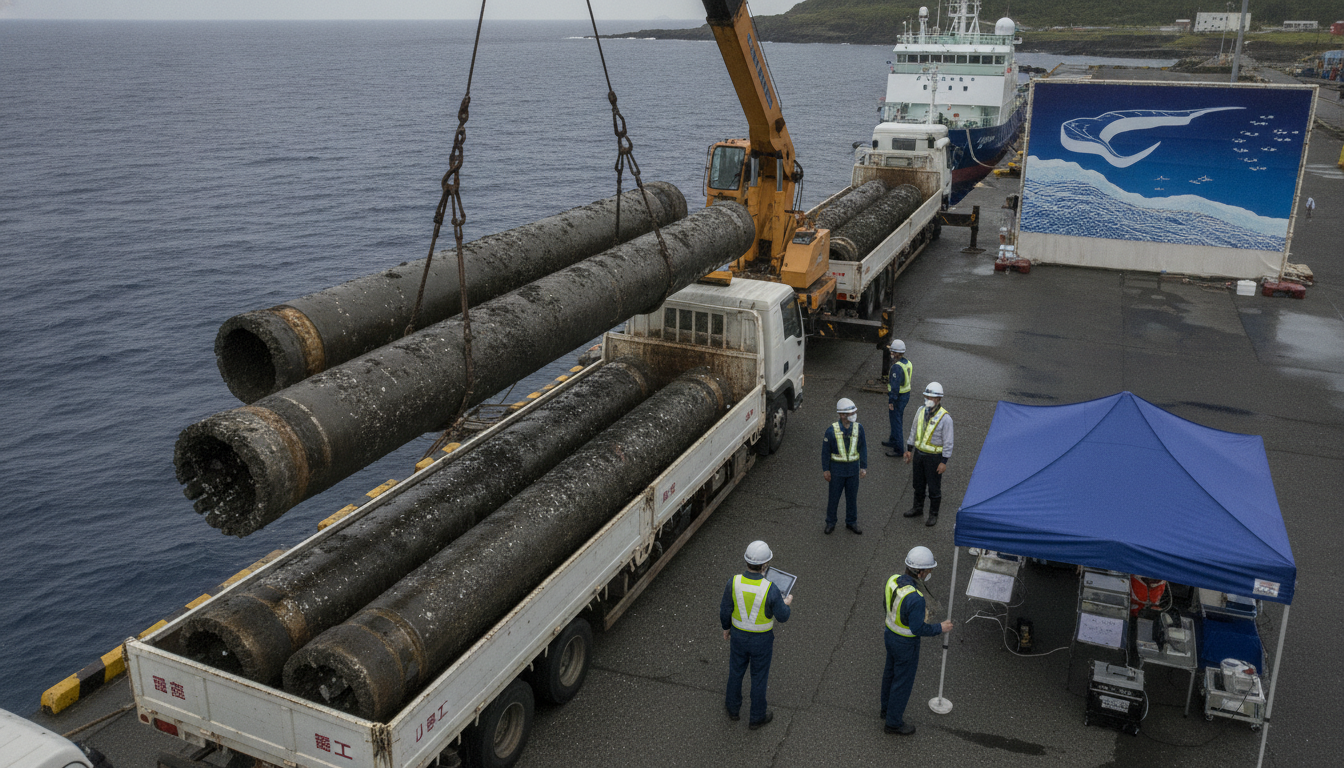
Japan recovers rare-earth elements in deep-sea test near Minamitori-shima
Japan recovers rare-earth elements from a deep-sea drilling test near Minamitori-shima, a move that could reduce reliance on China’s rare-earth supply.
Japan has recovered rare-earth elements from a deep-sea drilling test near the remote Pacific island of Minamitori-shima, officials said, marking a potential step toward diversifying supply chains for components used in semiconductors, electric vehicles and defense systems. The discovery offers a domestic source of materials long dominated by Chinese production and could reshape strategic planning for critical technology supply lines. Analysts caution that significant technical, environmental and regulatory hurdles remain before the find can be turned into a reliable commercial supply.
Deep-sea drill recovers rare-earth elements near Minamitori-shima
The drilling test recovered samples from seabed deposits close to Minamitori-shima, a Japanese-administered atoll in the Pacific Ocean. Initial analysis indicates the presence of measurable concentrations of rare-earth elements, the materials essential for high-performance magnets, chips and other advanced components.
The test was presented as a proof of concept rather than a commercial extraction operation. Japanese authorities framed the exercise as an early-stage success that will inform further surveys and feasibility studies.
Technical findings from the drilling test
Laboratory testing on the recovered cores reportedly confirmed the presence of rare-earth-bearing minerals within the sampled strata, consistent with international interest in marine mineral resources. These elements are used in permanent magnets, catalysts and other applications that underpin electronics and the automotive transition to electrified powertrains.
Technical challenges remain significant: deep-sea recovery requires specialized vessels, riser systems and processing technologies to separate and refine rare-earth oxides from marine sediments. Industry experts say scaling a test to continuous production will demand substantial capital, innovation in extraction methods, and robust supply-chain integration for downstream refining.
Supply-chain implications for Japan and allies
The find has strategic implications given global dependence on a small number of suppliers for rare-earth processing and refinement. A domestic or ally-accessible source could reduce Japan’s exposure to supply disruptions and give manufacturers greater control over critical inputs for chips, batteries and defense applications.
Diversification would not immediately displace existing suppliers but could strengthen bargaining positions and foster new industrial partnerships. Policymakers and industry leaders are likely to weigh the benefits of supply security against the costs and time required to develop a practicable production pathway.
Government and industry next steps
Officials said the next phase will focus on expanded surveying, more detailed sampling and environmental baseline studies to determine whether commercial extraction is feasible. Public investment and coordination with private firms are expected to play a role in funding the necessary research and pilot projects.
Private-sector participants will need to evaluate the economics of seabed extraction versus land-based mining and recycling initiatives. The development timeline will hinge on technological progress, investment decisions and regulatory approvals.
Environmental and legal challenges for deep-sea extraction
Environmental groups and scientists have warned that seabed mining can pose risks to fragile marine ecosystems and biodiversity. Concerns include habitat disruption, sediment plumes and impacts on species that may be slow to recover from disturbance at abyssal depths.
International legal frameworks and domestic regulations will shape what operations are permitted and how environmental safeguards are enforced. Japan will need to reconcile economic ambitions with commitments to marine conservation and rigorous impact assessment processes.
Commercial prospects and timeline uncertainties
Turning the test recovery into a steady supply chain will require further exploration, pilot development and a clear path to downstream processing and refining. Rare-earth elements often require complex separation and purification steps that are currently concentrated in a limited number of facilities globally.
Given those constraints, commercial production from deep-sea deposits is likely to remain uncertain for several years. Observers note that complementary strategies—such as expanding recycling, securing land-based deposits and investing in alternative materials—will remain important while seabed projects are evaluated.
The Minamitori-shima drilling test represents a notable technical milestone for Japan’s efforts to broaden access to rare-earth elements, but it is an initial step rather than a near-term solution. Converting the discovery into a resilient, environmentally responsible supply will require sustained research, investment and regulatory scrutiny, with outcomes that will shape industrial and strategic planning for years to come.

