
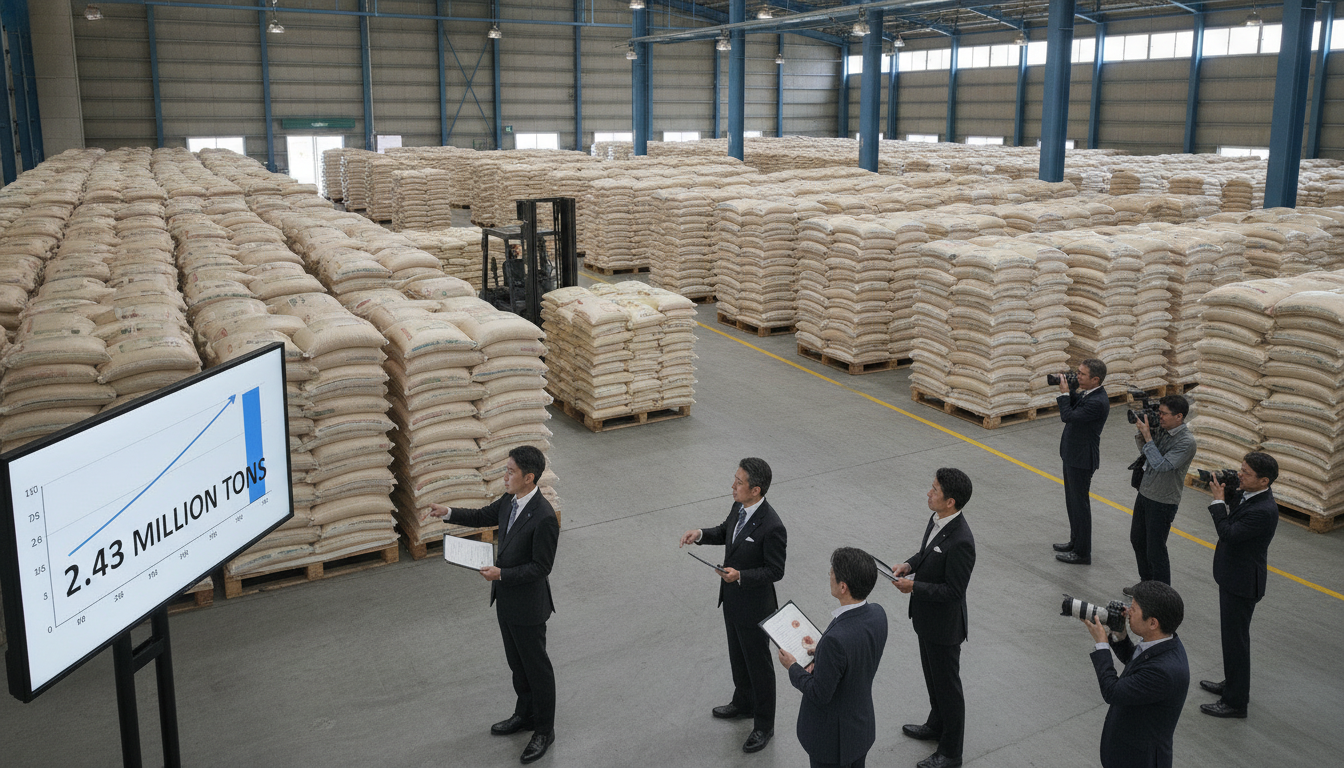
Rice stocks reach record 2.43 million tons at end-June, government delays reserve buyback
Japan’s private rice stocks reached a record 2.43 million tons at the end of June 2026, raising concern over rice price falls as the government delays buyback.
The Ministry of Agriculture, Forestry and Fisheries (MAFF) said on July 28, 2026 that private rice stocks in Japan stood at 2.43 million tons at the end of June, the largest level in comparable records dating back to 2004. The unusually large inventory has prompted warnings that rice price declines could accelerate, increasing pressure on farm incomes and market participants. While some government and ruling party officials urged an early purchase of public reserve rice to stabilize prices, MAFF announced it will defer a buyback for the time being.
MAFF data and upward revision
MAFF presented the figures to the Food, Agriculture and Rural Policy Council’s food subcommittee on July 28, 2026. The ministry had forecast in March that private stocks would rise to between 2.21 million and 2.34 million tons from last year’s 1.55 million tons, but the June stockpile exceeded that range. The 2.43 million-ton total represents a clear upward revision from earlier projections and is the highest level recorded under the current comparison series.
The ministry attributed the overshoot to a combination of weaker-than-expected domestic demand and a rise in tariff-paid private imports that were not fully factored into earlier projections. MAFF stressed the figures reflect inventories held by private traders, millers and wholesalers, not counts of government-held reserve rice.
Demand shortfall and unusual imports
MAFF had estimated domestic demand for last year’s crop at between 6.91 million and 7.04 million tons, but actual demand came in at about 6.83 million tons. The shortfall in consumption contributed directly to the buildup of private inventories. The ministry also noted that private trade brought in roughly 110,000 tons of rice last fiscal year under tariff-paid arrangements, a sharp increase from the typical volume of only a few hundred tons.
That surge in private imports followed a period of elevated domestic prices, which encouraged some traders to accept high tariff costs to supplement supply. MAFF said these tariff-paid imports were not fully anticipated in its March projection and therefore added to the unexpected inventory growth.
Market implications and price outlook
Analysts warn that the record private rice stocks are likely to exert downward pressure on domestic rice prices. Excess supply stored across commercial channels increases the risk that traders and retailers will seek to liquidate stocks, which could accelerate price reductions in wholesale and retail markets. Lower rice prices would relieve consumers but could damage farm incomes at a time when production costs remain a concern for growers.
Retail observations in recent months have shown some downward movement in shelf prices for mixed and lower-grade rice products, though wholesalers’ and futures markets will be the primary barometers of how quickly a price correction proceeds. Market participants are now watching storage and distribution flows closely to see whether inventories are released steadily or in clustered sell-offs.
Political response and buyback debate
Within the government and ruling Liberal Democratic Party, there have been calls to use public reserves to absorb excess supply and prop up prices through an early buyback of stored rice. Proponents argue that buying back reserve rice would remove a portion of marketable supply, supporting farm revenue and stabilizing rural economies. Opponents caution that immediate intervention could be costly to taxpayers and risk distorting longer-running market adjustments.
MAFF said it will not pursue an early purchase of reserve rice for the time being, opting to monitor market developments. The ministry indicated that a buyback remains a tool on the policy table but must be weighed against budgetary limits and the need to avoid sudden market disruption.
Risks for farmers and trade dynamics
The inventory glut raises near-term risks for producers, who may face narrower margins if farm-gate prices fall. There are also implications for planting and marketing decisions ahead of the next harvest cycle, as farmers and cooperatives reassess intended acreage and sales timing. Exporters and importers will likewise adjust strategies if domestic prices decline relative to international benchmarks.
Longer term, policymakers will need to consider whether structural measures—such as demand stimulation, diversified marketing channels, or adjusted import rules—are required to prevent repeated inventory buildups. For now, attention centers on balancing consumer interests, producer stability and public finance constraints.
MAFF said it will continue to release regular updates as market indicators evolve and will consult with industry stakeholders on any future intervention decisions.
Record private rice stocks have pushed the market into a delicate phase in which consumer relief from lower prices must be balanced against the economic health of rice producers, and authorities say they will keep monitoring inventories and price signals before taking further action.

