
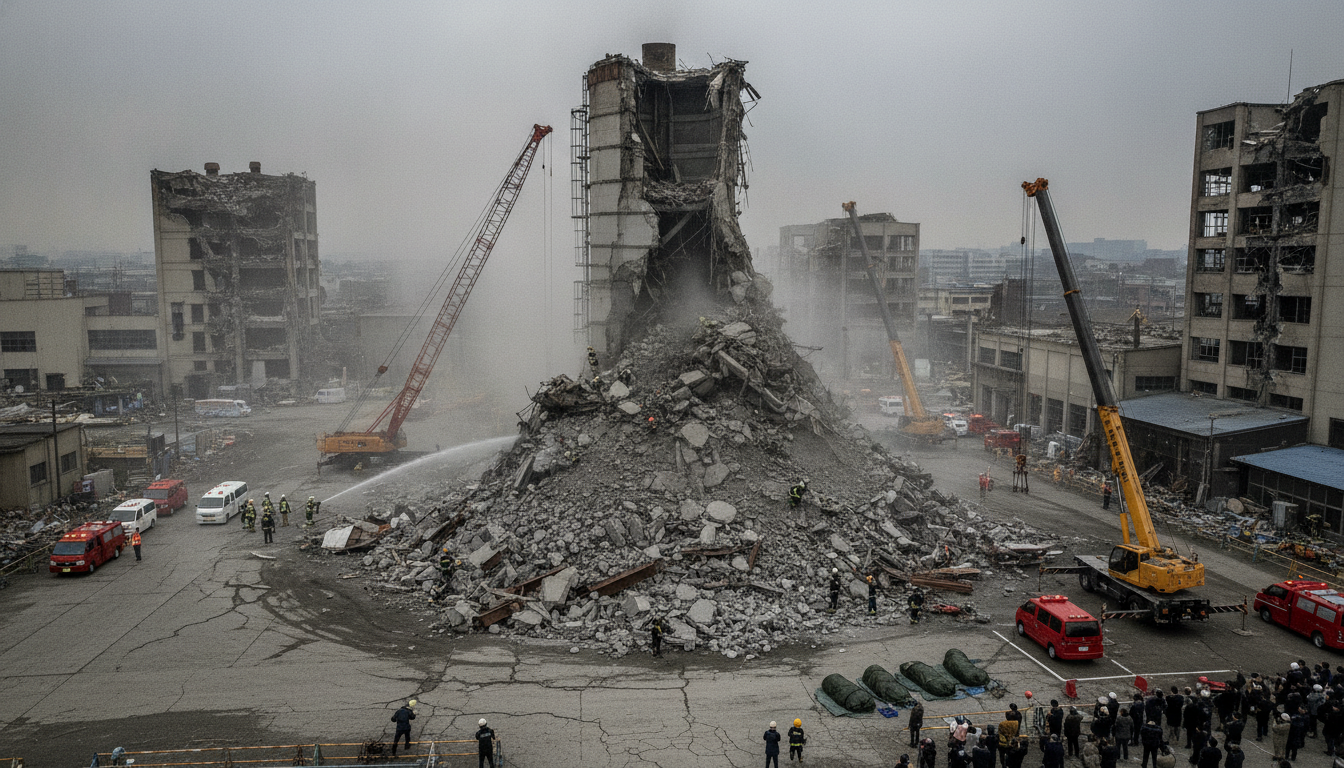
Nippon Paper chimney collapse in Yatsushiro raises questions about long‑period seismic shaking
A powerful July 28 earthquake in Kumamoto caused the Nippon Paper chimney collapse at the Yatsushiro plant, killing five and leaving four missing as of 2 p.m. on July 29, 2026, authorities said.
Chimney Collapse at Nippon Paper’s Yatsushiro Plant
A tall chimney at the Nippon Paper Yatsushiro paper mill toppled during the quake that struck Kumamoto Prefecture on July 28, 2026. The collapse was one of the most striking images of industrial damage after the tremor, which produced strong shaking in Yatsushiro and other communities. Emergency services reported five confirmed deaths and four people unaccounted for at 2 p.m. on July 29, 2026.
The plant’s damaged smokestack drew immediate attention because tall, slender structures can pose distinctive hazards in earthquakes. Local and national authorities have mobilized search teams and set up perimeter controls around the heavily damaged industrial site to secure risks from debris and potential secondary failures.
Immediate Human Toll and Emergency Response
Rescue teams from municipal and regional fire departments converged on the factory site in the hours after the quake, prioritizing life‑saving operations and stabilizing unstable structures. Officials emphasized that access to some areas remained restricted because of the risk of further collapse and falling debris. Families of workers at the mill have been notified and are being assisted by local authorities.
Hospitals in the region took in injured residents and factory staff, while municipal centers coordinated shelter and welfare services for displaced residents. Authorities warned the casualty figures were preliminary and subject to change as search operations continued and damaged areas were made safe.
Seismic Engineers Point to Long‑Period Motions
Structural engineers studying the incident noted that the earthquake produced pronounced long‑period ground motions across parts of Kumamoto, a characteristic that disproportionately affects tall and slender structures. Yoshikazu Takahashi, a professor of structural engineering at Kyoto University, said long‑period waves can resonate with chimneys and similar structures, amplifying sway and stress. He cautioned that resonance between ground motion period and structure period can produce larger movements than standard design assumptions anticipate.
Data collected from seismographs across the region indicated energetic, lower‑frequency waves were present during the main shock and some strong aftershocks. Experts said that these motions, combined with local soil conditions and the chimney’s structural details, could account for failure patterns observed at the site.
How Chimneys Fail Under Seismic Loads
Chimneys and industrial stacks are typically engineered to withstand seismic forces by reinforcing their bases and using connections designed to absorb bending and shear. However, the bottom of a chimney often functions as a fixed point during shaking, which can cause a whipping, cantilever effect where the upper sections experience large displacements. Weaknesses at joints or transitional sections may concentrate stress and initiate cracks that propagate rapidly.
Engineers described a plausible failure sequence in which the base held firm while mid‑height and upper sections developed localized buckling or shear fractures, eventually leading to a progressive collapse. They also noted that if the earthquake introduces unexpected combinations of translational and rotational motions, those interactions can exceed the performance envelope assumed in original design and retrofits.
Industrial Safety and Design Questions
The collapse has prompted renewed scrutiny of seismic design standards for industrial chimneys and similar infrastructure. While many stacks undergo periodic inspections and retrofits, experts said the event underscores that designs must account for a broader spectrum of ground motions, including long‑period and multi‑directional shaking. Industry groups and regulators will likely review whether existing codes and retrofit practices adequately cover the behavior revealed by the Kumamoto quake.
Plant operators and insurers also face questions about maintenance records, retrofit history and whether site‑specific seismic assessments were up to date. Investigators will seek documentation on the chimney’s construction, reinforcement measures and any past interventions to determine whether the failure resulted from exceptional ground motion, structural deficiency, or a combination of factors.
Investigations Underway and Wider Regional Impact
Official probes will involve engineers from national agencies, university specialists and independent consultants to reconstruct the sequence of the collapse and identify causal mechanisms. Authorities have said forensic inspections will include material sampling, joint and weld examinations, and analysis of instrument records from nearby seismic stations. The outcome of those investigations could influence future regulatory guidance for industrial facilities nationwide.
Beyond the factory, the July 28 quake produced broad disruption across Kumamoto Prefecture, with reports of building damage, infrastructure interruptions and other industrial incidents. Local governments continue rescue and relief operations while monitoring aftershocks that complicate recovery work and assessment of structural safety in affected communities.
The chimney collapse at Nippon Paper’s Yatsushiro plant has added urgency to calls for a careful review of seismic resilience in industrial design, and investigators say the forthcoming technical findings will be critical for preventing similar tragedies in the future.

