
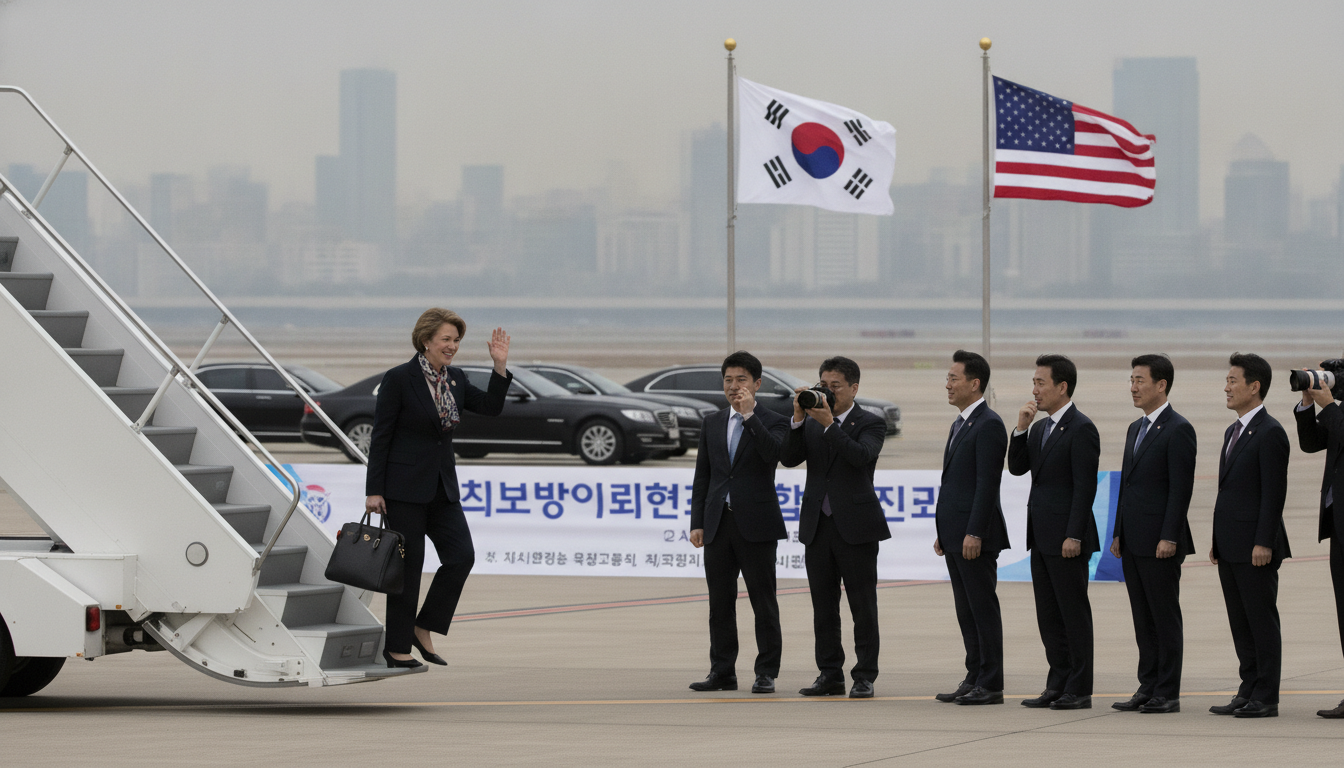
Michelle Steel Arrives in Seoul as U.S. Ambassador to South Korea amid Alliance Tensions
Michelle Steel arrives in Seoul as U.S. ambassador to South Korea, filling a long-vacant post amid tensions over China, defense policy, trade and North Korea.
U.S. envoy Michelle Steel arrived in Seoul on Thursday to assume the post of U.S. ambassador to South Korea, a role that has been vacant for an extended period and is central to regional security and diplomatic management. Her arrival comes as Washington and Seoul confront rising friction over China, evolving defence commitments and trade disputes that have tested the alliance in recent years. Steel, a Republican ally of former President Donald Trump, was confirmed after testimony before the Senate Foreign Relations Committee on May 20, and her tenure will be watched closely by governments in Seoul, Tokyo and Beijing.
Arrival in Seoul and ceremonial duties
Steel’s arrival was marked by customary diplomatic protocol and meetings with embassy staff to ensure an immediate transition in leadership at the U.S. mission. Officials said she planned to meet South Korean foreign ministry counterparts and senior diplomats in the coming days to establish lines of communication and priorities. The ambassador’s immediate tasks include restoring continuity at the embassy and signaling Washington’s commitment to a stable bilateral relationship after a prolonged vacancy.
Immediate agenda at the embassy
In Washington and Seoul, expectations are that the ambassador will focus first on alliance management, coordination on North Korea policy and practical cooperation on defence logistics. The embassy will also be central to coordinating high-level visits and joint military exercises that underpin deterrence on the Korean Peninsula. Steel’s office must reconcile domestic political considerations in the United States with Seoul’s security concerns while maintaining the day-to-day work of consular services and bilateral programs.
Defence posture and alliance burdens
One of the most sensitive items on the agenda is defence policy, where disputes over cost-sharing, force posture and wartime operational control have repeatedly strained ties. Seoul seeks reassurance about extended deterrence and the U.S. commitment to defend South Korea while also pursuing greater burden-sharing and operational autonomy. Washington expects its ambassador to help manage negotiations over troop presence and readiness, and to ensure military coordination remains robust in the face of North Korea’s continuing weapons developments.
Trade frictions and economic cooperation
Economic issues remain another source of tension that the ambassador will need to navigate, including trade disputes, supply-chain security and semiconductor collaboration. South Korea is a major trading partner and a critical node in global technology supply chains, which has made economic diplomacy a strategic priority for both capitals. The embassy will be tasked with balancing U.S. concerns over market access and industrial policy with Seoul’s efforts to protect its industries and sustain growth.
Political backdrop of the nomination and confirmation
Steel’s nomination drew attention due to her close political ties with former President Trump and her record as a member of Congress, which some analysts say will shape perceptions of Washington’s approach in Seoul. Her confirmation hearing on May 20 placed her past positions and affiliations under scrutiny, prompting debate over the extent to which partisan politics should influence a key bilateral posting. Nonetheless, she has now assumed the role, and officials in both countries appear focused on getting practical business done despite political differences.
Implications for regional diplomacy
Observers in East Asia say the ambassador’s tenure will be measured by how effectively she strengthens trilateral ties with allies such as Japan while managing Beijing’s expanding influence in the region. Seoul faces the complex task of deepening economic ties with China even as it relies on U.S. security guarantees, and the ambassador will play a central role in communicating U.S. expectations and support. How Steel balances these competing pressures could affect broader regional cooperation on issues ranging from North Korea denuclearisation to maritime security.
The coming weeks are likely to reveal how Steel prioritises tasks and engages with both the South Korean government and the range of civil society, business and defence actors that shape the alliance. Her performance in coordinating defence arrangements, calming trade disputes and sustaining dialogue on North Korea will be closely watched in Seoul and Washington. The appointment fills a diplomatic gap that existed at a sensitive moment for Northeast Asian security, and her actions now will help define the shape of U.S.-South Korea relations in the near term.

