
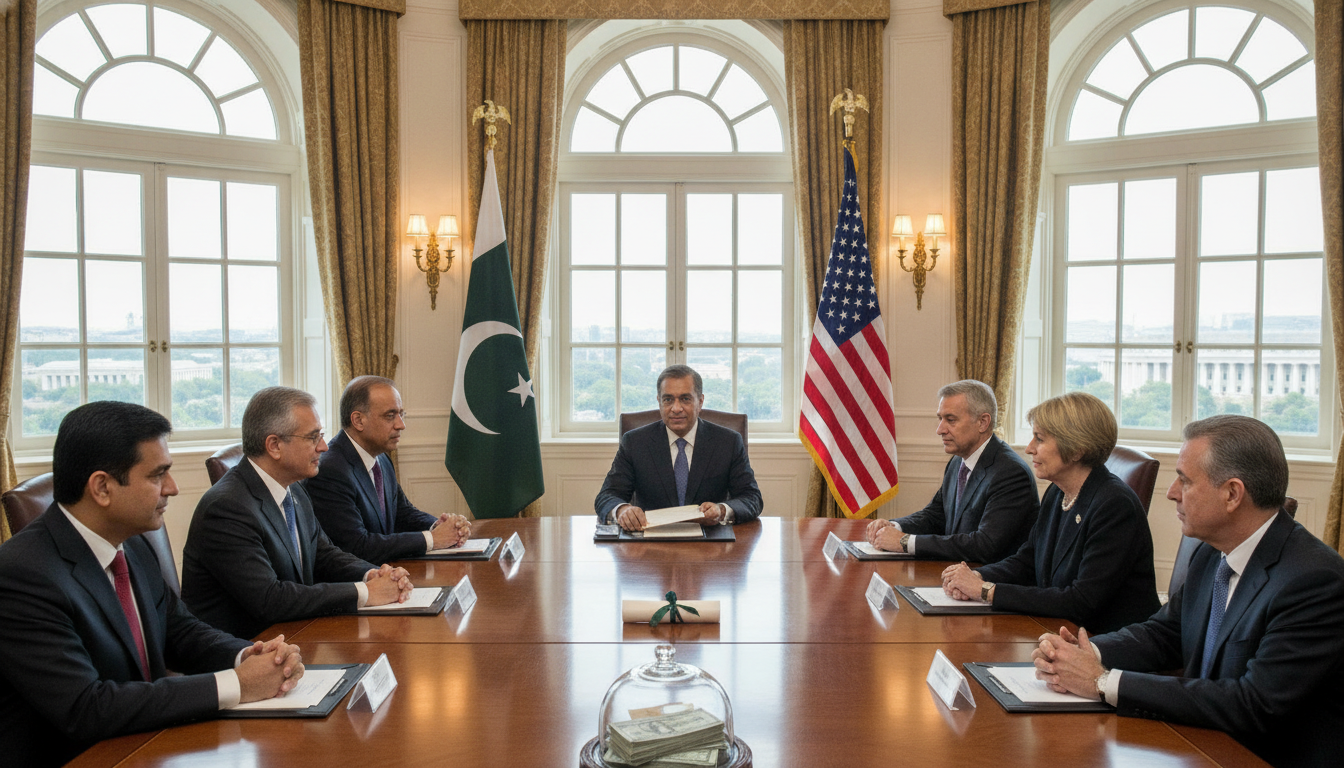
Pakistan Seeks $10 Billion U.S. Backstop After Mediating U.S.-Iran Talks
Pakistan has applied for a U.S. foreign currency backstop worth up to $10 billion to shore up reserves, Nikkei Asia reports.
Pakistan files formal request for U.S. backstop
Pakistan has formally applied for a U.S. foreign currency backstop facility, reportedly seeking access to up to $10 billion to bolster its ability to withstand shocks to foreign exchange reserves. The request, disclosed by Nikkei Asia, is intended to provide a buffer against sudden outflows and balance-of-payments pressures. Officials say the measure would be temporary support to stabilize markets while longer-term adjustments and financing arrangements are pursued.
The application marks a rare bilateral financial engagement with the United States at a scale that underscores Islamabad’s urgent need to protect its external position. Pakistani authorities framed the move as a precautionary liquidity backstop rather than a replacement for multilateral programs or structural reforms. The report did not detail which U.S. agencies would administer the facility or whether it would be conditioned on policy commitments.
Mediation between Washington and Tehran cited as catalyst
According to reports, Islamabad’s bid for the U.S. backstop followed Pakistan’s role in mediating a de-escalation between the United States and Iran. The mediation effort was led by Pakistan’s military chief, Field Marshal Asim Munir, a development that Pakistani officials and outside observers said helped open channels of communication. Diplomacy of this kind appears to have created political capital Islamabad sought to convert into financial support.
Observers note that diplomatic engagement can create openings for financial cooperation, particularly when a country plays a constructive role in easing regional tensions. Pakistani officials have argued that the mediation increased their standing with Washington and made a bilateral liquidity arrangement more feasible. Analysts caution, however, that political goodwill does not automatically translate into agreement on the technical and legal terms of financial facilities.
Economic pressures prompting the application
Pakistan’s request for a U.S. backstop comes against a backdrop of persistent external pressure, with foreign exchange reserves stretched by import bills, energy payments, and cyclical capital flows. Policymakers in Islamabad are grappling with the need to manage exchange-rate volatility while ensuring adequate import cover for essential goods. The backstop is being presented as a tool to prevent disruptive reserve runs that could force abrupt policy adjustments.
Domestic budgetary constraints and a reliance on external financing have left Pakistan more vulnerable to global shocks, according to market participants. While Pakistan has engaged with the International Monetary Fund and other creditors in prior years, bilateral liquidity can offer a quicker bridge to stabilize conditions. Still, many economists emphasize that such a facility would be most effective when paired with credible economic policy measures.
How a U.S. foreign currency backstop typically operates
A U.S. foreign currency backstop generally functions as contingent liquidity support to a partner government, designed to be drawn if markets or reserves face acute stress. These arrangements can take different legal forms and may involve central bank swap lines, Treasury-led guarantees, or credit lines facilitated through international financial institutions. The specific architecture and conditionality determine how and when funds are disbursed.
Any agreement involving U.S. resources would likely include a negotiation over terms, safeguards against misuse, and monitoring mechanisms. Recipients customarily accept transparency measures and policy commitments to demonstrate the backstop’s temporary and targeted purpose. The presence of a backstop can be as valuable for market confidence as any drawn funds, by signaling that official lenders stand ready to intervene.
Military leadership’s expanding diplomatic footprint
Field Marshal Asim Munir’s involvement in mediation highlights a growing diplomatic role for Pakistan’s military leadership in sensitive regional crises. The military’s influence in foreign policy has long been prominent in Islamabad, and recent high-level engagement with Washington and Tehran illustrates how security actors can shape economic outcomes. Analysts say this blending of security diplomacy and economic strategy reflects Pakistan’s search for leverage in tough financial circumstances.
Domestically, the military’s foreign engagements are likely to be scrutinized for their strategic gains and costs. Critics caution that relying on military-led diplomacy to secure financial assistance could complicate civilian oversight and long-term accountability. Proponents argue that pragmatic engagement across security and economic dimensions is necessary for a state facing both external and internal pressures.
Implications for markets and international partners
If a U.S. backstop is agreed, it could calm currency markets and reduce the likelihood of sudden capital flight, giving Pakistan breathing room to pursue fiscal and structural adjustments. International partners, including multilateral lenders and bilateral creditors, will be watching for any accompanying policy commitments that strengthen macroeconomic stability. The existence of a contingency line may also affect Pakistan’s negotiations with other creditors and investors.
However, the scale, conditionality, and governance of any facility will determine its ultimate effectiveness. Market participants caution that temporary liquidity support cannot substitute for deeper reforms to boost exports, improve revenue collection, and reduce external vulnerabilities. For Washington and other partners, the decision will involve balancing geopolitical and financial considerations.
Longer-term outcomes will depend on whether the backstop, if granted, is used solely as a precautionary buffer or becomes part of a broader financing strategy that includes multilateral support and domestic policy adjustments. The coming weeks are likely to involve technical talks and diplomatic exchanges as both sides shape the contours of any agreement.
Negotiations are ongoing and Islamabad’s application underscores the intersection of diplomacy, security and economics at a critical moment for Pakistan’s external stability.

