
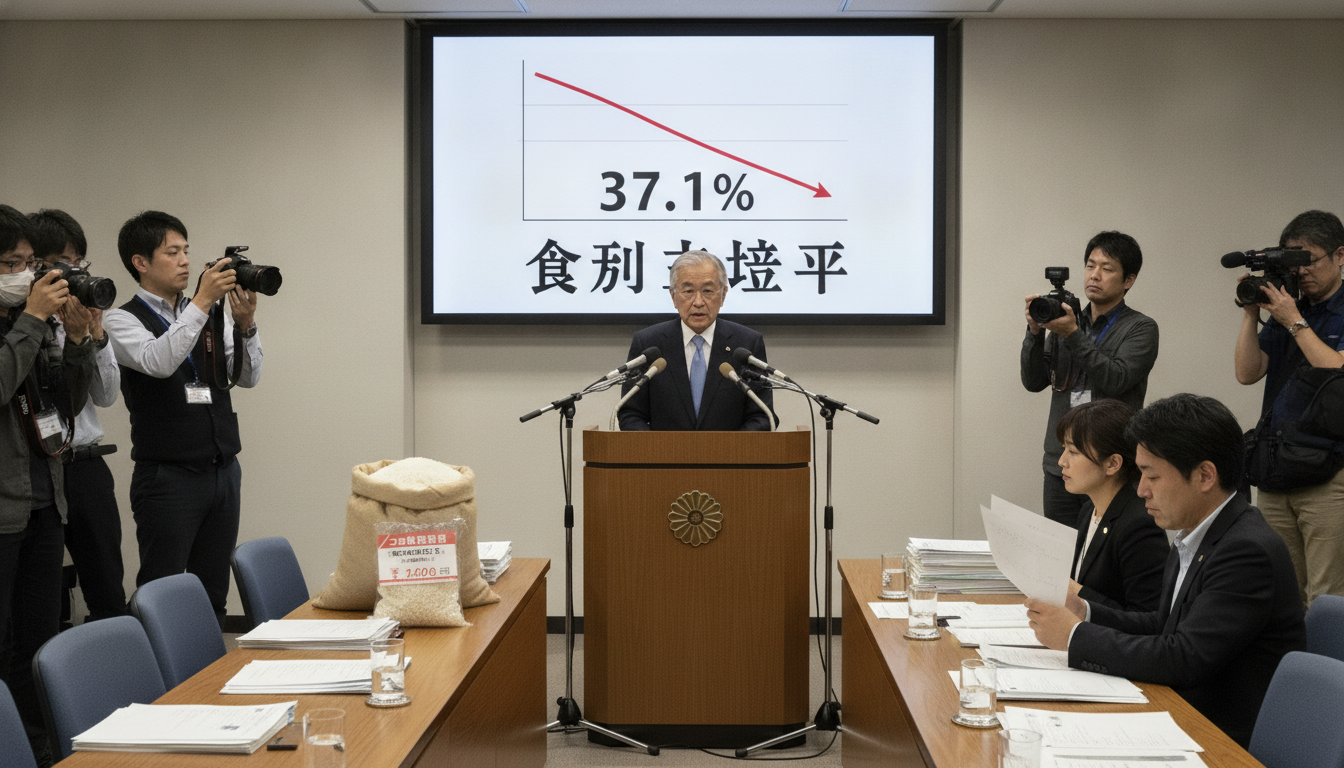
Food self-sufficiency rate falls to 37.11% in FY2025, lowest since 1965
Japan’s food self-sufficiency rate fell provisionally to 37.11% in FY2025—its lowest since 1965—as rising rice prices cut domestic demand and increased imports.
MAFF Announces Provisional FY2025 Figure
The Ministry of Agriculture, Forestry and Fisheries announced on August 7, 2026 that the provisional calorie-based food self-sufficiency rate for fiscal year 2025 is 37.11%.
The ministry said this figure is the lowest since comparable records began in 1965 and marks a sharp decline from the previous year’s final estimate.
This provisional calculation reflects the ministry’s standard methodology for calorie-based measurement and will be subject to revision when final figures are released.
Officials characterized the outcome as the result of recent shifts in domestic consumption and market prices rather than a single, isolated policy failure.
Rice Price Surge Cited as Primary Driver
MAFF identified a sharp rise in domestic rice prices during the period as the key factor behind the decline in the food self-sufficiency rate.
Higher domestic rice prices encouraged greater use of imported rice and alternative staples, shrinking the volume of domestically produced rice consumed in Japan.
The ministry and market observers point to a phenomenon widely described in domestic coverage as the "Reiwa rice disturbance," in which price spikes disrupted long-established consumption patterns.
As processors and consumers sought more affordable inputs, import volumes for staples increased, eroding the calorie share provided by domestic production.
Long-Term Trend Below 40% Continues
Japan’s calorie-based self-sufficiency rate has remained below 40% since fiscal 2010, and the provisional FY2025 number continues that extended downward trend.
The final figure for FY2024 was 38.16%, and the provisional FY2025 result represents a fall of 1.05 percentage points year on year.
The previous recorded low in comparable series was 37.15% in fiscal 2020, meaning the new provisional value narrowly undercuts that earlier trough.
Analysts note that persistent structural factors—such as dietary shifts, urbanization and the structure of agricultural production—have kept the rate under the 40% threshold for more than a decade.
Consumer and Industry Responses to Price Changes
Rising rice prices altered purchasing behaviour among households and food service operators, according to market reports referenced by MAFF.
Some consumers reduced rice consumption or switched to cheaper imported varieties, while some food processors modified product formulations or sourcing to control costs.
Food manufacturers and retailers face competing pressures: the need to contain prices for consumers and the need to maintain stable procurement for domestic producers.
These adjustments in the supply chain have direct implications for the calorie composition of food supplied in Japan, and they feed into the calculation of the self-sufficiency rate.
Policy and Food Security Implications
The drop to 37.11% has renewed attention among policymakers and experts to questions of food security and resilience.
A lower food self-sufficiency rate increases Japan’s exposure to global market volatility, which could matter in the event of international supply disruptions or price shocks.
Policymakers will be weighing options that balance consumer affordability with producer sustainability, including measures to stabilise markets, support production where feasible, and manage import dependence.
Any concrete policy response will require careful calibration to avoid exacerbating price volatility or harming long-term competitiveness in the agricultural sector.
MAFF Notes International Estimates but Details Remain Limited
The ministry indicated it has produced comparative estimates involving other G7 countries, but the provisional release did not include detailed international breakdowns.
MAFF’s broader analytic work aims to place Japan’s calorie-based measure in an international context, while recognising differences in diet, measurement and trade structures.
Further information and more granular comparisons are expected when MAFF publishes its full report and finalised figures for fiscal 2025.
Observers will be looking for those details to better understand how Japan’s self-sufficiency trajectory compares with peer economies and to inform policy debate.
The provisional fall in Japan’s food self-sufficiency rate to 37.11% underscores a persistent challenge for a nation that relies heavily on imports for a large share of its caloric needs.
As officials complete their final accounting and stakeholders assess market and policy options, the figure will likely shape discussions about price stability, supply-chain resilience, and the balance between domestic production and international trade.

