
Netanyahu Rejects U.S.-Led Gaza Peace Plan Roadmap, Calls for Genuine Hamas Disarmament
Israel’s prime minister on Aug. 9, 2026 rejected the U.S.-led Gaza peace plan’s 15-point roadmap, saying Israel will not withdraw until Hamas is fully disarmed.
Strong opening summary
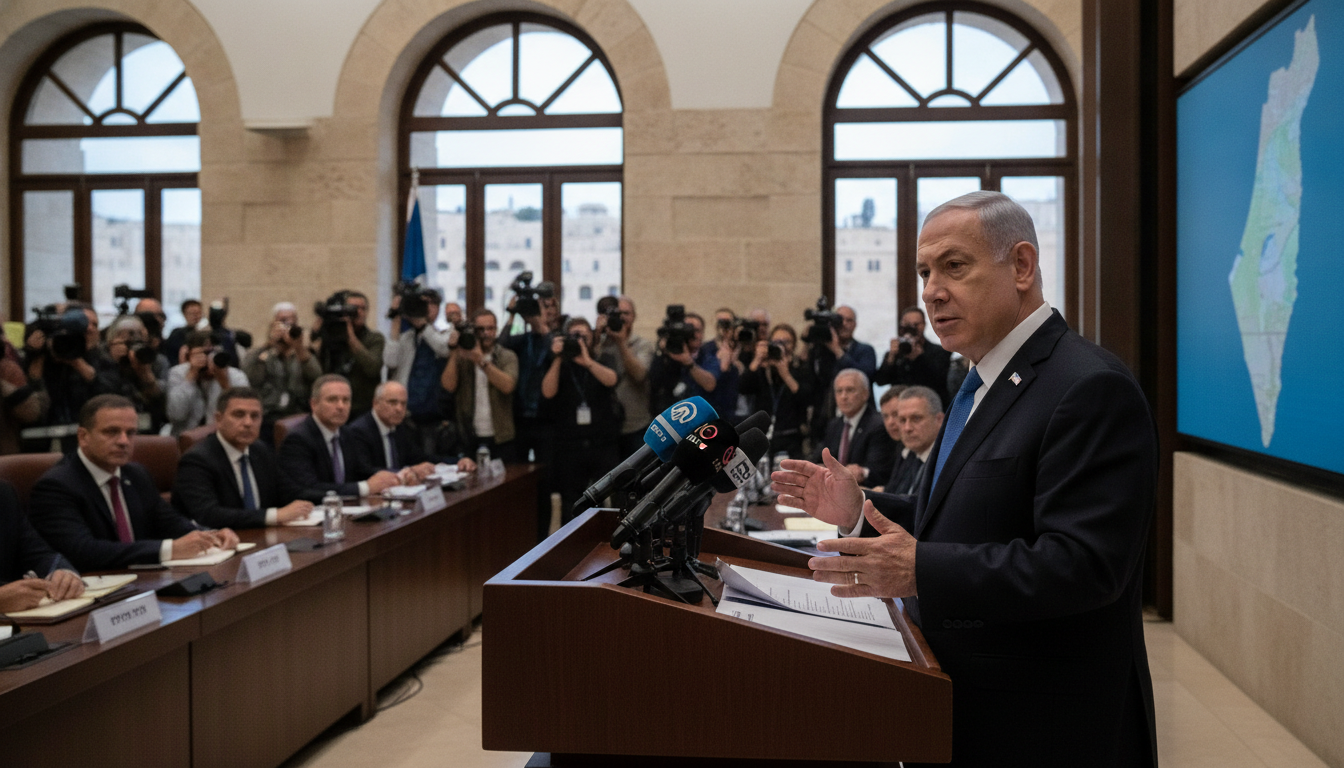
The Israeli prime minister announced on Aug. 9, 2026 that his government will not accept the 15-item roadmap attached to the Gaza peace plan promoted by U.S. President Donald Trump.
Binyamin Netanyahu told ministers at a cabinet meeting that Israel would not begin any withdrawal from Gaza until Hamas surrendered weapons in a verifiable, permanent way.
The standoff exposes deep disagreements between Jerusalem and Washington over sequencing, verification and security guarantees in the post-conflict arrangements.
Netanyahu’s cabinet declaration
At the opening of the Aug. 9 cabinet session, Netanyahu’s office said the prime minister reiterated that Israel “will not accept” the 15-point document prepared by the U.S.-led body.
He emphasized that any disarmament must be real, not symbolic, and that Israeli forces will remain in Gaza until concrete, verifiable steps are completed.
Netanyahu framed the position as necessary to protect Israeli citizens and signaled willingness to press even close allies if proposals undermine Israel’s security.
Origins and timing of the Gaza peace plan roadmap
The roadmap was issued in late July 2026 by an interim governing body chaired by U.S. President Donald Trump, who had hailed the wider agreement as historic when he unveiled the plan.
The document lays out a sequence of 15 measures intended to move the ceasefire into a more permanent political and security arrangement for Gaza.
Its release followed a ceasefire between Israel and Hamas reached in October 2025, which left the two sides in a fragile truce but with unresolved questions about governance and arms control.
Key provisions in the 15-point document
Among the roadmap’s central provisions is a staged transfer of heavy weaponry from Hamas to a Palestinian administrative committee composed of Palestinian officials and technocrats.
The plan links these transfers to a phased withdrawal of Israeli forces from Gaza, along with steps to restore civil services and international oversight of reconstruction.
U.S. drafters presented the package as conditional and sequential, intended to create reciprocal confidence-building measures that would reduce the risk of renewed fighting.
Israeli security concerns and verification demands
Jerusalem’s public objections focus on how disarmament would be verified and enforced before any Israeli disengagement takes place.
Netanyahu and senior security officials have demanded independent, transparent mechanisms to confirm that weapons have been surrendered and cannot be reconstituted.
Those demands reflect long-standing Israeli caution about relying solely on declarations and the practical challenges of securing demilitarization in densely populated urban areas.
U.S. position and diplomatic friction
Washington has defended the roadmap as a pragmatic pathway to consolidate the October 2025 ceasefire and accelerate reconstruction in Gaza.
U.S. officials indicated they are in consultations with Israeli counterparts after Netanyahu’s rejection, seeking to bridge differences over sequencing and guarantees.
The public impasse highlights a diplomatic strain between the two governments at a moment when international backing will be crucial to fund and implement rebuilding and governance measures.
Humanitarian and political stakes for Gaza
For civilians in Gaza, the dispute introduces further uncertainty about when reconstruction, essential services and a return to normalcy will begin.
Aid agencies have warned that delays in political progress could prolong humanitarian hardship and complicate the coordination of reconstruction projects.
Politically, the inability to agree on phase two threatens to leave Gaza under ad hoc arrangements that may perpetuate parallel authorities and limited accountability.
Regional risks and possible trajectories
Analysts say the current deadlock raises the risk that the temporary ceasefire could fray if either side perceives the other to be backtracking on commitments.
Possible next steps include intensified U.S.-Israeli negotiations, adjustments to the roadmap’s verification clauses, or calls for multilateral monitoring involving regional partners and international organizations.
Diplomats caution that without a clear compromise on sequencing and enforcement, momentum toward a durable settlement will likely remain stalled.
The coming days are likely to see intensified diplomacy in Washington and Jerusalem as officials attempt to reconcile Israel’s security demands with the roadmap’s sequence of actions.
How those talks address verification, the role of Palestinian institutions and the mechanics of a phased Israeli withdrawal will determine whether the Gaza peace plan can move beyond distant aspiration to actionable policy.

