
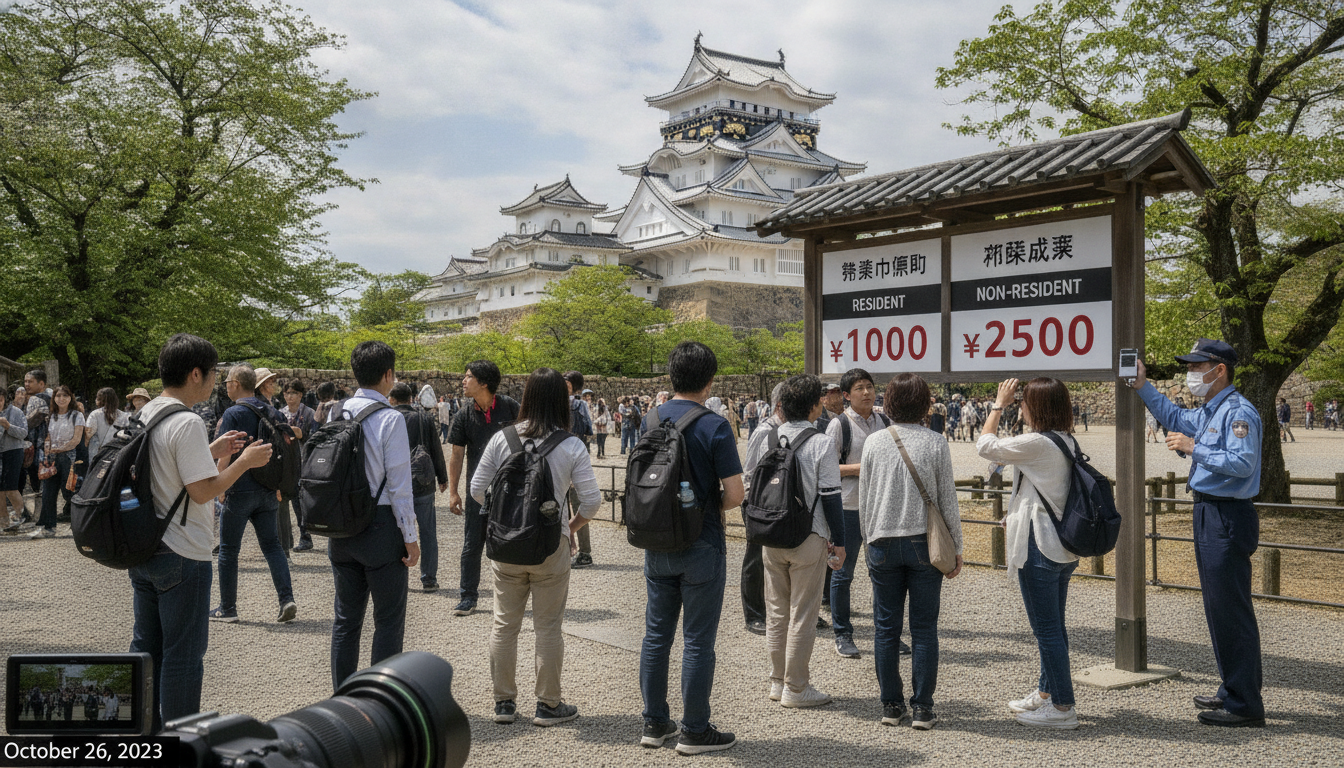
Himeji Castle dual pricing: non-residents to pay more than double as Japan expands split fares to protect heritage sites
Japan’s Himeji Castle will introduce a dual pricing scheme so non-residents pay more than double the regular fee, a move that marks a growing trend of “dual pricing” at historic sites to cover rising maintenance and overtourism costs.
Himeji Castle plans higher fees for non-residents
Hyogo Prefecture and site managers announced a plan to raise admission for visitors classified as non-residents, with the new rate set at more than twice the existing general ticket price. The measure is being framed as a targeted way to generate funds for conservation, visitor management and infrastructure upgrades at the World Heritage site. Officials said revenue will be ring-fenced for maintenance, crowd-control measures and programs that improve visitor experience and preserve fragile structures.
Dual pricing takes hold across Japan
Local governments across Japan have introduced or are considering similar dual pricing systems at shrines, castles and museums, citing pressure from record visitor numbers in recent years. The schemes vary: some charge foreign tourists higher fees, others differentiate between prefectural residents and non-residents, and some offer discounts to frequent domestic visitors. Authorities promoting the approach argue it allows popular destinations to spread the cost of upkeep more fairly without imposing blanket tax increases.
Overtourism and conservation costs cited as drivers
Managers of heritage sites say wear and tear, crowding and the expense of conservation work have outpaced traditional revenue streams such as standard admission and public subsidies. Historic timber structures, stonework and traditional gardens require specialized restoration that is costly and time-consuming. Dual pricing is presented as a way to secure steady funding while implementing measures to limit peak-period congestion and protect delicate cultural assets.
Potential effects on tourism and local economies
Tourism operators and local businesses warn that higher fees for non-residents could dampen short-term visitor numbers, particularly among price-sensitive travelers and day-trippers. However, some economists suggest better-managed flows and upgraded facilities could raise average spending per visitor and lengthen stays, offsetting any initial decline in entries. Municipalities are weighing these trade-offs as they model revenue forecasts and promotional strategies to sustain local tourism economies.
Reactions from residents, operators and rights groups
Residents near major attractions have largely welcomed measures intended to reduce overcrowding and improve quality of life, while some tourism stakeholders express concern about reputational risks and complexity in implementation. Civil liberties advocates and foreign community groups have questioned whether differential pricing based on residency or nationality could be perceived as discriminatory. Site managers say eligibility rules will be clarified and that schemes will include transparent criteria, concessions for children and seniors, and exemptions where necessary.
Policy and legal implications under review
Local administrations are consulting legal advisors to ensure dual pricing complies with national law and international obligations, and to avoid unintended consequences such as discouraging repeat visits or inviting legal challenges. Experts emphasize the need for clear signage, multilingual information and straightforward verification procedures to reduce confusion at ticket gates. Policy makers are also exploring complementary measures — such as timed entry, reservation systems and visitor education campaigns — to make fee differentials part of a broader conservation strategy.
Japan’s move toward dual pricing at Himeji Castle and other heritage sites reflects a broader shift in how the country balances access and preservation. Proponents argue the approach provides necessary funding and management tools, while critics warn of fairness and reputational issues that authorities will need to address through transparent rules and public engagement. As implementation proceeds, officials say they will monitor visitor patterns and economic impacts to refine the systems and ensure they meet conservation goals without unduly restricting access.
The evolution of dual pricing in Japan will be watched closely by other countries facing similar tensions between tourism demand and heritage preservation, and by communities dependent on tourist economies seeking durable, equitable solutions.

