
India-Indonesia ties deepen as Modi and Prabowo pledge closer manufacturing cooperation
India-Indonesia ties deepen after Modi and Prabowo met in Jakarta on July 7, 2026, as both nations seek to boost manufacturing, investment and supply chains.
A high-level meeting at Jakarta’s Merdeka Palace on July 7 signaled a renewed push to deepen India-Indonesia ties, with Prime Minister Narendra Modi and President Prabowo Subianto underlining economic cooperation as a priority. Both leaders framed closer collaboration on manufacturing, investment and supply-chain resilience as urgent responses to sluggish domestic industrial growth. The talks followed a period of comparatively limited high-level engagement and were presented by officials as an effort to translate political goodwill into concrete economic outcomes.
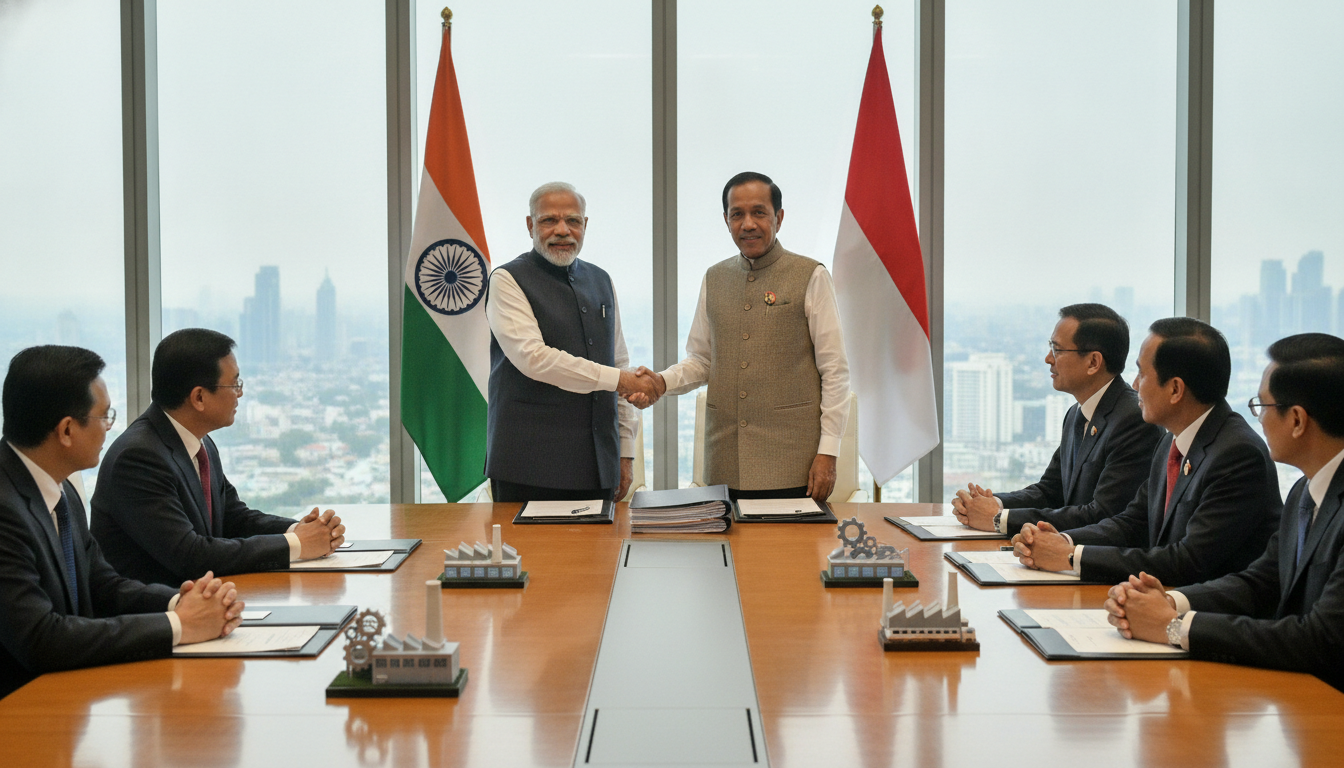
Modi and Prabowo meet at Merdeka Palace
The bilateral meeting on July 7 brought the two leaders together for a joint press conference that highlighted a shared intention to expand cooperation. Officials described the encounter as a turning point designed to accelerate dialogues on trade, investment and industrial cooperation. Photographs from the event showed the leaders emphasizing partnership and mutual interest in faster implementation of agreed initiatives.
Both delegations signaled that follow-up technical talks and working groups would be convened in the coming months to convert broad commitments into actionable plans. While officials did not disclose detailed packages or fixed timetables at the press conference, they emphasized a commitment to sustained engagement and regular ministerial-level contact.
Agreements aimed at boosting manufacturing and investment
The core message from the meeting was a pledge to deepen economic ties with manufacturing at the center of cooperation. Leaders and senior officials framed joint efforts around attracting investment, facilitating technology transfer and improving industrial linkages between the two economies. Export diversification and domestic job creation were put forward as immediate policy goals.
Economic teams were instructed to prioritize sectors where bilateral synergies exist, including electronics, automotive parts, and energy transition technologies. Authorities indicated plans to simplify investment procedures and explore joint ventures that could leverage each country’s comparative strengths in labor, markets and raw-material access.
Supply-chain resilience and regional positioning
Discussions also focused on strengthening supply-chain resilience amid a volatile global trade environment. Both governments stressed the need to reduce vulnerability to external disruptions by deepening regional production networks. Enhanced connectivity and logistics cooperation were discussed as tools to lower trade frictions and shorten delivery times for manufacturers.
Analysts note that closer India-Indonesia ties could help both countries attract manufacturers looking to diversify operations within Asia. Officials framed the partnership as complementary: India’s large domestic market and skilled services base paired with Indonesia’s natural resources and strategic location could form a more attractive offer for investors seeking alternatives to single-country concentration.
Domestic hurdles to scaling up manufacturing
Despite political momentum, both countries face significant domestic challenges in scaling manufacturing quickly. Structural constraints such as infrastructure gaps, land acquisition complexities and skills shortages were acknowledged by policymakers as lingering obstacles. Regulatory uncertainty and fragmented local supply bases also limit the speed at which large-scale industrial projects can be mobilized.
Government officials said reforms aimed at easing business procedures and improving vocational training would accompany bilateral efforts. However, economists caution that tangible results will depend on sustained policy reforms and concrete investment commitments, not just diplomatic declarations.
Business response and private-sector engagement
Business groups in both countries welcomed the summit’s tone and stressed the importance of predictable rules and transparent incentives. Corporate leaders signaled readiness to explore joint ventures and supply-chain partnerships, particularly in sectors tied to the energy transition and electronics manufacturing. Chambers of commerce and industry federations said they expected follow-up forums to focus on regulatory harmonization and sector-specific roadmaps.
Private-sector participants also underscored the need for finance facilities, public infrastructure upgrades and streamlined customs procedures to make cross-border production viable. Multilateral development partners and regional financial institutions were cited as potential partners to underwrite projects that carry higher upfront costs.
Roadmap and next steps after the summit
Officials outlined a phased approach to implementation, starting with working groups to draft sectoral plans and culminating in targeted investment missions. The first set of technical meetings is expected to prioritize actionable items such as customs facilitation, standards alignment and pilot manufacturing projects. Both governments said they would present progress reports at the next scheduled bilateral review.
Observers said the real test will be the speed and scale of follow-through over the coming 12 to 24 months. Concrete project announcements, financing arrangements and measurable job-creation targets will be pivotal to maintaining momentum and ensuring that India-Indonesia ties translate into expanded industrial output.
The Jakarta meeting on July 7 thus marked a diplomatic nudge toward deeper economic integration, with manufacturing and supply-chain resilience placed front and center. Whether pledges evolve into sustained investment and structural change will depend on policy execution, private-sector engagement and timely delivery of infrastructure and regulatory reforms.

