
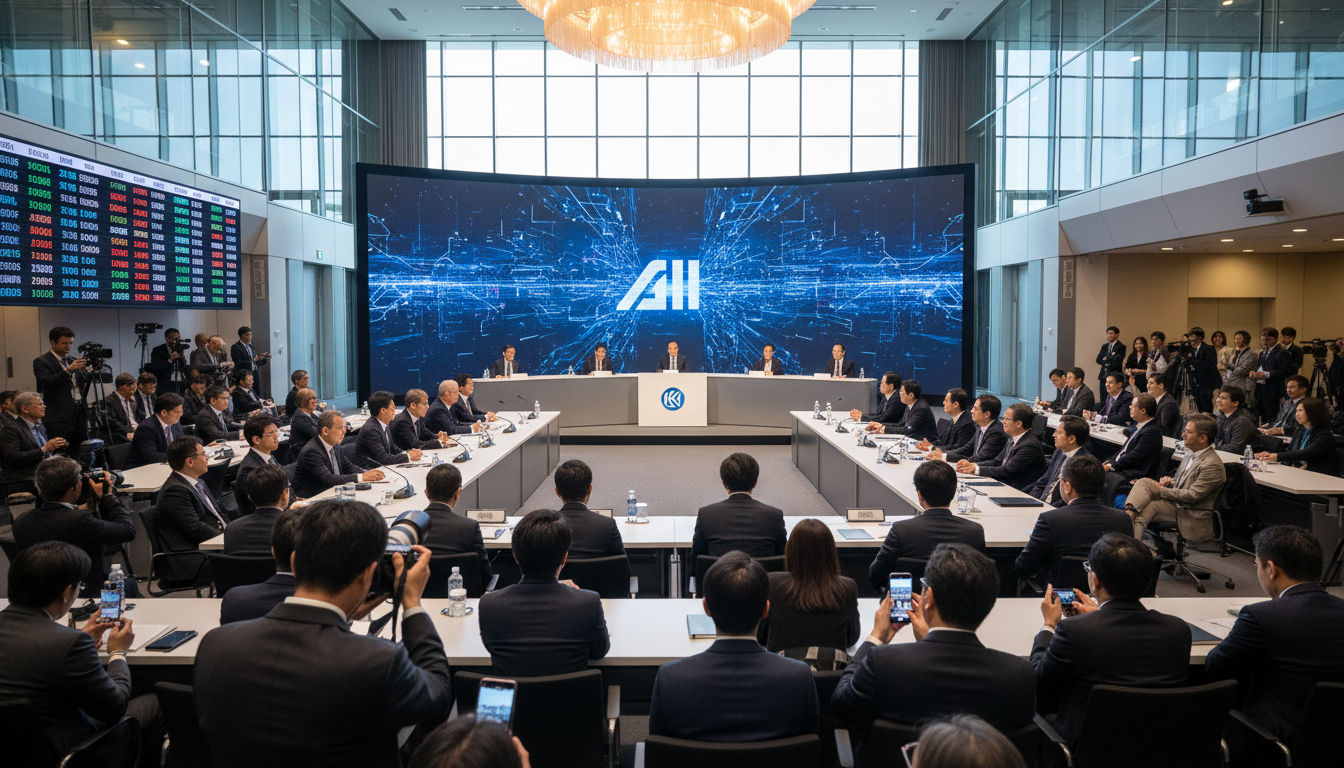
Kioxia Forecasts 48-Fold Net Profit as AI Data Center Demand Boosts Memory Prices
Kioxia forecasts a 48-fold quarterly net profit jump as AI data center demand drives higher memory semiconductor prices and shipments, strengthening its outlook.
Kioxia Holdings on May 15, 2026, forecast a roughly 48-fold increase in quarterly net profit, citing surging demand from artificial intelligence data centers that has pushed up prices and shipments of memory semiconductors. The company said the strength of the flash memory market is expected to continue, driven by higher capacity requirements and accelerated procurement by cloud and hyperscale operators. The forecast marks a sharp reversal from the market weakness that weighed on the sector in prior quarters.
Kioxia’s forecast and immediate drivers
The 48-fold net profit forecast reflects both price recovery and growing volume for NAND flash memory, Kioxia said. Rates for high-density memory used in AI servers have climbed as data center operators expand capacity to handle larger models and training workloads.
Executives pointed to a mix of stronger contract pricing and order acceleration from cloud customers as the primary drivers. Kioxia has also been prioritizing advanced memory products aimed at enterprise and AI infrastructure, a shift that supports both revenue per bit and margin expansion.
Supply and production adjustments behind the recovery
Kioxia and other memory suppliers tightened supply in earlier quarters after prolonged oversupply and weak demand, a move that helped clear inventory and firm up prices. The company’s forecast assumes continued discipline in production alongside targeted investments in next-generation process technologies.
Capacity allocation toward higher-margin, high-density products for AI and data center applications will remain a focus. Kioxia’s strategy includes scaling production of advanced flash devices while managing wafer starts to align with market recovery.
Market reaction and industry context
The forecast is likely to reverberate across the memory semiconductor sector, boosting investor sentiment for chipmakers exposed to NAND and DRAM markets. Analysts have noted that the pace of AI adoption has shortened inventory cycles and created pockets of acute demand for specific memory configurations.
Competitors have similarly reported improved pricing dynamics for key memory segments, though the extent of recovery varies by company and product mix. Market participants caution that recovery could be uneven if AI spending moderates or if macroeconomic pressures resurface.
Customer demand from AI and hyperscalers
Hyperscale cloud providers and AI infrastructure vendors are increasing orders for high-capacity flash to support model training and inference at scale. Kioxia highlighted that shipments to data center customers have risen, particularly for products tailored to performance-sensitive workloads.
These customers are also seeking longer-term supply stability, which has led to larger, more predictable contracts. That trend benefits suppliers with diversified product road maps and the ability to deliver advanced memory solutions at scale.
Risks and uncertainties in the outlook
Despite the optimistic forecast, Kioxia warned that the memory market remains cyclical and exposed to rapid shifts in demand. A slowdown in AI spending, a sudden shift in inventory strategies among major customers, or macroeconomic shocks could quickly alter the recovery trajectory.
Supply-chain issues, including equipment lead times and geopolitical factors, also pose potential constraints on the company’s ability to meet rising demand. Kioxia said it will monitor market conditions closely and retain flexibility in production planning to mitigate downside risks.
Implications for Japan’s semiconductor sector
Kioxia’s rebound underscores the role of Japanese suppliers in the global memory ecosystem and could bolster local investment in advanced chip manufacturing. A stronger performance by domestic memory firms may encourage further capital allocations to R&D and next-generation process technologies in Japan.
Policymakers and industry groups are likely to watch the recovery for its potential to support supplier networks and export activity. The demand driven by AI workloads highlights the strategic importance of memory technology for both global cloud infrastructure and Japan’s semiconductor ambitions.
Kioxia’s guidance signals a notable turnaround for the flash memory segment, driven by the rapid expansion of AI-related data center capacity and tighter supply conditions that have lifted prices and shipments. The company’s continued focus on advanced memory products positions it to capture a meaningful share of the AI hardware supply chain while keeping a cautious eye on cyclical risks.

