
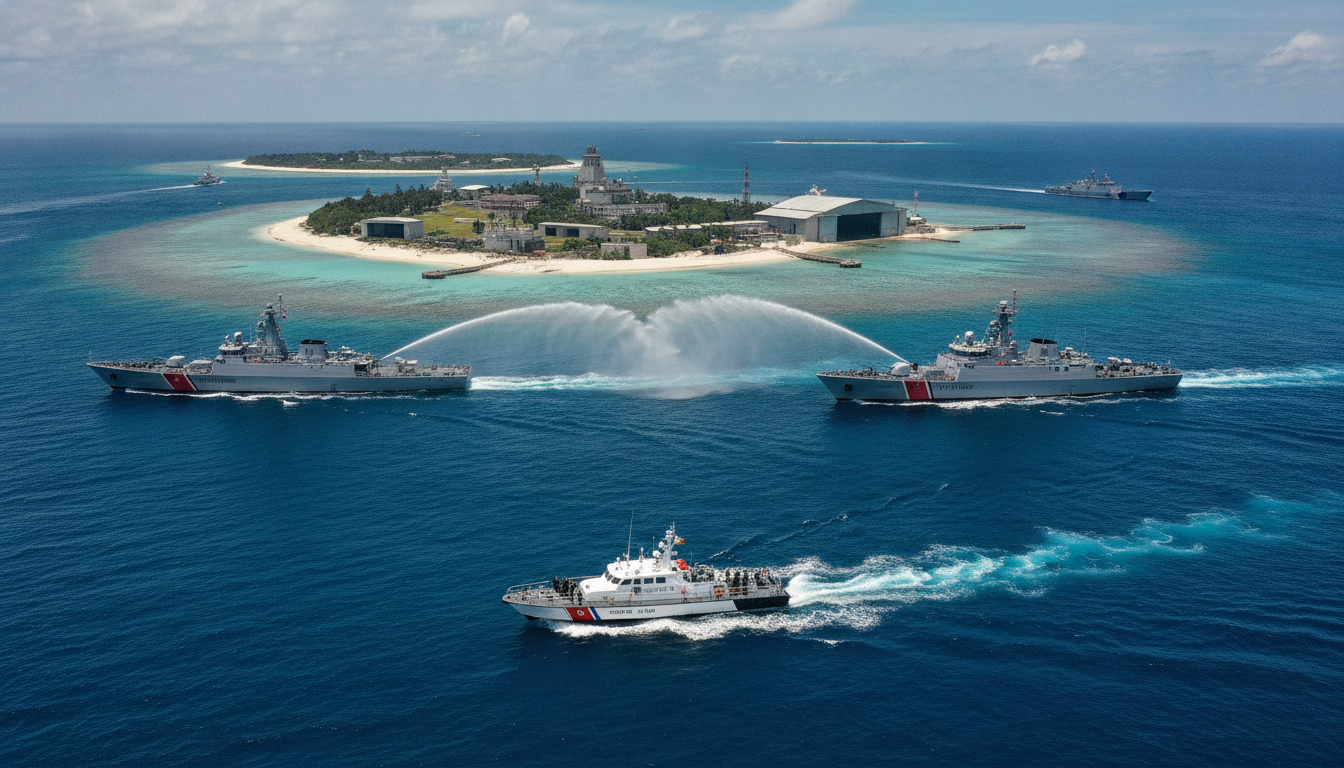
China Steps Up Pressure in South China Sea, Expands Fiery Cross Reef Facilities near Philippines
China has intensified pressure in the South China Sea, expanding facilities at Fiery Cross Reef and pressing the Philippines amid legal and security tensions.
China has increased activity around the Spratly Islands, with imagery showing significant development at Fiery Cross Reef, a strategic outpost in the South China Sea. Philippine officials say the moves have coincided with more frequent close approaches by Chinese coast guard and other vessels, heightening Manila’s security concerns. The developments come a decade after the July 12, 2016 arbitration ruling that rejected Beijing’s sweeping maritime claims, renewing debate over enforcement of international law in the region.
Beijing’s construction at Fiery Cross Reef documented by imagery
Satellite and aerial photos from the CSIS Asia Maritime Transparency Initiative and Planet Labs show marked changes at Fiery Cross Reef between November 2024 and June 2026. The imagery indicates an expanded port area and the construction of what analysts describe as a runway capable of handling larger fixed‑wing aircraft, reported at about 3,000 meters in length. These physical improvements suggest a transition from temporary outpost infrastructure toward more permanent military‑capable facilities on the Spratly outpost.
Manila lodges protests and increases maritime monitoring
Philippine authorities have formally protested incursions and bolstered maritime monitoring around their exclusive economic zone boundaries. Manila has described a pattern of close‑distance approaches, signaling harassment of Filipino vessels and interference with resupply missions to offshore features. In response, the Philippines has stepped up coast guard patrols, increased the presence of civilian maritime assets, and sought international diplomatic support to deter further escalation.
Legal backdrop: the 2016 arbitration ruling remains central
The current tensions are framed against the Permanent Court of Arbitration award issued on July 12, 2016, which found no legal basis for China’s claim to most of the South China Sea maritime areas. Manila has repeatedly cited the ruling to buttress its position, arguing that Beijing’s activities violate the Philippines’ maritime rights under the United Nations Convention on the Law of the Sea. Despite the legal verdict, enforcing the decision has proven difficult amid competing power dynamics and limited mechanisms for compelling compliance.
Security implications for regional navies and alliances
Analysts warn that expanded facilities on reclaimed features can alter operational dynamics for regional navies and air forces. A runway of the reported length and an improved port would allow longer‑range patrols, rapid logistics and increased force projection from the Spratlys, changing the calculus for nearby states. The developments have prompted closer security consultations among Southeast Asian claimants, and have intensified cooperation between the Philippines and external partners concerned with freedom of navigation.
United States’ role and concerns about rules and deterrence
U.S. officials and security experts say that shifts in global military focus and selective interventions elsewhere risk diluting consistent enforcement of maritime norms. Washington has maintained a pattern of freedom‑of‑navigation patrols and security cooperation in the region, but policymakers caution that changing priorities and operational tempos can affect deterrence credibility. Regional capitals worry that episodic responses, rather than a durable rules‑based approach, may embolden further unilateral actions and complicate peaceful dispute resolution.
The unfolding situation underscores the limits of legal rulings without sustained diplomatic or security mechanisms to back them, and it highlights the strategic importance of maritime features in the South China Sea. Southeast Asian claimants and external partners now face a narrow window to shape a coordinated response that lowers the risk of accidental clashes, preserves access to sea lanes, and reaffirms the primacy of international law in contested waters.

