
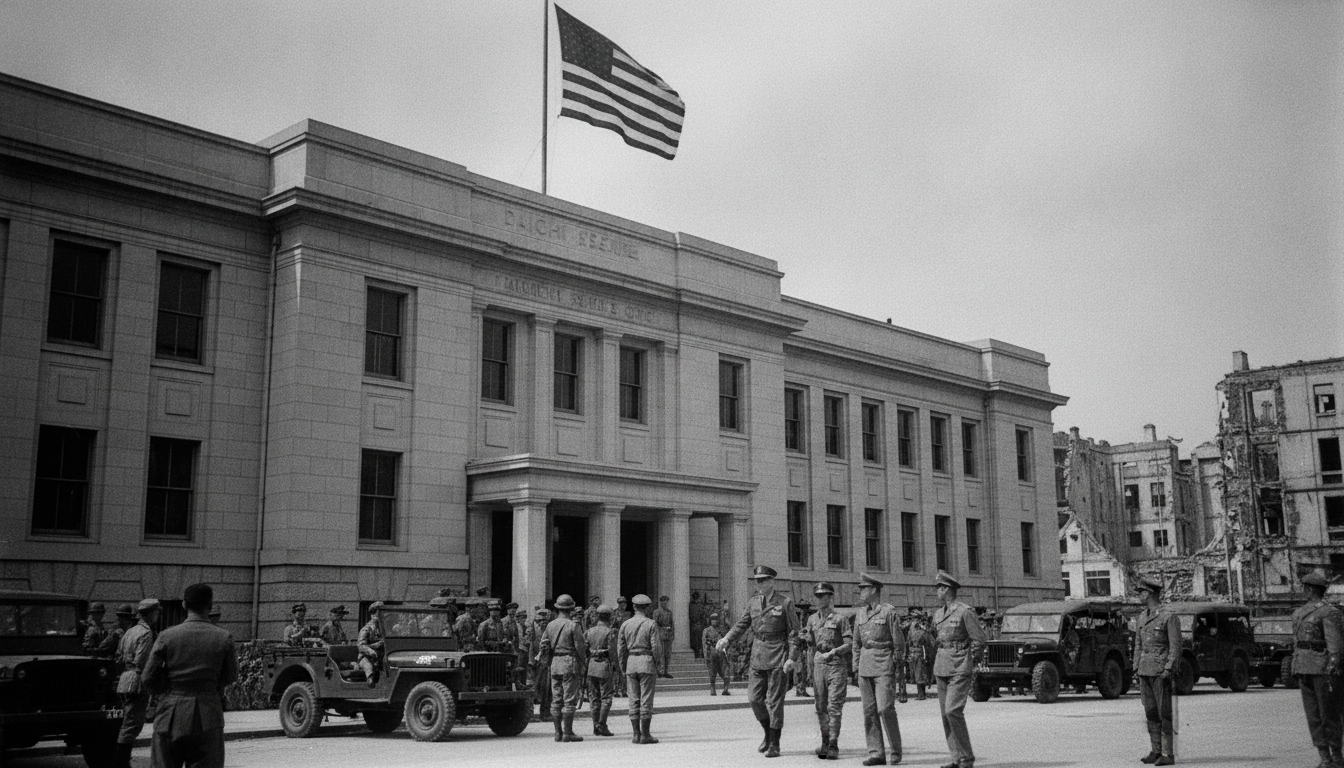
MacArthur headquarters Tokyo: Daiichi Life Building’s Role in Japan’s Postwar Occupation
Tokyo’s Daiichi Life building was requisitioned as Gen. Douglas MacArthur’s headquarters after World War II, a focal point of occupation-era reforms and memory.
Occupation Command Posts Established in Central Tokyo
The Daiichi Life Insurance head office in Tokyo was taken over by Allied authorities in the weeks following Japan’s surrender in August 1945. Command staff converted office space into the general headquarters for Gen. Douglas MacArthur, who led the occupation as Supreme Commander for the Allied Powers.
The building became a hub for military and civilian planners coordinating the immediate tasks of disarmament and governance. Its central location in Tokyo allowed rapid communication with military airfields and transportation nodes used by arriving occupation forces.
MacArthur’s Arrival at Atsugi and the Move to Tokyo
Gen. MacArthur landed at Atsugi Airfield on Aug. 30, 1945, an arrival that was widely photographed and disseminated across occupied Japan. From that point, his staff established a presence in Tokyo that quickly concentrated authority in the Daiichi Life building and nearby facilities.
The image of MacArthur at Atsugi underscored the speed and scale of the Allied occupation, and the choice of an existing commercial tower for GHQ signaled a reliance on prewar infrastructure. That pragmatic use of office space allowed occupation administrators to begin governing almost immediately.
Decisions Shaping Japan Were Routed Through the Building
From the Daiichi Life headquarters, SCAP and its staff directed major policy initiatives including demilitarization and democratization of Japanese institutions. Key directives issued during the early occupation period covered the dissolution of militarist organizations and purges of wartime leaders.
Work coordinated from the building also included oversight of the legal and political reforms that culminated in the 1947 Constitution. Economic measures, such as initial steps toward land reform and labor policy, were planned and transmitted through the GHQ apparatus operating from the site.
Daily Life in Occupied Tokyo Around the Headquarters
The presence of GHQ altered the rhythms of the surrounding Tokyo neighborhoods, where curfews, rationing and frequent official proclamations changed daily routines. Local businesses and municipal offices adapted to the influx of foreign personnel and to regulations issued from occupation command centers.
For many Tokyo residents, the Daiichi Life building became a visible symbol of the new order imposed by the Allied occupation. Street-level interactions—such as checkpoints and information postings—made the building’s role tangible in everyday civic life.
Historical Memory and Public Debate Today
The requisition of the Daiichi Life building is a recurrent subject in discussions about postwar memory and the occupation’s legacy in Japan. Historians and civic groups have examined how decisions taken from that headquarters reshaped Japanese politics, society, and the economy for decades after 1945.
Commemorations and exhibitions in Tokyo sometimes reference the site when marking milestones of the occupation era, and public debate continues over how to interpret the balance between imposed reform and domestic agency. The location remains a point of reference in education and scholarship on Japan’s reconstruction.
Preservation, Records and Future Study
Preserving documentary records and first-hand accounts tied to the Daiichi Life headquarters remains a priority for archivists and researchers. Official directives, correspondence and photographs from the period provide vital evidence for understanding how occupation policies were formulated and implemented.
Modern conservation efforts emphasize contextualizing the site within broader wartime and postwar histories rather than treating it as an isolated relic. Scholars say that continued research into GHQ operations can deepen public understanding of how Tokyo transformed under occupation administration.
The commandeering of the Daiichi Life Insurance building to serve as MacArthur’s general headquarters was a decisive early act of the Allied occupation that left a lasting imprint on Tokyo and on Japan’s postwar trajectory. As the country marks successive anniversaries of 1945, the building’s wartime role remains central to discussions about governance, reform and historical memory.

