
South Korea launches pilot underwater data center off Ulsan to host AI infrastructure
South Korea launches pilot underwater data center off Ulsan to explore space for AI infrastructure amid limited land and rising demand for compute capacity.
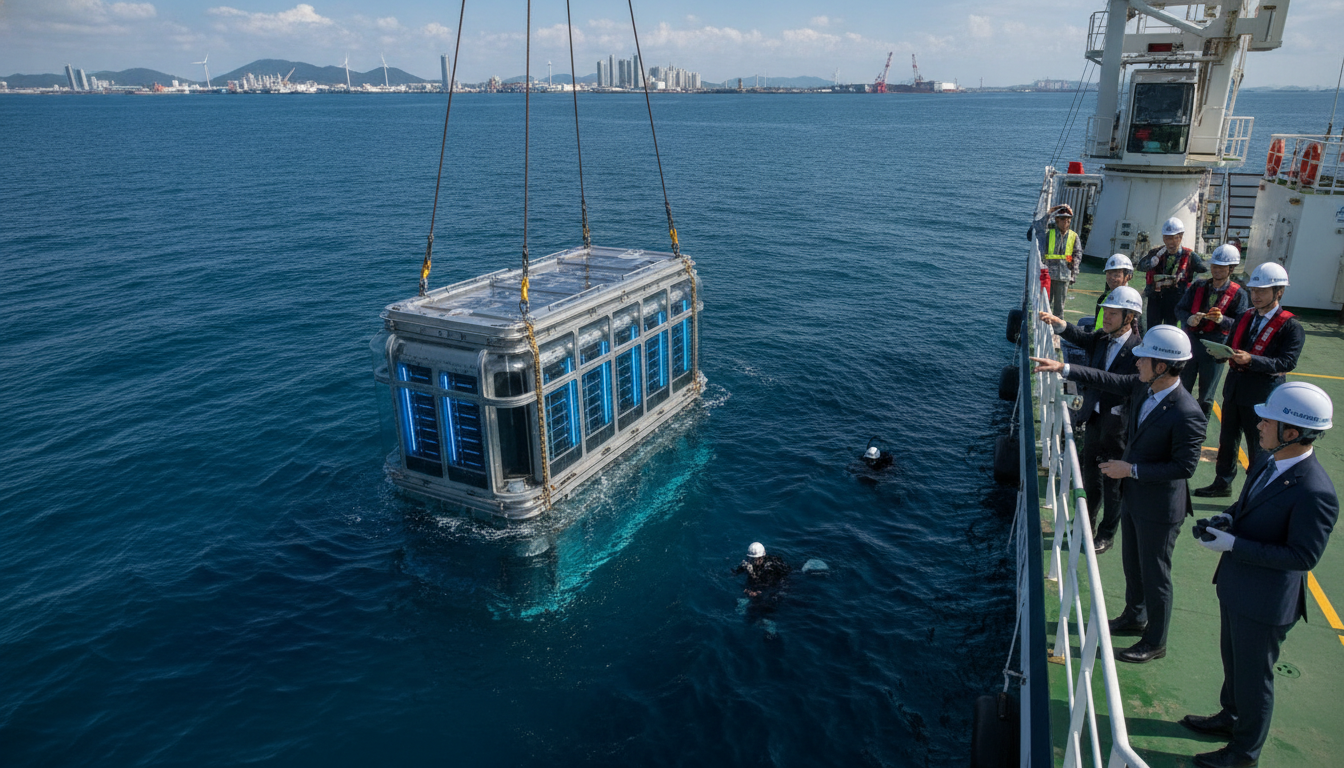
South Korea has unveiled plans for a pilot underwater data center off the coast of Ulsan as officials seek new sites to host artificial intelligence infrastructure. The proposed underwater data center, pictured in an artist’s rendering released by the Korea Institute of Ocean Science and Technology, is intended to help relieve land constraints while testing technical, environmental and regulatory requirements. Government and research bodies say the initiative will assess whether submerged facilities can provide reliable power, cooling and connectivity for next‑generation compute workloads. The announcement signals a push to diversify data center locations as demand for AI compute assets accelerates across the country.
Pilot project launched off Ulsan coast
The pilot project was announced as a targeted effort to locate marine sites suitable for housing server installations and support systems required by high‑performance AI computing. Authorities described the deployment as exploratory, focused on evaluating seabed conditions, mooring options and access for maintenance vessels. The selection of the Ulsan coastal area reflects its existing maritime infrastructure and proximity to industrial hubs where low‑latency connectivity could be advantageous. Project leaders emphasize that the pilot will inform whether underwater data center concepts can scale safely and economically in South Korea’s coastal waters.
KIOST releases artist’s depiction of underwater facility
The Korea Institute of Ocean Science and Technology released an artist’s rendering showing a submerged modular structure situated near the seabed, accompanied by surface buoys and support vessels. The image is intended as a conceptual illustration rather than a final engineering design, and KIOST has framed the depiction as part of preliminary outreach to researchers and potential industry partners. Technical teams will now move from imagery and modeling to site surveys and environmental baseline studies. Officials said additional technical details, including exact dimensions and equipment layouts, will be developed as the pilot advances.
Project aims to free land for AI infrastructure
Planners say the primary motivation for exploring underwater data center options is South Korea’s constrained land availability, particularly near urban and industrial centers where power and fiber connectivity converge. The surge in AI model training and inference workloads is driving demand for more dense, energy‑intensive facilities that are increasingly difficult to locate onshore. An underwater data center could offer an alternative footprint while benefiting from natural cooling and the potential to colocate near submarine cable routes. Project proponents caution, however, that land relief alone will not justify deployment unless operational reliability, energy sourcing and lifecycle costs are favorable.
Technical and operational challenges identified
Engineers and researchers note several technical hurdles that the pilot must address, including long‑term equipment corrosion, remote maintenance procedures and the integration of resilient power and networking systems. Ensuring uninterrupted power supply and high‑capacity fiber links is essential for AI workloads, which are sensitive to latency and interruptions. The pilot will test modular designs that allow for retrieval and replacement of components, as well as monitoring systems capable of detecting faults before they affect compute operations. Cybersecurity, physical access controls and emergency response protocols will also be part of technical evaluations.
Environmental monitoring and regulatory oversight
Environmental impact assessments and continuous monitoring will be integral to the pilot, officials said, to evaluate effects on marine ecosystems and fisheries that operate in the Ulsan coastal area. Independent scientists and regulatory agencies are expected to be involved in baseline studies and in the design of mitigation measures to minimize acoustic, chemical and habitat disturbances. South Korea’s maritime regulatory framework will need to adapt to novel facility classes, covering seabed leasing, safety standards and decommissioning obligations. Transparency with local communities and stakeholders has been highlighted as a priority to build public trust.
Next steps and interagency coordination
Project stakeholders outlined a phased timetable that begins with detailed site surveys and laboratory testing, followed by a short pilot deployment intended to run long enough to validate operational concepts. Coordination among research institutes, energy providers, telecommunications operators and municipal authorities will be required to align permitting, grid connections and fiber routes. Funding and private‑sector participation are expected to be sought after initial technical viability is demonstrated. Officials said any wider rollout would depend on the pilot’s ability to demonstrate dependable performance, acceptable environmental outcomes and competitive costs relative to onshore alternatives.
Interest in alternative data center locations has grown globally as AI demand reshapes the market for compute capacity, and South Korea’s pilot will be closely watched by regional technology planners. The Ulsan test seeks to balance technical ambition with caution, aiming to gather empirical evidence rather than promising immediate commercial deployments. If successful, the underwater data center approach could become one of several strategies to expand national compute capacity while conserving scarce land resources. The pilot’s findings will guide policy decisions on infrastructure planning, investment priorities and environmental safeguards in the years ahead.

