
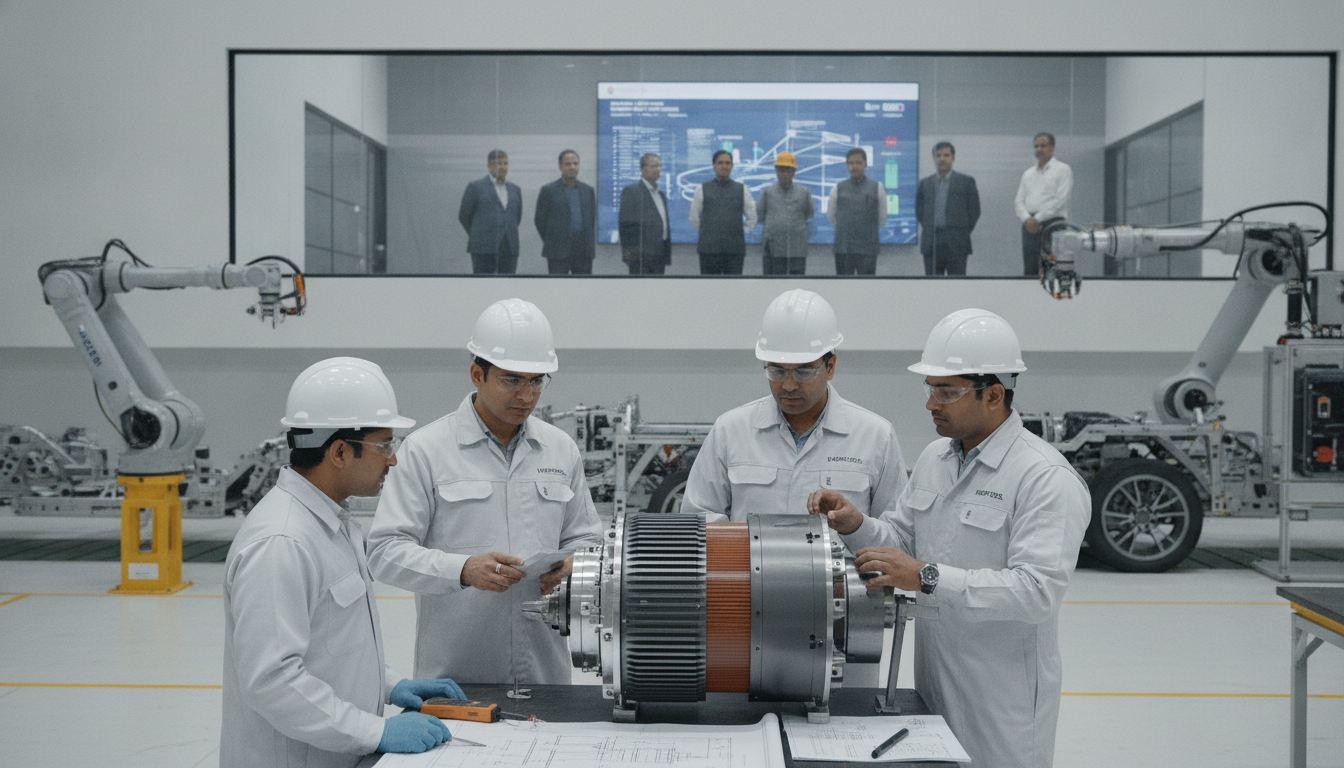
Varroc Engineering develops rare-earth-free traction motors as China export curbs reshape EV supply chains
Varroc Engineering is developing rare-earth-free traction motors after China’s 2025 export curbs, reducing reliance on heavy rare earths while targeting India’s EV growth surge.
Varroc pivots after China’s 2025 export curbs
Varroc Engineering announced a strategic move to develop traction motors that do not require heavy rare earth elements after Beijing imposed export restrictions in 2025. The company said the decision is intended to reduce dependence on suppliers in China and secure a more resilient parts pipeline for electric vehicles.
Arjun Jain, CEO and whole-time director of Varroc’s India business, highlighted the move as central to the firm’s near-term R&D and production priorities. He framed the initiative as a response to geopolitical risk and a commercial opportunity in the expanding EV market.
Technical approach to rare-earth-free motors
Engineers at Varroc have focused on motor designs that minimize or eliminate the need for heavy rare earths such as dysprosium and terbium, while maintaining energy density and efficiency. The company is exploring alternative permanent magnet chemistries and non-permanent magnet motor architectures, according to its technical briefings.
Varroc’s R&D teams are balancing cost, thermal performance and scalability in prototype builds intended for mass production. Early trials have shown promising torque characteristics, though the company acknowledges further validation is required before full-scale rollout.
Supply-chain diversification and local sourcing
The shift is part of a broader supply-chain diversification strategy that includes greater sourcing within India and partnerships outside China. Varroc is accelerating procurement from domestic suppliers and developing supplier qualification programs to raise local capacity for motors and electronic components.
This localization drive aims to insulate Varroc and its automaker customers from export controls and shipping disruptions. Company executives say closer supplier relationships could also shorten lead times and reduce currency and logistics exposures.
Commercial implications for the EV market
Varroc’s push toward rare-earth-free traction motors could change cost dynamics for electric vehicles in India and other markets where the company supplies parts. If successful, the technology could lower exposure to volatile rare-earth prices and reduce the need for long, geopolitically sensitive supply chains.
Automakers are watching because motor architecture affects vehicle range, weight and assembly processes. Varroc’s customers have signaled interest in options that preserve performance while improving resilience and cost predictability.
Manufacturing ramp-up and investment plans
To move from prototypes to high-volume production, Varroc plans targeted investments in new tooling and test facilities in India. The company is prioritizing modular production lines that can adapt to different motor topologies and allow quick scaling based on demand.
Executives say the investment timeline will align with automaker production schedules and the broader pace of EV adoption in key markets. Varroc expects to sequence capacity increases to limit capital intensity while meeting customer launch dates.
Market outlook and competitive positioning
Varroc sees India’s accelerating EV adoption as a major growth driver and frames rare-earth-free motors as a way to capture a larger share of that opportunity. The company believes that reduced supply-chain risk and competitive pricing will strengthen its pitch to both domestic and international original equipment manufacturers.
Industry analysts note that the transition may heighten competition among parts suppliers to offer validated, cost-effective motor solutions. Varroc’s early investment gives it a potential advantage if prototypes meet performance benchmarks and receive rapid customer acceptance.
Varroc’s engineering pivot underscores the broader reshaping of global EV supply chains following policy moves in 2025, as suppliers and automakers seek alternatives to concentrated rare-earth sources. The company is betting that technology adaptation, paired with manufacturing investments in India, will secure long-term contracts and support faster vehicle electrification across its customer base.

