
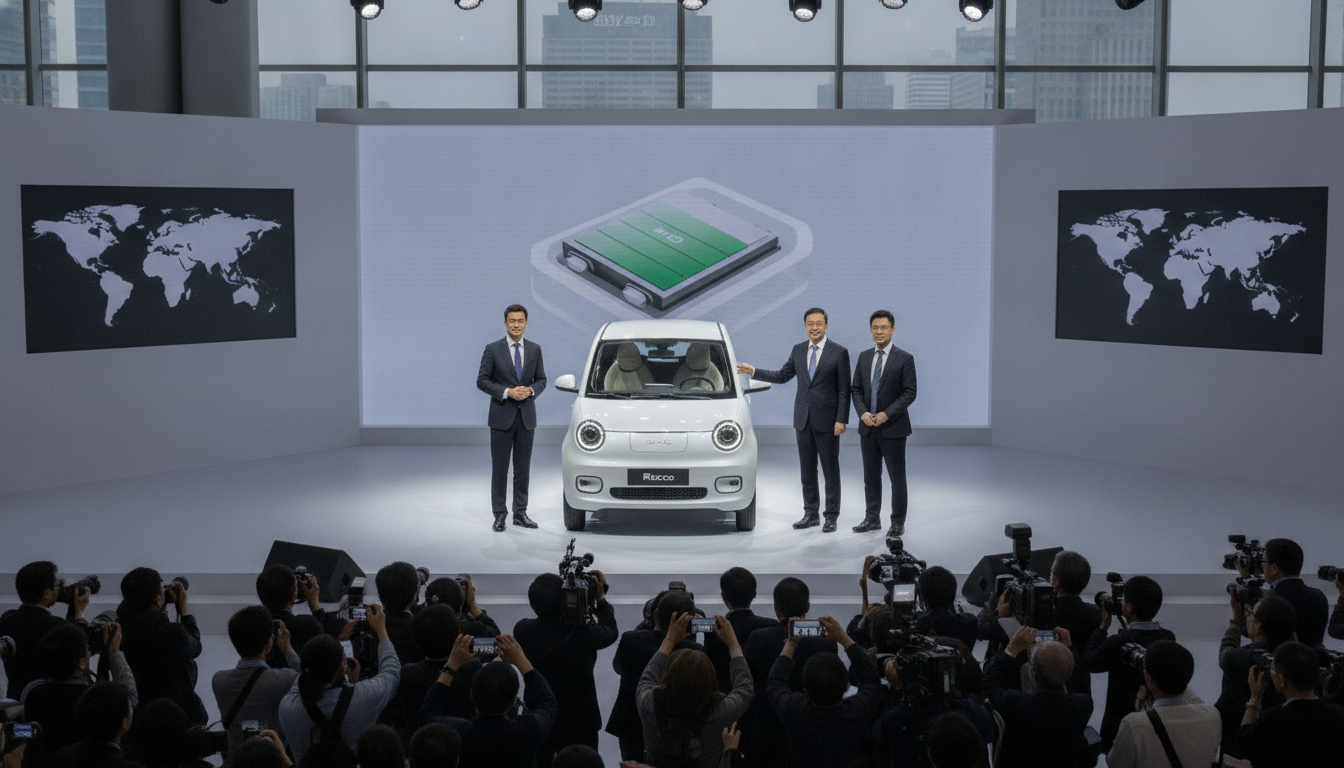
BYD Racco to Drive International Push for Electric Minicars with Space‑Saving Battery
BYD Racco mini EV to be adapted for Europe and other markets, leveraging a space‑saving battery pack and platform first launched in Japan in July and beyond.
Chinese automaker BYD said it will develop an electric minicar for international markets, using the technologies that underpin the BYD Racco, the compact EV it launched in Japan this July. The move marks the company’s intent to export a vehicle architecture designed originally for Japan’s kei minicar sector to broader markets including Europe. BYD’s announcement in Guangzhou signals a strategic push to translate space‑efficient packaging into vehicles that meet different regulatory and consumer demands overseas.
BYD to Expand Racco Platform Abroad
BYD has indicated the Racco’s core engineering will serve as the basis for new, internationally oriented minicars. The company is positioning the platform and its compact battery layout as adaptable to markets beyond Japan’s kei class. BYD frames the strategy as a way to offer city‑focused electric mobility that combines affordability and efficient use of interior space.
The decision to globalize the Racco architecture follows the vehicle’s July debut in Japan, where it was developed specifically to fit the country’s strict dimensional and power limits for kei cars. BYD’s announcement did not specify production sites or exact launch schedules for Europe and other regions, but it emphasized the transferability of the packaging and electrification technology.
Space‑Saving Battery and Packaging Innovation
Central to BYD’s plan is a space‑saving battery pack that the company says powers the Racco while preserving cabin room. BYD highlighted the packaging concept as a competitive advantage for minicars that prioritize interior space and low curb weight. Such a layout is also intended to simplify adaptations to different vehicle bodies and local equipment requirements.
Automakers aiming at compact urban models increasingly focus on battery packaging to maximize passenger and cargo space. BYD’s approach in the Racco aims to reduce the trade‑offs between energy storage and interior comfort, a priority for buyers in dense metropolitan areas. The company has presented the battery and chassis layout as a scalable solution for varied markets where small footprint and daily usability matter.
Adapting a Kei Vehicle to European Regulations
Translating a kei‑class design into a vehicle for Europe presents regulatory and engineering challenges that BYD will need to address. European safety regulations, crash‑test standards and pedestrian protection rules differ from Japan’s kei requirements, and adjustments to structure and safety systems will be required. BYD will also have to calibrate powertrain performance and emissions‑adjacent test cycles to meet local homologation standards.
Beyond certification, consumer expectations vary: European buyers typically expect higher‑speed capability and different feature sets compared with Japan’s kei customers. BYD has signaled it will modify the Racco’s platform and specification to suit these preferences while preserving the small‑car advantages that defined the model in Japan.
Production Planning and Market Timing
BYD has not disclosed a full timetable for production or market entry for Racco‑based models outside Japan. Industry analysts note that adapting a small‑car architecture for multiple markets can be quicker than developing a brand‑new vehicle, but it still requires investment in testing, homologation and dealer networks. BYD’s existing production scale and battery expertise could accelerate the process if the company decides to route manufacturing through established plants or localized assembly.
The company’s move comes amid intensifying competition in the small EV segment, where legacy automakers and startups alike are seeking to capture urban mobility demand. Timing and pricing will be key variables as BYD weighs where to introduce Racco‑derived models first and how to position them against local rivals.
Market Implications for Japan and Europe
For Japan, the Racco’s internationalization underscores how designs tailored to the kei segment can influence broader EV lineups. Japanese consumers may see the Racco evolve in parallel with versions aimed at export, affecting local production and supply choices. The model’s success in Japan could serve as a proof point for BYD as it courts regulators and customers overseas.
In Europe, the arrival of a compact, battery‑efficient minicar could reshape the lower end of the EV market by offering an alternative to larger city cars and microcars already on sale. If BYD maintains the Racco’s emphasis on interior space and affordability, the model could appeal to urban drivers and fleet operators seeking compact, energy‑efficient transport.
The company’s expansion plans will be watched closely by competitors and regulators, with implications for local suppliers and market dynamics as small EVs gain traction.
As BYD adapts the Racco’s architecture for new markets, the company faces a balancing act between preserving the compact vehicle’s character and meeting the technical and regulatory demands of international customers. The success of that effort will depend on BYD’s ability to engineer compliant variants, establish production and distribution channels, and price the resulting models competitively in diverse markets.

