
Chudo–Komeito merger abandoned as Centrist Reform Alliance considers split
Centrist Reform Alliance abandons Chudo–Komeito merger plan on August 31, 2026, and is weighing a split into former CDP and Komeito factions as talks falter.
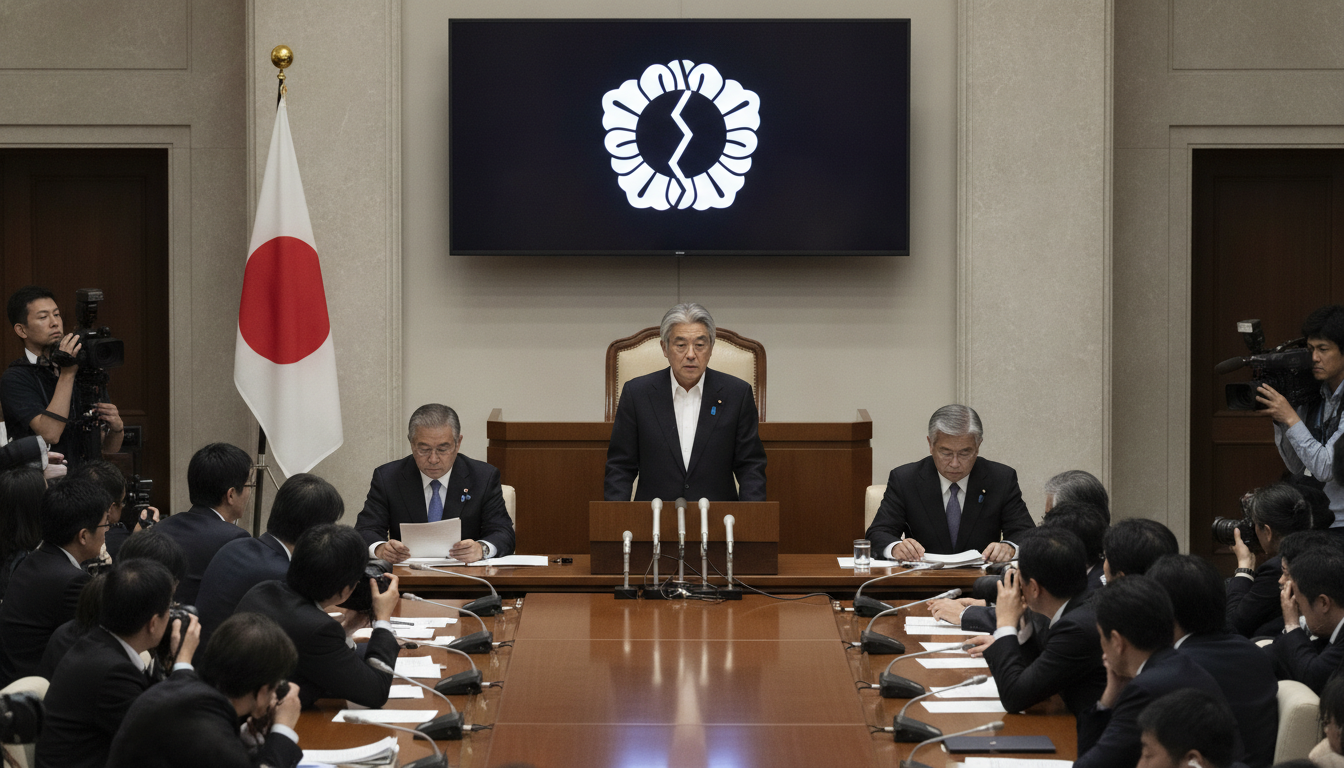
The Centrist Reform Alliance decided on August 31, 2026, to forgo a planned merger with Komeito, party officials said, marking a major setback for a project that sought to form a centrist opposition bloc to the government of Prime Minister Sanae Takaichi. The decision, announced after an emergency executive meeting in the morning, also left open the possibility that the alliance could reorganize along the lines of its original components — former members of the Constitutional Democratic Party and ex-Komeito lawmakers. Party sources characterized the move as a last-resort step after prolonged talks with both the Constitutional Democratic Party and Komeito failed to produce an agreement.
Emergency executive meeting finalizes merger halt
The Centrist Reform Alliance convened an extraordinary board meeting on the morning of August 31 to determine its next steps, according to insiders familiar with the discussions. Delegates debated competing proposals, including a full merger with Komeito, a broader three-party consolidation, and an internal reorganization that would split the alliance back into its constituent groups.
After several hours of closed deliberations, the leadership opted to abandon the immediate plan for a two-party union with Komeito, citing unresolved policy differences and political calculations that made a formal merger untenable. The decision was described by participants as pragmatic, intended to preserve legislative unity while avoiding a fractious formal integration that could alienate core supporters.
Leaders to meet at the Diet to formalize outcome
Party officials said the leaders of the Centrist Reform Alliance, the Constitutional Democratic Party and Komeito planned to meet at the Diet on the evening of August 31 to confirm the outcome of merger negotiations. The scheduled summit was presented as an effort to coordinate next steps and prevent abrupt fallout in parliamentary alignments ahead of upcoming legislative sessions.
Observers noted that the meeting aims to clarify whether parliamentary cooperation short of a formal merger — such as coordinated voting or a unified policy platform — would remain feasible, or whether more distinct realignments are inevitable. Officials on all sides have emphasized the need to manage the transition carefully to avoid destabilizing the opposition’s parliamentary tactics.
Rikken’s withdrawal ends three-party merger bid
Negotiations for a three-party consolidation that would have included the Constitutional Democratic Party, Komeito and the Centrist Reform Alliance effectively collapsed when the CDP decided against joining the proposed union. That withdrawal eliminated the possibility of a broader amalgamation and left the smaller Centrist Reform Alliance isolated in its bid to build a new center bloc.
Sources within the CDP cited concerns about policy coherence and electoral strategy as reasons for stepping back, while some lawmakers reportedly feared that a merger would dilute the party’s identity ahead of future contests. The CDP’s refusal to proceed with a three-party union was decisive in scuttling the more ambitious plan that had been discussed since the Centrist Reform Alliance’s formation earlier this year.
Komeito’s two-party bid and the alliance’s response
Komeito had actively pushed for a two-party merger with the Centrist Reform Alliance as a way to consolidate centrist votes and present a clearer counterweight to the ruling administration. Party representatives argued that structural unity would strengthen negotiations on policy and improve electoral positioning.
The Centrist Reform Alliance, however, signaled discomfort with the terms and timing of Komeito’s offer, with internal debates centering on ideological differences, organizational control and the potential reaction from local supporters. Those tensions contributed to the decision reported on August 31 to decline the immediate merger proposal while keeping open alternative paths for cooperation.
Possible split into former CDP and Komeito factions
With the merger option set aside, the Centrist Reform Alliance is reportedly exploring a formal split that would return lawmakers to groupings based on their origins — namely former Constitutional Democratic Party members and former Komeito members. Party insiders said the idea was under active consideration as a mechanism to reduce internal friction and allow each faction to pursue distinct strategies in parliament.
Such a reconfiguration would be significant less than eight months after the alliance’s launch in January 2026, and it could reshape opposition arithmetic in the Lower House. Analysts cautioned that a split risks weakening the centrist presence overall, but supporters of the move argue it could preserve legislative effectiveness by clarifying lines of responsibility and policy on key votes.
Implications for opposition strategy and political outlook
The collapse of the Chudo–Komeito merger and the prospect of an internal split complicate efforts to present a unified opposition alternative to Prime Minister Sanae Takaichi’s administration. For lawmakers seeking to challenge government initiatives, the unraveling of the centrist project raises questions about coalition-building and vote coordination on critical bills.
Political strategists suggest parties may now focus on tactical cooperation — such as joint committee actions or synchronized campaigning in targeted districts — rather than formal fusion. The coming days and the leaders’ scheduled talks at the Diet will be watched closely for signs of whether pragmatic arrangements can replace the aborted merger and stabilize opposition coordination ahead of the next legislative calendar.
The Centrist Reform Alliance’s leaders have framed the decision to halt the merger as a necessary recalibration, emphasizing the need to protect party cohesion and voter trust while continuing to oppose policies they see as undermining centrist priorities. How that balance will be struck in practice, and whether the alliance can avoid further fragmentation, remains an open question as Japan’s political landscape adjusts to the latest developments.

