
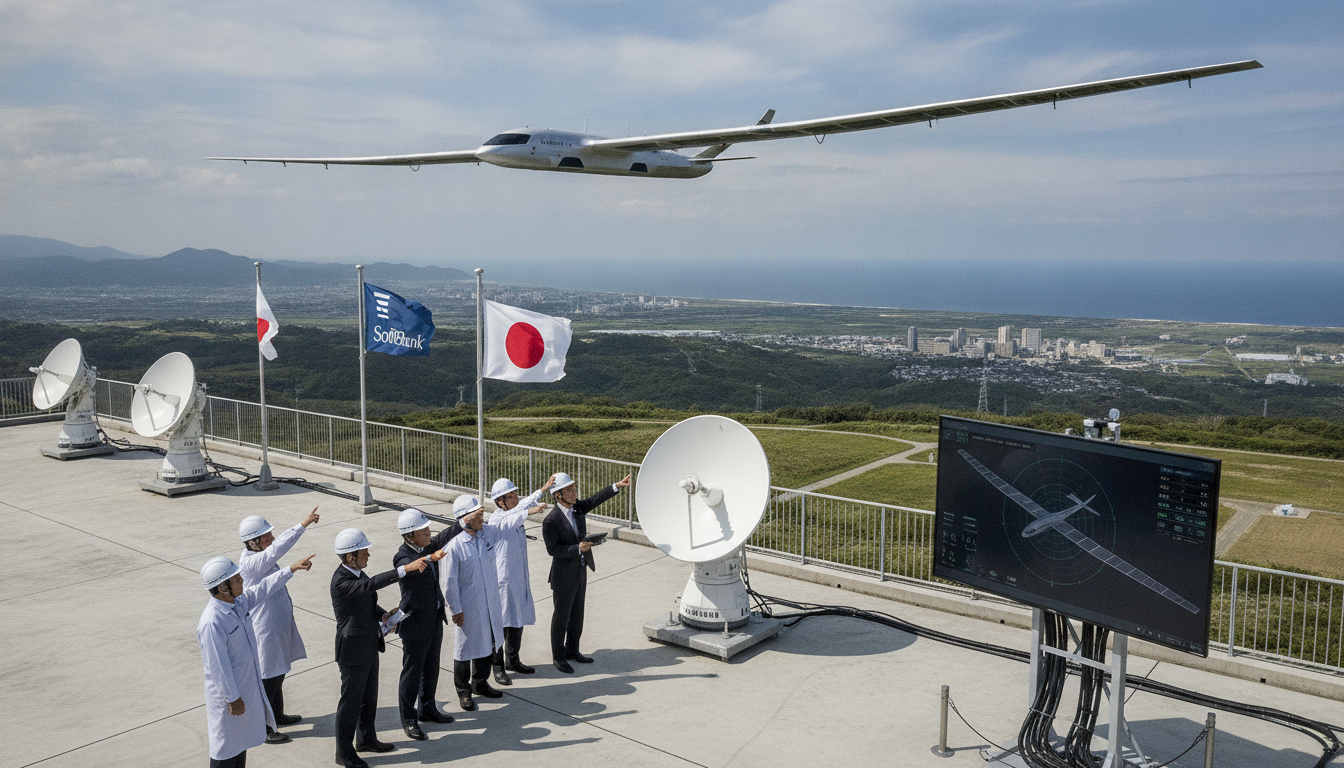
SoftBank completes Japan’s first High-Altitude Platform Station (HAPS) trials, targets 2027 commercial launch
SoftBank tested a High-Altitude Platform Station (HAPS) from U.S. aerospace startup Sceye in Japan to maintain emergency communications, aiming for a 2027 commercial launch.
SoftBank confirms successful HAPS demonstration
SoftBank Corp. announced the completion of what it described as Japan’s first successful trials of a High-Altitude Platform Station (HAPS). The balloon-like station, supplied by U.S. aerospace startup Sceye, was flown to demonstrate its ability to deliver communications coverage from aloft.
The company said the test validated key communications functions and operational stability required for emergency response and network augmentation. SoftBank is now moving to refine technical performance and chart steps toward commercialization in 2027.
Details of the airborne test and equipment used
The demonstration used Sceye’s high-altitude platform, a stratospheric, long-endurance aerial vehicle designed to carry telecommunications payloads. During the trial, the platform relayed signals and showed the feasibility of maintaining connectivity over wide areas without relying on ground infrastructure.
SoftBank emphasized the trial’s focus on transmission integrity and persistent coverage rather than on consumer service rollout. Engineers monitored signal latency, power consumption, and platform behavior over the test period to assess readiness for broader deployment.
Partnership with U.S. startup Sceye and industry roles
SoftBank identified Sceye as the equipment provider for the trial, reflecting growing collaboration between Japanese carriers and overseas aerospace firms on HAPS technology. The partnership combines SoftBank’s telecommunications expertise with Sceye’s airborne platform capabilities, according to the company’s statement.
Industry observers say such alliances accelerate technology transfer and operational learning, while also sharing development risk. SoftBank’s engagement signals carrier-level interest in alternative aerial networks as complements to satellites and terrestrial towers.
Emergency communications and disaster resilience goals
A principal aim of the HAPS initiative is to ensure communications resilience during natural disasters, a pressing priority for Japan given frequent earthquakes, typhoons and other extreme weather events. High-altitude platforms can be positioned over affected regions to restore or supplement connectivity when ground networks are damaged.
SoftBank framed the technology as a rapid-response tool that can sustain voice, data and coordination channels for emergency services and affected communities. The airborne station’s ability to cover large footprints makes it particularly useful in situations where rebuilding ground infrastructure would take days or weeks.
Regulatory, spectrum and commercialization pathway
SoftBank has set 2027 as its target for commercial rollout, but company officials acknowledge that regulatory approvals and spectrum allocation are key next steps. Operators must coordinate with national regulators on frequency use and airspace permissions to operate stratospheric platforms safely and consistently.
SoftBank plans further testing and simulations to satisfy safety, aviation and communications authorities, and to finalize technical specifications for a commercial offering. The company also intends to work with local governments and disaster response agencies on operational protocols ahead of any full-scale deployment.
How HAPS fits with Japan’s broader connectivity strategy
The HAPS trial comes as Japan and other nations diversify their network architectures to increase redundancy and reach underserved areas. Alongside undersea cables, terrestrial 5G and geostationary or low-earth-orbit satellites, high-altitude platforms offer an intermediate layer of persistent coverage at lower cost and latency than some satellite systems.
For carriers, HAPS can extend consistent service to rural islands, mountainous zones and temporary event sites without immediate investment in new ground towers. For policymakers, the technology represents another option to strengthen national infrastructure and ensure continuity of communications during crises.
SoftBank’s test with Sceye reinforces a growing global interest in airborne base stations as part of national resilience and commercial-service portfolios. The company’s next months of refinement, regulatory engagement and additional trials will determine how quickly HAPS moves from demonstration to everyday use in Japan.
SoftBank said the company will publish further technical and operational details as subsequent test phases conclude and regulatory milestones are met.

