
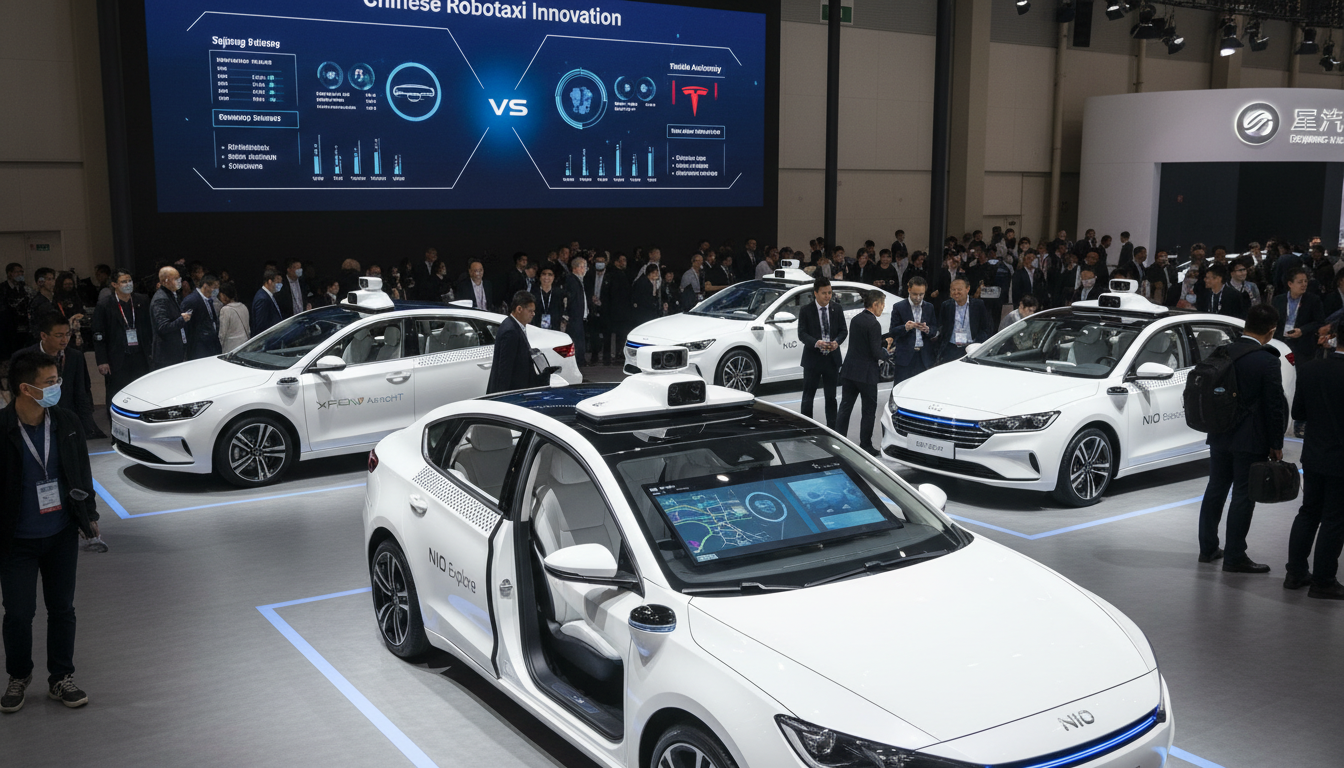
Chinese Automakers Challenge Tesla with Robotaxi Push at Beijing Auto Show
At Auto China 2026, Chinese automakers unveiled robotaxi prototypes and global fleet plans, with Geely’s Caocao targeting 100,000 driverless cabs by 2030.
BEIJING — Chinese automakers used the Auto China 2026 show to present a new front in the race for autonomous mobility, rolling out robotaxi prototypes and public plans to scale driverless fleets. The displays signaled an intensified bid to compete with Tesla and other global players in self-driving services, with Geely’s ride-hailing arm Caocao announcing ambitions to field 100,000 driverless cabs by 2030. Industry attention at the Beijing event was focused on how rapidly carmakers are moving from concept demonstrations to commercial fleet strategies.
Geely and Caocao’s Ambitious Targets
Geely showcased a robotaxi prototype that reflects a broader strategy to pivot beyond passenger EV sales into mobility services. Caocao, the company’s ride-hailing unit, said it intends to deploy up to 100,000 driverless cabs worldwide by 2030, framing the effort as both a scale and branding play.
Executives at the show described the target as part of a dual approach: sell vehicles and operate platforms that control customer access and recurring revenue. That strategy underlines the commercial logic driving the robotaxi push across several Chinese automakers.
Technical Advances Displayed at Auto China 2026
Manufacturers emphasized sensor suites, computing power and in-vehicle redundancy at display booths and press briefings. Prototypes combined lidar, multiple camera arrays and high-performance onboard processors designed to run complex perception and planning software in urban settings.
Companies also highlighted simulation and data-labeling investments, saying large-scale testing and machine-learning pipelines are central to raising system reliability. Several firms presented software demonstrations intended to show decision-making in dense traffic, pedestrian environments and adverse weather conditions.
Fleet Deployment and Commercial Strategy
Beyond demonstrations, automakers laid out concrete rollout plans that link vehicle production to service operations. The Caocao proposal for 100,000 robotaxis by 2030 is emblematic: manufacturers are planning manufacturing schedules, fleet management infrastructure and partnerships with local operators to accelerate adoption.
Plans frequently include phased deployment in selected cities with supportive regulation, followed by geographic expansion as confidence in safety metrics grows. Operators stressed that fleet economics—vehicle utilization, maintenance cycles and occupancy rates—will determine how quickly services scale and whether they can be profitable without heavy subsidies.
Regulatory and Safety Challenges in China and Abroad
Officials and company spokespeople acknowledged that regulatory approval and safety validation remain major obstacles to mass robotaxi deployment. Local authorities in China have eased some trial allowances, but full public operation requires a mix of vehicle certification, operator licensing and public acceptance.
Companies are preparing to navigate a patchwork of rules both within China and in export markets, where standards vary on oversight, data handling and liability. Demonstrations at Auto China 2026 aimed to show regulators and prospective partners that providers can meet stringent performance and cybersecurity expectations.
Investor Pressure and Market Dynamics
Investor expectations in the electric vehicle sector have pushed many manufacturers to diversify into services such as robotaxi fleets that promise recurring revenue. With EV margins under pressure, selling mobility as a service can reduce reliance on one-time vehicle sales while leveraging software and data as higher-margin businesses.
However, capital intensity for autonomous vehicle fleets is high, and profitability projections depend on rapid technological progress and regulatory approvals. Analysts at the show noted that companies must balance ambitious public targets with realistic timetables to retain investor confidence.
Implications for Tesla and Global Competition
The prominence of robotaxi demonstrations at Beijing signals a more direct challenge to Tesla and other global firms that are developing autonomous-driving capabilities. Chinese manufacturers are betting that integrated strategies—linking vehicle design, ride-hailing platforms and local market access—will let them compete on speed and scale.
At the same time, competition may spur faster innovation and lower costs for autonomous systems worldwide, while also raising questions about standards, interoperability and international market access. How quickly consumers adopt robotaxi services will hinge on demonstrated safety, clear pricing and the convenience advantage over private car ownership.
The robotaxi push at Auto China 2026 marks a clear shift in the industry’s priorities, with legacy automakers and new entrants alike positioning themselves for a future in which self-driving fleets play a central role in urban mobility. As prototypes move toward commercial trials, the interplay of technology, regulation and business models will determine which companies can convert ambition into sustained services.

