
King Charles state visit to U.S. begins with White House reception amid diplomatic tensions
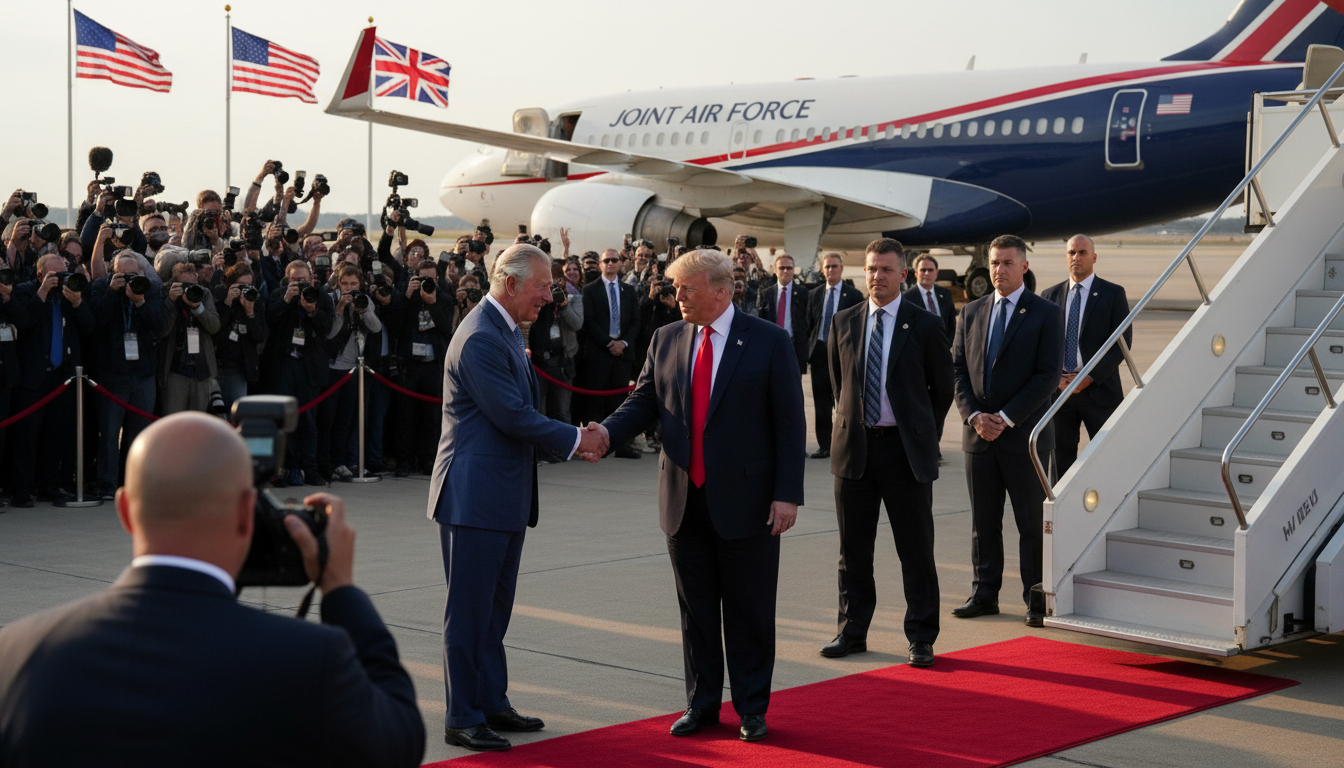
King Charles state visit began with an arrival at Joint Base Andrews and a White House reception with President Trump, marking a rare royal state visit to the U.S.
Britain’s King Charles and Queen Camilla arrived in Washington on Monday for a four-day King Charles state visit, stepping into a finely choreographed program that recalled centuries of shared history. The royal couple were greeted at Joint Base Andrews before proceeding to the White House, where President Donald Trump and first lady Melania Trump received them for a brief public greeting and private tea. The visit comes at a politically charged moment, with the U.S. president publicly at odds with the British government over the war in Iran, even as ceremonial protocol was observed.
Royal Arrival at Joint Base Andrews
The king and queen landed at Joint Base Andrews, where a modest arrival ceremony was held to mark the opening of the state visit. Officials said the ceremony was concise, reflecting both security protocols and the condensed schedule for the four-day engagement. From the base, the royal motorcade traveled to the White House for the formal part of the day’s engagements.
White House Reception and Private Tea
At the White House the couple were welcomed by President Trump and first lady Melania Trump, who greeted King Charles and Queen Camilla with warm gestures in front of photographers. The public portion lasted only moments before the group moved inside for a private tea, following the pattern of state-visit protocol that blends public pageantry with closed-door hospitality. The brief public exchange underscored the ceremonial nature of the visit while allowing leaders to confer privately.
Diplomatic Context: Iran War Disagreement
The trip unfolds against a backdrop of diplomatic friction between Washington and London over the Iran war, a disagreement that has surfaced in public comments and policy statements. President Trump has differed with the British government’s stance, even as the White House observed customary hospitality for the visiting monarch. Analysts say the state visit provides a forum for leaders to manage differences while reinforcing broader strategic ties.
Historic Timing and Symbolism
The visit is the first by a British monarch in roughly two decades and coincides with the 250th anniversary of the U.S. Declaration of Independence, a historical milestone that adds a layer of symbolic resonance. Organizers have emphasized both reconciliation and renewal in the language surrounding the itinerary, seeking to frame ceremonial moments as a reaffirmation of shared democratic values. For many observers, the optics of the monarchy on U.S. soil serve as a reminder of long-standing cultural and diplomatic links.
Planned Public Events and Official Programme
Officials have outlined a programme combining official state business with public-facing events, including formal meetings, receptions and cultural exhibitions designed to highlight bilateral cooperation. State visits traditionally feature a state banquet, meetings with congressional leaders and visits to institutions selected to reflect mutual priorities such as trade, education and cultural exchange. The royal couple’s schedule is likely to balance ceremonial duties with opportunities to spotlight joint initiatives and charitable projects.
Domestic Reactions and Security Measures
The arrival drew attention from royal supporters and critics alike, with public reactions split along political and ideological lines in both countries. Security measures were tightened around principal venues, with the White House and Joint Base Andrews operating under elevated protocols for the duration of the visit. Organizers emphasized that the ceremonial elements would proceed as planned despite the contentious policy backdrop.
The King Charles state visit provides Washington and London an opportunity to reset public narratives and reaffirm longstanding partnerships while acknowledging real policy disagreements. Across scheduled events, the visit is expected to mix tradition and diplomacy, delivering carefully staged moments for heads of state and government as well as quieter discussions behind closed doors.

