
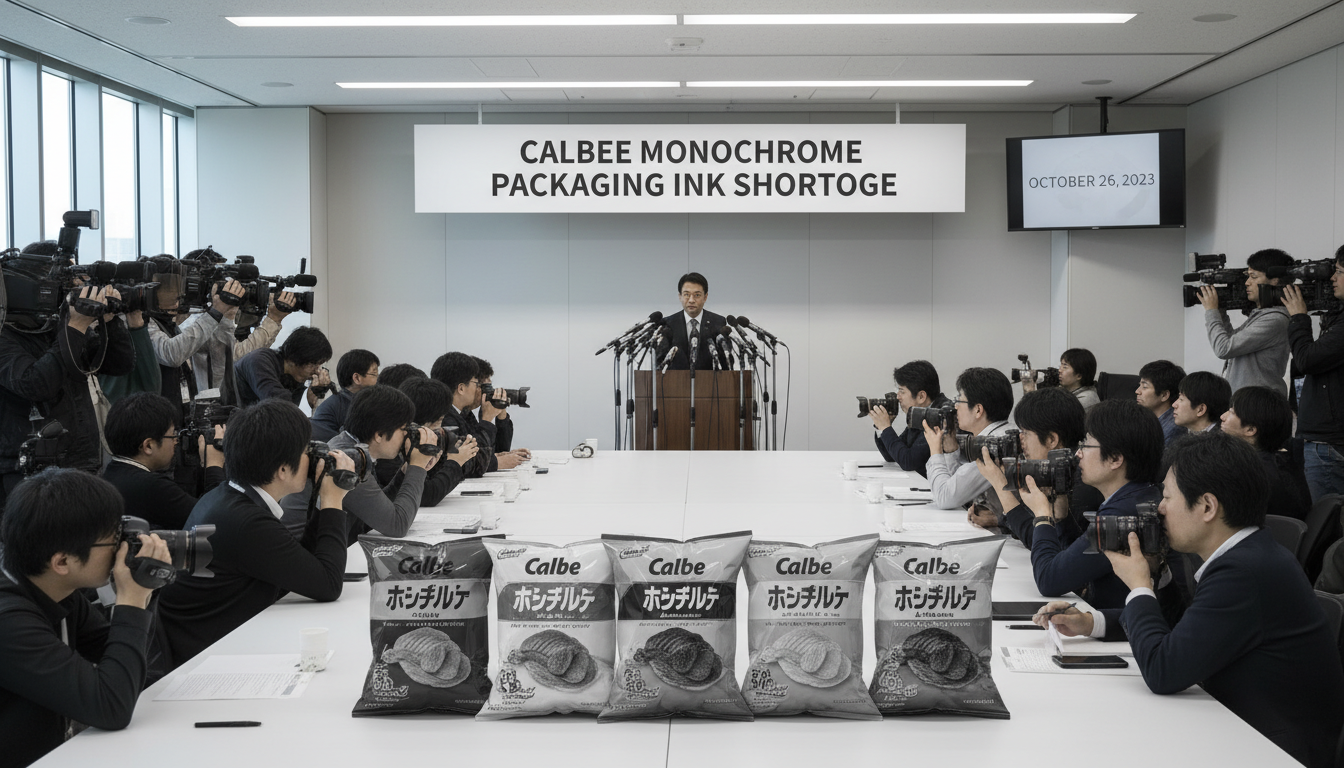
Ink supply disruption forces Calbee to switch 14 snack packages to black-and-white
Ink supply disruptions tied to Middle East tensions force Calbee to switch 14 snack packages to black-and-white; food makers reassess labeling and costs.
Calbee announced on May 12 that it will change the packaging of 14 snack products from color printing to black-and-white as a response to an ongoing ink supply disruption. The company said the change will be phased in from May 25 and affects well-known items including potato chips and Kappa Ebisen. The move reflects mounting pressure on ink supply chains that rely on naphtha-derived organic solvents, and signals broader adjustments across food packaging.
Calbee announces phased shift for 14 products
Calbee informed business partners on May 12 that color printing for 14 products will be replaced with monochrome printing, citing instability in procuring printing ink and related raw materials. The company plans to roll out the new packaging gradually from May 25 onward to ensure continuity of supply and distribution. A Calbee representative met with officials at the Ministry of Agriculture, Forestry and Fisheries on the afternoon of May 12 to explain the package changes and the company’s mitigation steps.
Production and logistics teams at Calbee are coordinating the switch to minimize retail disruptions, company sources said. Retail displays will change appearance as branded color elements are removed, but the company emphasized that product recipes and quality will remain unchanged. The decision aims to stretch existing ink inventories and limit additional procurement costs amid volatile market conditions.
Naphtha-linked solvent shortages drive ink market stress
Many printing inks for food packaging, furniture and wallpaper rely on organic solvents derived from naphtha, a petroleum fraction whose supply and price are sensitive to global energy tensions. The recent escalation of conflict in parts of the Middle East has disrupted shipments and tightened spot markets, reducing the availability of these solvent feedstocks. Industry observers say this squeeze on raw materials has flowed through to ink makers, prompting constrained production and higher unit costs.
The Printing Ink Industry Association issued guidance to customers on April 2 noting that some solvent supplies were already becoming difficult to secure as geopolitical risks rose. Several ink manufacturers have responded by trimming output or prioritizing key customers, while others have raised prices by more than 30 percent for certain formulations. Those price moves have intensified pressure on downstream users such as food manufacturers that rely on regular, low-cost packaging runs.
Packaging labels pared back to conserve ink and information
Beyond a shift to monochrome printing, some food makers have removed non-essential label elements to reduce ink usage and simplify production. Manufacturers reported that decorative bands and auxiliary print items on products such as pasta are being revised; in some cases, the printed “boiling time” on pasta bands was omitted. Companies say they are prioritizing legally required information and nutrition data while temporarily trimming decorative or promotional printing.
Retailers and consumer groups have raised questions about potential impacts on usability and transparency, particularly when cooking instructions or product variations are conveyed on reduced labels. Producers have indicated they will maintain required safety and allergen information in compliance with regulations, and that changes are intended to be temporary until supply conditions stabilize. The trade-off reflects a balancing act between preserving product safety information and managing acute input cost pressures.
Industry association and manufacturers report price and supply signals
The ink industry’s formal communications and private discussions with customers have made clear that the situation is uneven across suppliers and product types. Some ink makers have imposed significant price increases amid constrained solvent deliveries, while others are prioritizing longstanding contracts. These shifts have prompted manufacturers across the food and consumer goods sectors to review their packaging plans and inventory strategies.
Companies that depend on outsourced printing and flexible packaging are considering measures such as consolidating print runs, delaying non-essential promotional packaging, and seeking alternative formulations that use less solvent. However, converting printing processes or qualifying new ink suppliers can take time and require safety and compliance checks, limiting how quickly firms can adapt. The current environment has therefore produced short-term actions like monochrome printing alongside longer planning to diversify raw-material sources.
Government and supply-chain stakeholders assess responses
Regulatory bodies and industry groups have been briefed by affected firms about the operational steps they are taking and the scope of potential impacts. Calbee’s meeting with the Agriculture Ministry on May 12 is one example of companies coordinating with authorities to explain packaging changes and reassure consumers. Officials are monitoring whether label simplifications affect consumer information or violate labeling rules, and they are consulting with industry on acceptable interim measures.
Supply-chain leaders are also weighing strategic responses, including bulk purchasing, alternative solvent options, and closer coordination with ink manufacturers to smooth allocations. Some packaging printers have begun to recommend design adjustments to clients that achieve the same branding effect with less color coverage. For now, firms emphasize that product availability is the priority and that most changes are cosmetic or logistical rather than alterations to product content.
The ink supply disruption triggered by geopolitical tensions has prompted rapid operational adjustments in Japan’s food-manufacturing sector, and companies say they will continue to prioritize safety and information compliance while managing input cost pressures.

